
Pulp Fiction, 1921 · page 190 of 200
Adventure Magazine Cover — page 190: what you’re looking at
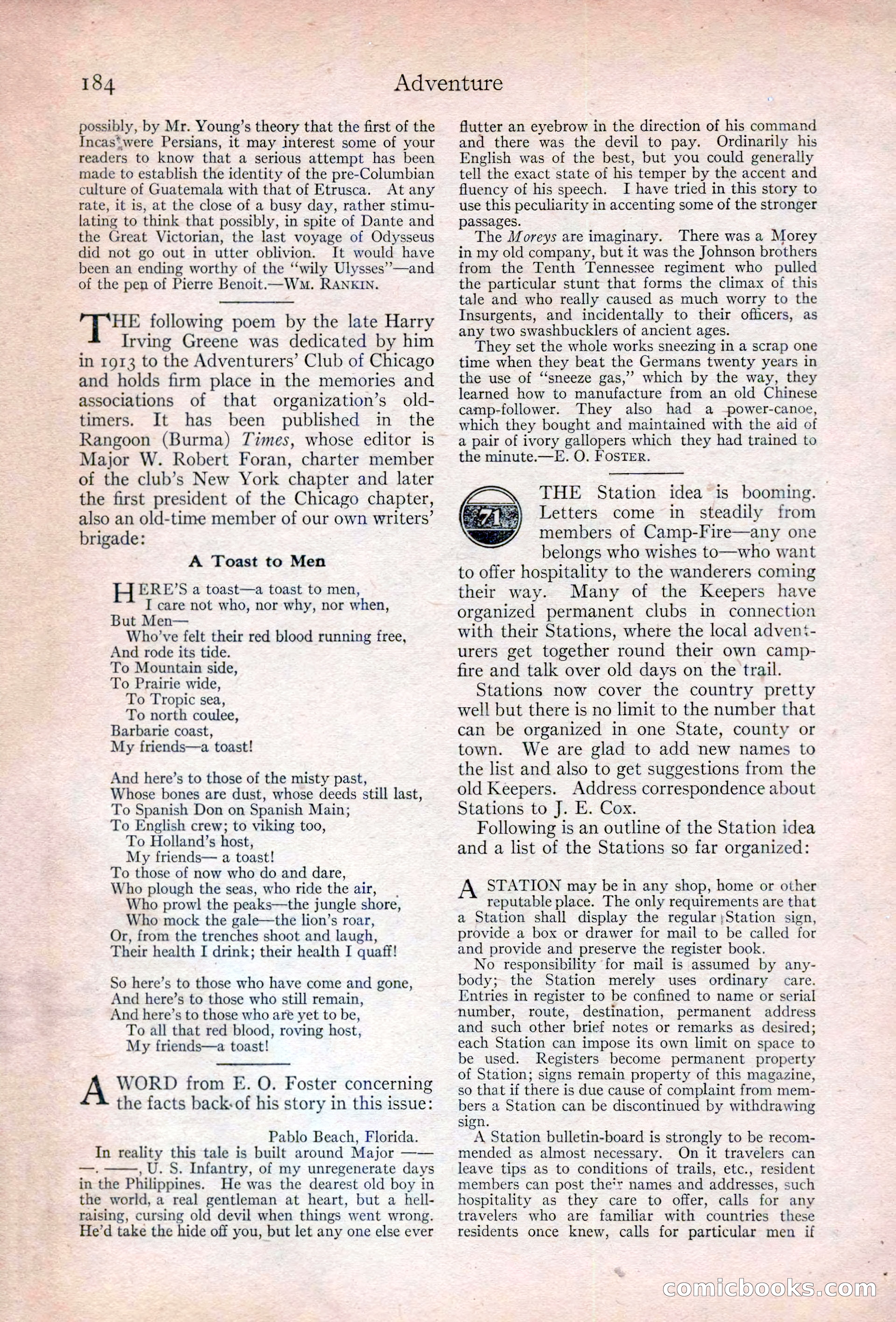
A restored page from Pulp Fiction, 1921. Page through the whole issue in the reader above.
📄 Transcribed text from this page (OCR, searchable)
Machine-transcribed from the original scan — historical spelling and the odd misread are preserved.
184 possibly, by Mr. Young’s theory that the first of the Incas*were Persians, it may interest some of your readers to know that a serious attempt has been made to establish the identity of the pre-Columbian culture of Guatemala with that of Etrusca. At any rate, it is, at the close of a busy day, rather stimu- lating to think that possibly, in spite of Dante and the Great Victorian, the last voyage of Odysseus did not go out in utter oblivion. It would have been an ending worthy of the ‘‘wily Ulysses” —and of the pen of Pierre Benoit—Wwmo. RANKIN. Bete following poem by the late Harry Irving Greene was dedicated by him in r913 to the Adventurers’ Club of Chicago and holds firm place in the memories and associations of that organization’s old- timers. It has been published in the Rangoon (Burma) Times, whose editor is Major W. Robert Foran, charter member of the club’s New York chapter and later the first president of the Chicago chapter, also an old-time member of our own writers’ brigade: A Toast to Men H ERE’S a toast—a toast to men, I care not who, nor why, nor when, But Men— Who've felt their red blood running free, And rode its tide. To Mountain side, To Prairie wide, To Tropic sea, To north coulee, Barbarie coast, My friends—a toast! And here’s to those of the misty past, Whose bones are dust, whose deeds still last, To Spanish Don on Spanish Main; To English crew; to viking too, To Holland’s host, My friends— a toast! To those of now who do and dare, Who plough the seas, who ride the air, _ Who prowl the peaks—the jungle shore, Who mock the gale—the lion’s roar, Or, from the trenches shoot and laugh, Their health I drink; their health I quaff! So here’s to those who have come and gone, And here’s to those who still remain, And here’s to those who are yet to be, To all that red blood, roving host, My friends—a toast! A WORD from E. O. Foster concerning the facts back-of his story in this issue: Pablo Beach, Florida. In reality this tale is built around Major —— , U. S. Infantry, of my unregenerate days in the Philippines. He was the dearest old boy in the world, a real gentleman at heart, but a hell- raising, cursing old devil when things went wrong. He’d take the hide off you, but let any one else ever a . Adventure flutter an eyebrow in the direction of his command and there was the devil to pay. Ordinarily his English was of the best, but you could generally tell the exact state of his temper by the accent and fluency of his speech. I have tried in this story to use this peculiarity in accenting some of the stronger passages. The Moreys are imaginary. There was a Morey in my old company, but it was the Johnson brothers from the Tenth Tennessee regiment who pulled the particular stunt that forms the climax of this tale and who really caused as much worry to the Insurgents, and incidentally to their officers, as any two swashbucklers of ancient ages. They set the whole works sneezing in a scrap one time when they beat the Germans twenty years in the use of ‘‘sneeze gas,’’ which by the way, they learned how to manufacture from an old Chinese camp-follower. They also had a -power-canoe, which they bought and maintained with the aid of a pair of ivory gallopers which they had trained to the minute.—E. O. Foster. Letters come in steadily from members of Camp-Fire—any one belongs who wishes to—who want to offer hospitality to the wanderers coming their way. Many of the Keepers have organized permanent clubs in connection with their Stations, where the local adven:- urers get together round their own camp- fire and talk over old days on the trail. Stations now cover the country pretty well but there is no limit to the number that can be organized in one State, county or town. We are glad to add new names to the list and also to get suggestions from the old Keepers. Address correspondence about Stations to J. E. Cox. Following is an outline of the Station idea and a list of the Stations so far organized: STATION may be in any shop, home or other reputable place. The only requirements are that a Station shall display the regular;Station sign, provide a box or drawer for mail to be called for and provide and preserve the register book. No responsibility for mail is assumed by any- body; the Station merely uses ordinary care. I-ntries in register to be confined to name or serial number, route, destination, permanent address and such other brief notes or remarks as desired; each Station can impose its own limit on space to be used. Registers become permanent property of Station; signs remain property of this magazine, so that if there is due cause of complaint from mem- bers a Station can be discontinued by withdrawing sign. A Station bulletin-board is strongly to be recom- mended as almost necessary. On it travelers can leave tips as to conditions of trails, etc., resident members can post ther names and addresses, such hospitality as they care to offer, calls for any travelers who are familiar with countries these residents once knew, calls for particular men if CORMICLOO© S THE Station idea is booming. - (E@