
Pulp Fiction, 1921 · page 14 of 204
Adventure Magazine Cover, October 10, 1921 — page 14: what you’re looking at
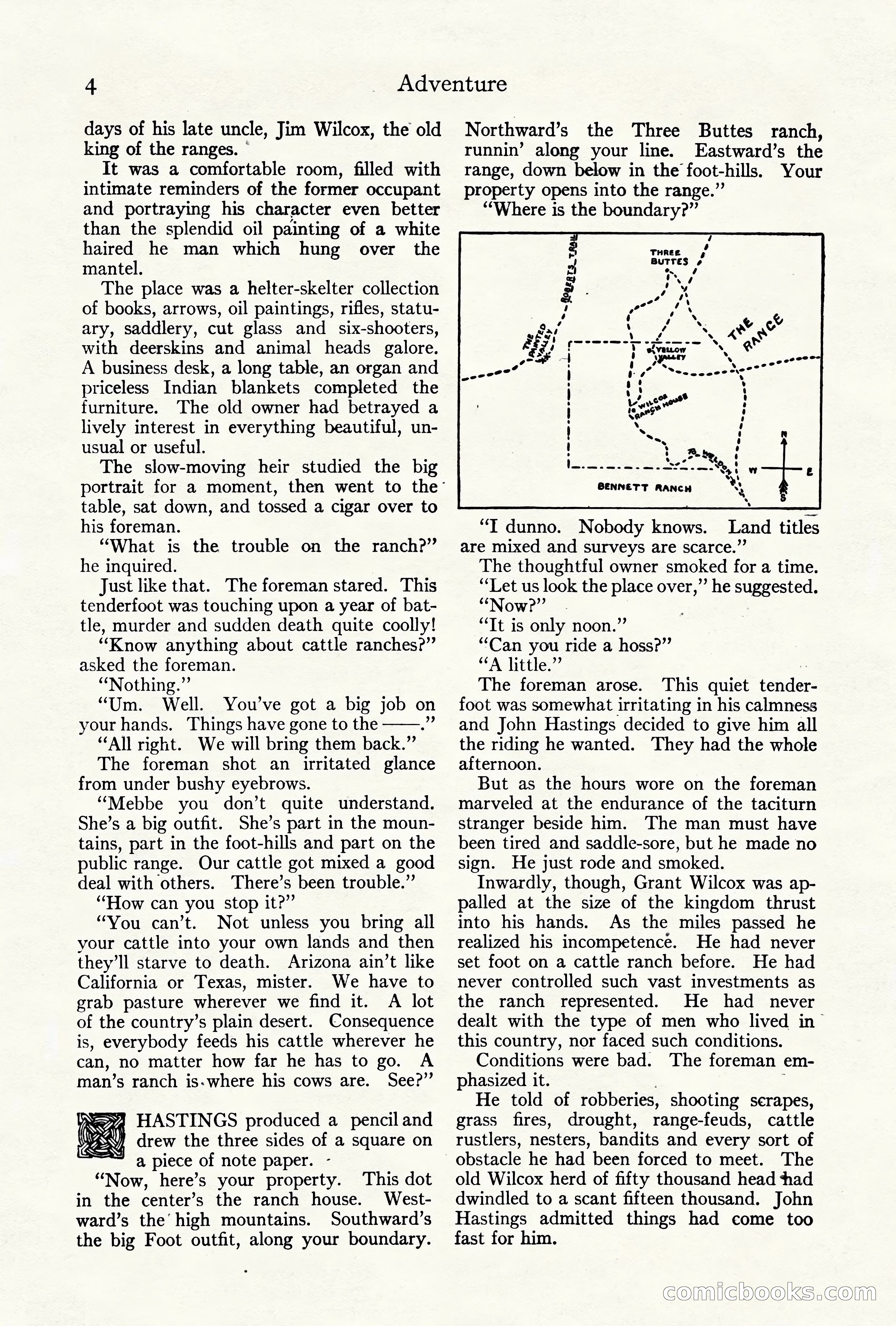
A restored page from Pulp Fiction, 1921. Page through the whole issue in the reader above.
📄 Transcribed text from this page (OCR, searchable)
Machine-transcribed from the original scan — historical spelling and the odd misread are preserved.
4 _ Adventure days of his late uncle, Jim Wilcox, the old king of the ranges. It was a comfortable room, filled with intimate reminders of the former occupant and portraying his character even better than the splendid oil painting of a white haired he man which hung over the mantel. The place was a helter-skelter collection of books, arrows, oil paintings, rifles, statu- ary, saddlery, cut glass and six-shooters, with deerskins and animal heads galore. A business desk, a long table, an organ and priceless Indian blankets completed the furniture. The old owner had betrayed a lively interest in everything beautiful, un- usual or useful. The slow-moving heir studied the big portrait for a moment, then went to the’ table, sat down, and tossed a cigar over to his foreman. “What is the trouble on the ranch?” he inquired. Just like that. The foreman stared. This tenderfoot was touching upon a year of bat- tle, murder and sudden death quite coolly! “Know anything about cattle ranches?” asked the foreman. “Nothing.” “Um. Well. your hands. Things have gone to the “All right. We will bring them back.” The foreman shot an irritated glance from under bushy eyebrows. “Mebbe you don’t quite understand. She’s a big outfit. She’s part in the moun- tains, part in the foot-hills and part on the public range. Our cattle got mixed a good deal with others. There’s been trouble.” “How can you stop it?” “Vou can’t. Not unless you bring all your cattle into your own lands and then they’ll starve to death. Arizona ain’t like California or Texas, mister. We have to grab pasture wherever we find it. A lot of the country’s plain desert. Consequence is, everybody feeds his cattle wherever he can, no matter how far he has to go. A man’s ranch is-where his cows are. See?” You’ve got a big job on 9 1 HASTINGS produced a _ pencil and 1 drew the three sides of a square on a piece of note paper. - “Now, here’s your property. This dot in the center’s the ranch house. West- ward’s the high mountains. Southward’s the big Foot outfit, along your boundary. obstacle he had been forced to meet. Northward’s the Three Buttes ranch, runnin’ along your line. Eastward’s the range, down below in the foot-hills. Your property opens into the range.” “Where is the boundary?” “T dunno. Nobody knows. Land titles are mixed and surveys are scarce.” The thoughtful owner smoked for a time. ‘Let us look the place over,” he suggested. “Now?” “Tt is only noon.” “Can you ride a hossP” “CA little.” : The foreman arose. This quiet tender- foot was somewhat irritating in his calmness and John Hastings decided to give him all the riding he wanted. They had the whole afternoon. But as the hours wore on the foreman marveled at the endurance of the taciturn stranger beside him. The man must have been tired and saddle-sore, but he made no sign. He just rode and smoked. Inwardly, though, Grant Wilcox was ap- palled at the size of the kingdom thrust into his hands. As the miles passed he realized his incompetence. He had never set foot on a cattle ranch before. He had never controlled such vast investments as the ranch represented. He had never dealt with the type of men who lived in this country, nor faced such conditions. Conditions were bad. The foreman em- phasized it. He told of robberies, shooting serapes, grass fires, drought, range-feuds, cattle rustlers, nesters, bandits and every sort of The old Wilcox herd of fifty thousand head shad dwindled to a scant fifteen thousand. John Hastings admitted things had come too fast for him. DOOLK C@