
Pulp Fiction, 1921 · page 17 of 204
Adventure Magazine Cover, October 10, 1921 — page 17: what you’re looking at
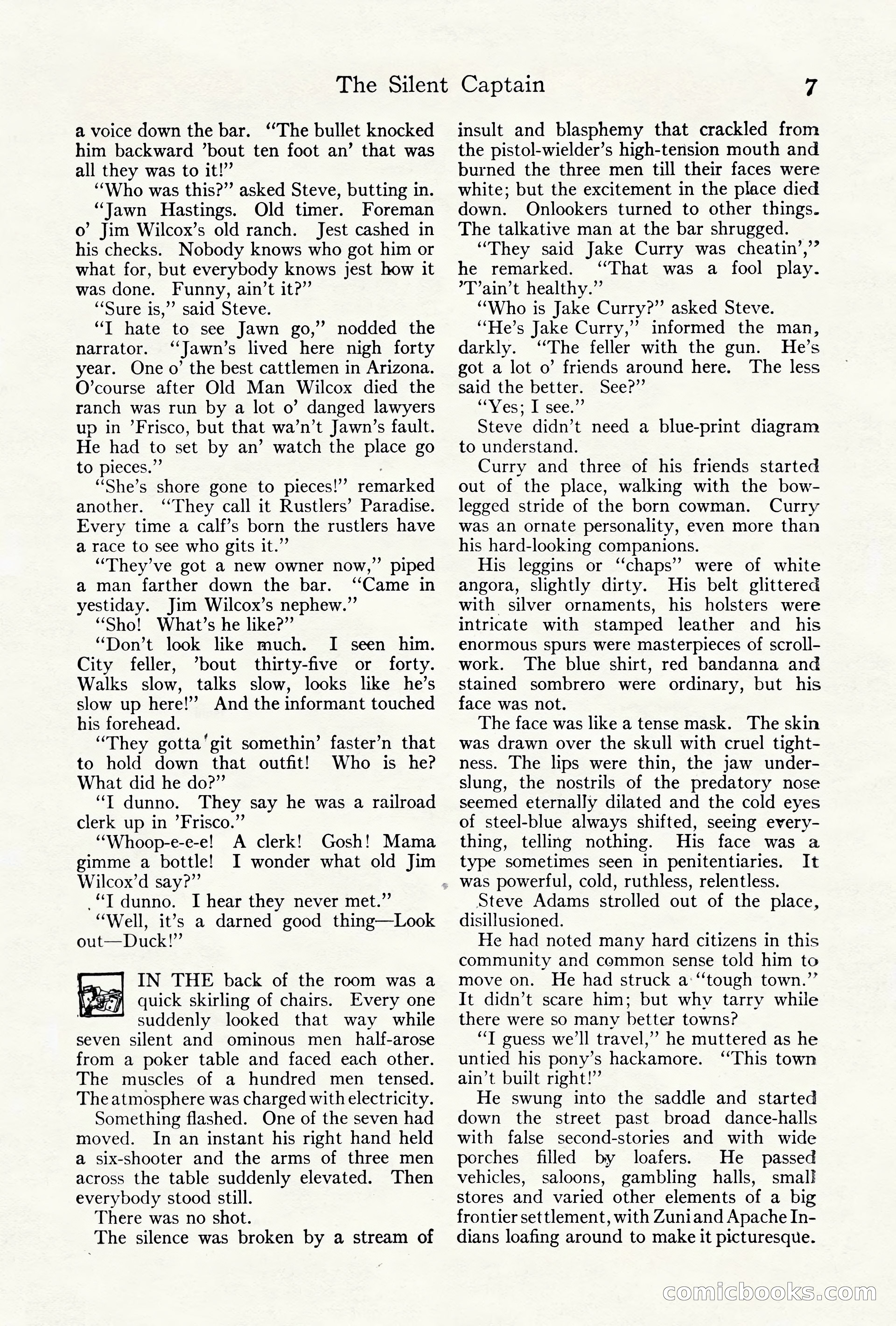
A restored page from Pulp Fiction, 1921. Page through the whole issue in the reader above.
📄 Transcribed text from this page (OCR, searchable)
Machine-transcribed from the original scan — historical spelling and the odd misread are preserved.
The Silent Captain a voice down the bar. ‘‘The bullet knocked him backward ’bout ten foot an’ that was all they was to it!” ‘“‘Who was this?” asked Steve, butting in. “Jawn Hastings. Old timer. Foreman o Jim Wilcox’s old ranch. Jest cashed in his checks. Nobody knows who got him or what for, but everybody knows jest how it was done. Funny, ain’t it?” ‘‘Sure is,” said Steve. “T hate to see Jawn go,” nodded the narrator. ‘“Jawn’s lived here nigh forty year. One o’ the best cattlemen in Arizona. O’course after Old Man Wilcox died the ranch was run by a lot o’ danged lawyers up in ’Frisco, but that wa’n’t Jawn’s fault. He had to set by an’ watch the place go to pieces.” “She’s shore gone to pieces!” remarked another. ‘They call it Rustlers’ Paradise. Every time a calf’s born the rustlers have a race to see who gits it.” “They’ve got a new owner now,” piped a man farther down the bar. “Came in yestiday. Jim Wilcox’s nephew.” “Sho! What’s he like?” “Don’t look like much. I seen him. City feller, "bout thirty-five or forty. Walks slow, talks slow, looks like he’s slow up here!”’ And the informant touched his forehead. “They gotta’git somethin’ faster’n that to hold down that outfit! Who is he? What did he do?” “f dunno. They say he was a railroad clerk up in ’Frisco.”’ ‘‘Whoop-e-e-e! A clerk! Gosh! Mama gimme a bottle! I wonder what old Jim Wilcox’d say?”’ _“T dunno. I hear they never met.” “Well, it’s a darned good thing—Look out—Duck!”’ eRe IN THE back of the room was a #7, quick skirling of chairs. Every one suddenly looked that way while seven silent and ominous men _half-arose from a poker table and faced each other. The muscles of a hundred men tensed. The atmosphere was charged with electricity. Something flashed. One of the seven had moved. In an instant his right hand held a six-shooter and the arms of three men across the table suddenly elevated. Then everybody stood still. There was no shot. The silence was broken by a stream of 7 insult and blasphemy that crackled from the pistol-wielder’s high-terision mouth and burned the three men till their faces were white; but the excitement in the place died down. Onlookers turned to other things. The talkative man at the bar shrugged. “They said Jake Curry was cheatin’, he remarked. “That was a fool play. *T’ain’t healthy.” “Who is Jake Curry?” asked Steve. ‘““He’s Jake Curry,’ informed the man, darkly. ‘The feller with the gun. He’s got a lot o’ friends around here. The less said the better. See?”’ ~ Yes: | see Steve didn’t need a blue-print diagram to understand. Curry and three of his friends started out of the place, walking with the bow- legged stride of the born cowman. Curry was an ornate personality, even more than his hard-looking companions. His leggins or ‘‘chaps’” were of white angora, slightly dirty. His belt glittered with silver ornaments, his holsters were intricate with stamped leather and his enormous spurs were masterpieces of scroll- work. The blue shirt, red bandanna and stained sombrero were ordinary, but his face was not. The face was like a tense mask. The skin was drawn over the skull with cruel tight- ness. The lips were thin, the jaw under- slung, the nostrils of the predatory nose seemed eternally dilated and the cold eyes of steel-blue always shifted, seeing every- thing, telling nothing. His face was a type sometimes seen in penitentiaries. It . was powerful, cold, ruthless, relentless. Steve Adams strolled out of the place, disillusioned. He had noted many hard citizens in this community and common sense told him to move on. He had struck a:“‘tough town.’’ It didn’t scare him; but whv tarry while there were so manv better towns? “T guess we'll travel,’’ he muttered as he untied his pony’s hackamore. ‘This town ain’t built right!” He swung into the saddle and started down the street past broad dance-halls with false second-stories and with wide porches filled by loafers. He passed vehicles, saloons, gambling halls, small stores and varied other elements of a big frontier settlement, with Zuniand Apache In- dians loafing around to make it picturesque. COnmiclbooks Cc C@