
Pulp Fiction, 1921 · page 175 of 204
Adventure Magazine Cover, October 10, 1921 — page 175: what you’re looking at
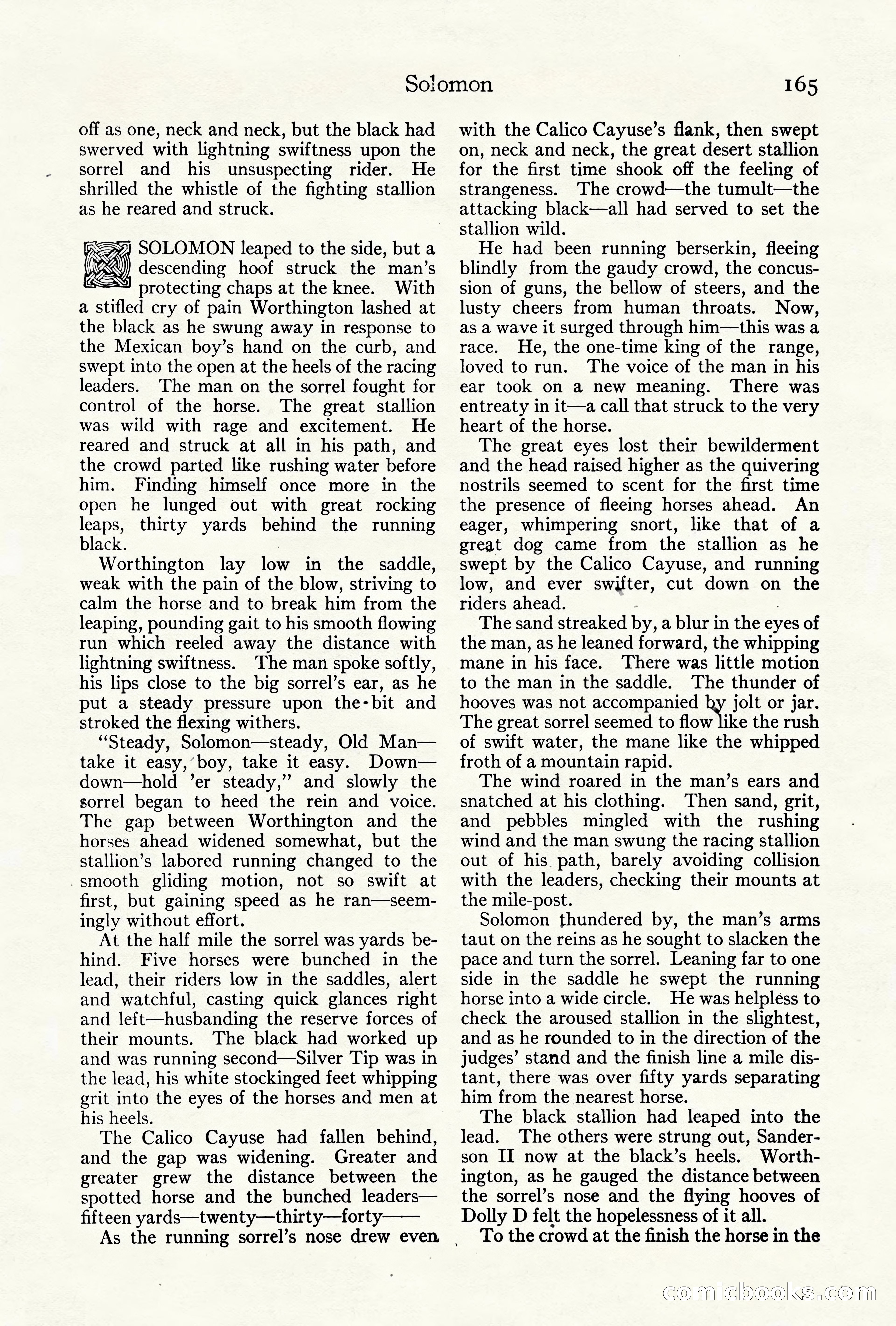
A restored page from Pulp Fiction, 1921. Page through the whole issue in the reader above.
📄 Transcribed text from this page (OCR, searchable)
Machine-transcribed from the original scan — historical spelling and the odd misread are preserved.
Solomon off as one, neck and neck, but the black had swerved with lightning swiftness upon the sorrel and his unsuspecting rider. He shrilled the whistle of the fighting stallion as he reared and struck. BY ie a) descending hoof struck the man’s aN protecting chaps at the knee. With a stifled cry of pain Worthington lashed at the black as he swung away in response to the Mexican boy’s hand on the curb, and swept into the open at the heels of the racing leaders. The man on the sorrel fought for control of the horse. The great stallion was wild with rage and excitement. He reared and struck at all in his path, and the crowd parted like rushing water before him. Finding himself once more in the open he lunged out with great rocking leaps, thirty yards behind the running black. Worthington lay low in the saddle, weak with the pain of the blow, striving to calm the horse and to break him from the leaping, pounding gait to his smooth flowing run which reeled away the distance with lightning swiftness. The man spoke softly, his lips close to the big sorrel’s ear, as he put a steady pressure upon the-bit and stroked the flexing withers. “Steady, Solomon—steady, Old Man— take it easy,’ boy, take it easy. Down— down—hold ’er steady,” and slowly the sorrel began to heed the rein and voice. The gap between Worthington and the horses ahead widened somewhat, but the stallion’s labored running changed to the .smooth gliding motion, not so swift at first, but gaining speed as he ran—seem- ingly without effort. At the half mile the sorrel was yards be- hind. Five horses were bunched in the lead, their riders low in the saddles, alert and watchful, casting quick glances right and left—husbanding the reserve forces of their mounts. The black had worked up and was running second—Silver Tip was in the lead, his white stockinged feet whipping grit into the eyes of the horses and men at his heels. The Calico Cayuse had fallen behind, and the gap was widening. Greater and greater grew the distance between the spotted horse and the bunched leaders— fifteen yards—twenty—thirty—forty As the running sorrel’s nose drew even |, SOLOMON leaped to the side, but a 165 with the Calico Cayuse’s flank, then swept on, neck and neck, the great desert stallion for the first time shook off the feeling of strangeness. The crowd—the tumult—the attacking black—all had served to set the stallion wild. He had been running berserkin, fleeing blindly from the gaudy crowd, the concus- sion of guns, the bellow of steers, and the lusty cheers from human throats. Now, as a wave it surged through him—this was a race. He, the one-time king of the range, loved to run. The voice of the man in his ear took on a new meaning. There was entreaty in it—a call that struck to the very heart of the horse. The great eyes lost their bewilderment and the head raised higher as the quivering nostrils seemed to scent for the first time the presence of fleeing horses ahead. An eager, whimpering snort, like that of a great dog came from the stallion as he swept by the Calico Cayuse, and running low, and ever swifter, cut down on the riders ahead. The sand streaked by, a blur in the eyes of the man, as he leaned forward, the whipping mane in his face. There was little motion to the man in the saddle. The thunder of hooves was not accompanied hy jolt or jar. The great sorrel seemed to flow like the rush of swift water, the mane like the whipped froth of a mountain rapid. The wind roared in the man’s ears and snatched at his clothing. Then sand, grit, and pebbles mingled with the rushing wind and the man swung the racing stallion out of his path, barely avoiding collision with the leaders, checking their mounts at the mile-post. Solomon thundered by, the man’s arms taut on the reins as he sought to slacken the pace and turn the sorrel. Leaning far to one side in the saddle he swept the running horse into a wide circle. He was helpless to check the aroused stallion in the slightest, and as he rounded to in the direction of the judges’ stand and the finish line a mile dis- tant, there was over fifty yards separating him from the nearest horse. The black stallion had leaped into the lead. The others were strung out, Sander- son II now at the black’s heels. Worth- ington, as he gauged the distance between the sorrel’s nose and the flying hooves of Dolly D felt the hopelessness of it all. To the crowd at the finish the horse in the COMmGboo Cc SS CO