
Pulp Fiction, 1921 · page 191 of 204
Adventure Magazine Cover, October 10, 1921 — page 191: what you’re looking at
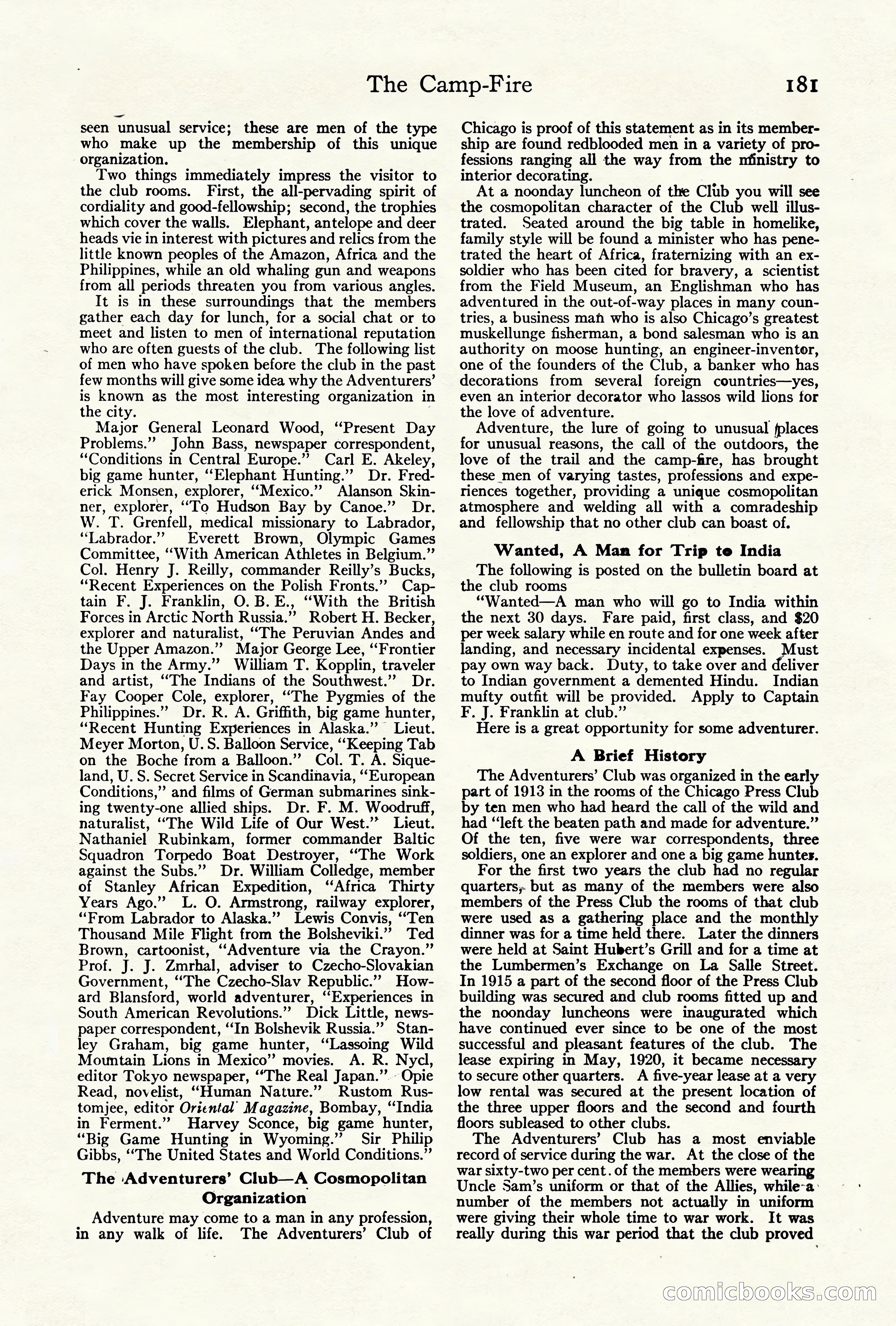
A restored page from Pulp Fiction, 1921. Page through the whole issue in the reader above.
📄 Transcribed text from this page (OCR, searchable)
Machine-transcribed from the original scan — historical spelling and the odd misread are preserved.
The Camp-Fire seen unusual service; these are men of the type who make up the membership of this unique - organization. | Two things immediately impress the visitor to the club rooms. First, the all-pervading spirit of cordiality and good-fellowship; second, the trophies which cover the walls. Elephant, antelope and deer heads vie in interest with pictures and relics from the little known peoples of the Amazon, Africa and the Philippines, while an old whaling gun and weapons from all periods threaten you from various angles. It is in these surroundings that the members gather each day for lunch, for a social chat or to meet and listen to men of international reputation who are often guests of the club. The following list of men who have spoken before the club in the past few months will give some idea why the Adventurers’ is known as the most interesting organization in the city. Major General Leonard Wood, ‘‘Present Day Problems.”’ John Bass, newspaper correspondent, “Conditions in Central Europe.” Carl E. Akeley, big game hunter, ‘‘Elephant Hunting.” Dr. Fred- erick Monsen, explorer, ‘‘Mexico.”’? Alanson Skin- ner, explorer, ‘‘To Hudson Bay by Canoe.” Dr. W. T. Grenfell, medical missionary to Labrador, “Labrador.” Everett Brown, Olympic Games Committee, ““With American Athletes in Belgium.”’ Col. Henry J. Reilly, commander Reilly’s Bucks, “Recent Experiences on the Polish Fronts.”’ Cap- tain F. J. Franklin, O. B. E., “With the British Forces in Arctic North Russia.”” Robert H. Becker, explorer and naturalist, ““The Peruvian Andes and the Upper Amazon.”’ Major George Lee, ‘‘Frontier Days in the Army.” William T. Kopplin, traveler and artist, ‘““The Indians of the Southwest.”’ Dr. Fay Cooper Cole, explorer, ‘““The Pygmies of the Philippines.” Dr. R. A. Griffith, big game hunter, “Recent Hunting Experiences in Alaska.” Lieut. Meyer Morton, U.S. Balloon Service, ‘‘Keeping Tab on the Boche from a Balloon.” Col. T. A. Sique- land, U. S. Secret Service in Scandinavia, “European Conditions,” and films of German submarines sink- ing twenty-one allied ships. Dr. F. M. Woodruff, naturalist, ‘‘The Wild Life of Our West.” Lieut. Nathaniel Rubinkam, former commander Baltic Squadron Torpedo Boat Destroyer, ‘‘The Work against the Subs.”’ Dr. William Colledge, member of Stanley African Expedition, ‘‘Africa Thirty Years Ago.” L. O. Armstrong, railway explorer, “From Labrador to Alaska.” Lewis Convis, ‘Ten Thousand Mile Flight from the Bolsheviki.” Ted Brown, cartoonist, ““Adventure via the Crayon.” Prof. J. J. Zmrhal, adviser to Czecho-Slovakian Government, “The Czecho-Slav Republic.” How- ard Blansford, world adventurer, “Experiences in South American Revolutions.”” Dick Little, news- paper correspondent, ‘‘In Bolshevik Russia.” Stan- ley Graham, big game hunter, ‘“‘Lassoing Wild Mountain Lions in Mexico” movies. A. R. Nycl, editor Tokyo newspaper, “The Real Japan.” - Opie Read, novelist, “Human Nature.’’ Rustom Rus- tomjee, editor Oriental Magazine, Bombay, “India in Ferment.” Harvey Sconce, big game hunter, “Big Game Hunting in Wyoming.” Sir Philip Gibbs, ‘“‘The United States and World Conditions.” The Adventurers’ Club—A Cosmopolitan Organization Adventure may come to a man in any profession, in any walk of life. The Adventurers’ Club of 181 Chicago is proof of this statement as in its member- ship are found redblooded men in a variety of pro- fessions ranging all the way from the nfinistry to interior decorating. At a noonday luncheon of the Club you will see the cosmopolitan character of the Club well illus- trated. Seated around the big table in homelike, family style will be found a minister who has pene- trated the heart of Africa, fraternizing with an ex- soldier who has been cited for bravery, a scientist from the Field Museum, an Englishman who has adventured in the out-of-way places in many coun- tries, a business mah who is also Chicago’s greatest muskellunge fisherman, a bond salesman who is an authority on moose hunting, an engineer-inventor, one of the founders of the Club, a banker who has decorations from several foreign countries—yes, even an interior decorator who lassos wild lions tor the love of adventure. Adventure, the lure of going to unusual places for unusual reasons, the call of the outdoors, the love of the trail and the camp-fire, has brought these men of varying tastes, professions and expe- riences together, providing a unique cosmopolitan atmosphere and welding all with a comradeship and fellowship that no other club can boast of. Wanted, A Man for Trip te India The following is posted on the bulletin board at the club rooms “‘Wanted—A man who will go to India within the next 30 days. Fare paid, first class, and $20 per week salary while en route and for one week after landing, and necessary incidental expenses. Must pay own way back. Duty, to take over and deliver to Indian government a demented Hindu. Indian mufty outfit will be provided. Apply to Captain F. J. Franklin at club.” Here is a great opportunity for some adventurer. A Brief History The Adventurers’ Club was organized in the early part of 1913 in the rooms of the Chicago Press Club by ten men who had heard the call of the wild and had “‘left the beaten path and made for adventure.” Of the ten, five were war correspondents, three soldiers, one an explorer and one a big game hunter. For the first two years the club had no regular quarters, but as many of the members were also members of the Press Club the rooms of that club were used as a gathering place and the monthly dinner was for a time held there. Later the dinners were held at Saint Hubert’s Grill and for a time at the Lumbermen’s Exchange on La Salle Street. In 1915 a part of the second floor of the Press Club building was secured and club rooms fitted up and the noonday luncheons were inaugurated which have continued ever since to be one of the most successful and pleasant features of the club. The lease expiring in May, 1920, it became necessary to secure other quarters. A five-year lease at a very low rental was secured at the present location of the three upper floors and the second and fourth floors subleased to other clubs. The Adventurers’ Club has a most enviable record of service during the war. At the close of the war sixty-two per cent. of the members were wearing Uncle Sam’s uniform or that of the Allies, while-a: number of the members not actually in uniform were giving their whole time to war work. It was really during this war period that the club proved MICLOOOKS C©