
Pulp Fiction, 1921 · page 20 of 204
Adventure Magazine Cover, October 10, 1921 — page 20: what you’re looking at
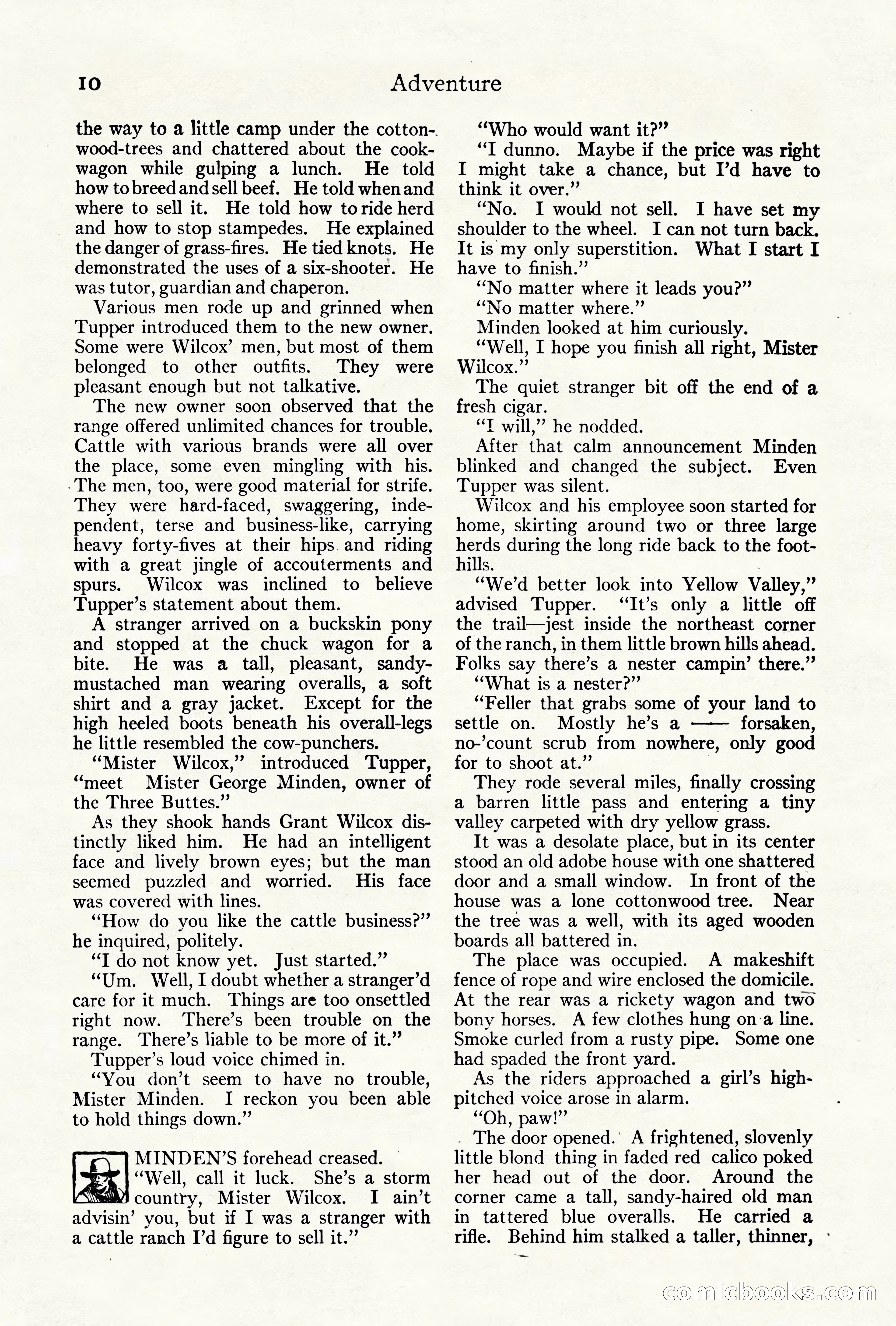
A restored page from Pulp Fiction, 1921. Page through the whole issue in the reader above.
📄 Transcribed text from this page (OCR, searchable)
Machine-transcribed from the original scan — historical spelling and the odd misread are preserved.
IO the way to a little camp under the cotton-. wood-trees and chattered about the cook- wagon while gulping a lunch. He told how tobreed and sell beef. He told whenand where to sell it. He told how toride herd and how to stop stampedes. He explained the danger of grass-fires. He tied knots. He demonstrated the uses of a six-shooter. He was tutor, guardian and chaperon. Various men rode up and grinned when Tupper introduced them to the new owner. Some were Wilcox’ men, but most of them belonged to other outfits. They were pleasant enough but not talkative. The new owner soon observed that the range offered unlimited chances for trouble. Cattle with various brands were all over the place, some even mingling with his. -The men, too, were good material for strife. They were hard-faced, swaggering, inde- pendent, terse and business-like, carrying heavy forty-fives at their hips. and riding with a great jingle of accouterments and spurs. Wilcox was inclined to believe Tupper’s statement about them. A stranger arrived on a buckskin pony and stopped at the chuck wagon for a bite. He was a tall, pleasant, sandy- mustached man wearing overalls, a soft shirt and a gray jacket. Except for the high heeled boots beneath his overall-legs he little resembled the cow-punchers. “Mister Wilcox,” introduced Tupper, “meet Mister George Minden, owner of the Three Buttes.” As they shook hands Grant Wilcox dis- tinctly liked him. He had an intelligent face and lively brown eyes; but the man seemed puzzled and worried. His face was covered with lines. “How do you like the cattle business?” he inquired, politely. “T do not know yet. Just started.” “Um. Well, I doubt whether a stranger’d care for it much. Things are too onsettled right now. ‘There’s been trouble on the range. There’s liable to be more of it.” Tupper’s loud voice chimed in. “Vou don’t seem to have no trouble, Mister Minden. I reckon you been able to hold things down.” MINDEN’S forehead creased. — ¥. “Well, call it luck. She’s a storm ASM} country, Mister Wilcox. I ain’t advisin’ you, but if I was a stranger with a cattle ranch I’d figure to sell it.” Adventure “Who would want it?” “T dunno. Maybe if the price was right I might take a chance, but I’d have to think it over.” 7 “No. I would not sell. I have set my shoulder to the wheel. I can not turn back. It is my only superstition. What I start I have to finish.” ‘“‘No matter where it leads you?” ‘‘No matter where.”’ Minden looked at him curiously. “Well, I hope you finish all right, Mister Wilcox.” The quiet stranger bit off the end of a fresh cigar. “T will,” he nodded. After that calm announcement Minden blinked and changed the subject. Even Tupper was silent. Wilcox and his employee soon started for home, skirting around two or three large herds during the long ride back to the foot- hills. : “We'd better look into Yellow Valley,” advised Tupper. “It’s only a little off the trail—jest inside the northeast corner of the ranch, in them little brown hills ahead. Folks say there’s a nester campin’ there.” ‘What is a nester?”’ “Feller that grabs some of your land to settle on. Mostly he’s a forsaken, no-’count scrub from nowhere, only good for to shoot at.” | They rode several miles, finally crossing a barren little pass and entering a tiny valley carpeted with dry yellow grass. It was a desolate place, but in its center stood an old adobe house with one shattered door and a small window. In front of the house was a lone cottonwood tree. Near the tree was a well, with its aged wooden boards all battered in. The place was occupied. A makeshift — fence of rope and wire enclosed the domicile. At the rear was a rickety wagon and two bony horses. A few clothes hung on-a line. Smoke curled from a rusty pipe. Some one had spaded the front yard. As the riders approached a girl’s high- pitched voice arose in alarm. “Oh, paw!” _ The door opened.’ A frightened, slovenly little blond thing in faded red calico poked her head out of the door. Around the corner came a tall, sandy-haired old man in tattered blue overalls. He carried a rifle. Behind him stalked a taller, thinner, ~ _— COnmiclbooks Cc C©