
Pulp Fiction, 1921 · page 200 of 204
Adventure Magazine Cover, October 10, 1921 — page 200: what you’re looking at
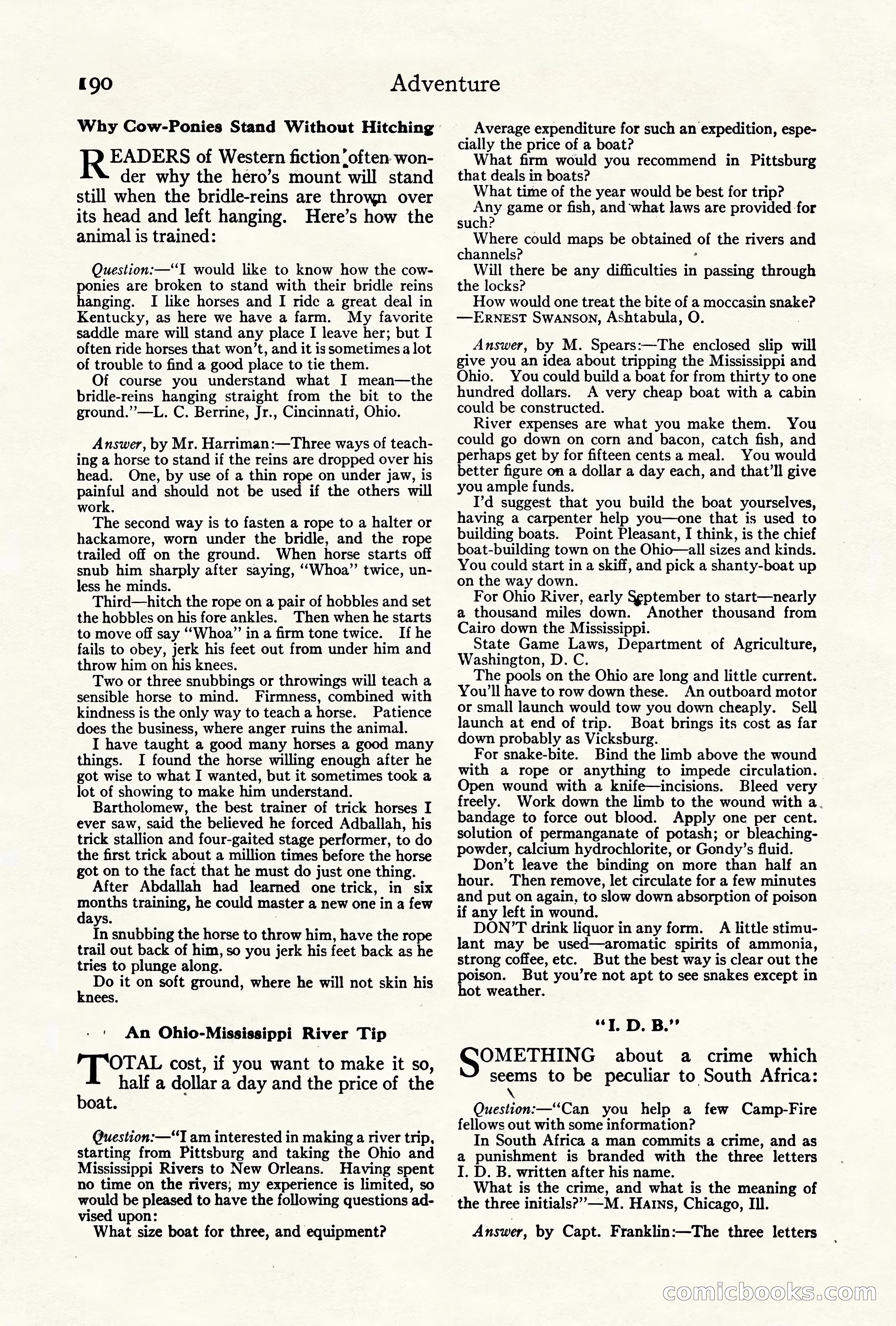
A restored page from Pulp Fiction, 1921. Page through the whole issue in the reader above.
📄 Transcribed text from this page (OCR, searchable)
Machine-transcribed from the original scan — historical spelling and the odd misread are preserved.
190 Why Cow-Ponies Stand Without Hitching EADERS of Western fiction’ often won- der why the hero’s mount will stand still when the bridle-reins are thrown over its head and left hanging. Here’s how the animal is trained: Question: —“TI would like to know how the cow- ponies are broken to stand with their bridle reins hanging. I like horses and I ride a great deal in Kentucky, as here we have a farm. My favorite saddle mare will stand any place I leave her; but I often ride horses that won’t, and it is sometimes a lot of trouble to find a good place to tie them. Of course you understand what I mean—the bridle-reins hanging straight from the bit to the ground.”—L. C. Berrine, Jr., Cincinnati, Ohio. Answer, by Mr. Harriman:—Three ways of teach- ing a horse to stand if the reins are dropped over his head. One, by use of a thin rope on under jaw, is painful and should not be used if the others will work. : The second way is to fasten a rope to a halter or hackamore, worn under the bridle, and the rope trailed off on the ground. When horse starts off snub him sharply after saying, ‘‘Whoa”’ twice, un- less he minds. Third—hitch the rope on a pair of hobbles and set the hobbles on his fore ankles. Then when he starts to move off say ‘“‘Whoa”’ in a firm tone twice. If he fails to obey, jerk his feet out from under him and throw him on his knees. Two or three snubbings or throwings will teach a sensible horse to mind. Firmness, combined with kindness is the only way to teach a horse. Patience does the business, where anger ruins the animal. I have taught a good many horses a good many things. I found the horse willing enough after he got wise to what I wanted, but it sometimes took a lot of showing to make him understand. Bartholomew, the best trainer of trick horses I ever saw, said the believed he forced Adballah, his trick stallion and four-gaited stage performer, to do the first trick about a million times before the horse got on to the fact that be must do just one thing. After Abdallah had learned one trick, in six ease training, he could master a new one in a few ays. : In snubbing the horse to throw him, have the rope trail out back of him, so you jerk his feet back as he tries to plunge along. : Do it on soft ground, where he will not skin his nees. ' An Ohio-Mississippi River Tip TOTAL cost, if you want to make it so, half a dollar a day and the price of the boat. Question: —“T am interested in making a river trip, starting from Pittsburg and taking the Ohio and Mississippi Rivers to New Orleans. Having spent no time on the rivers; my experience is limited, so would be pleased to have the following questions ad- vised upon: What size boat for three, and equipment? Adventure Average expenditure for such an expedition, espe- cially the price of a boat? What firm would you recommend in Pittsburg that deals in boats? What time of the year would be best for trip? ay game or fish, and what laws are provided for such? 7 Where could maps be obtained of the rivers and channels? ‘ Will there be any difficulties in passing through the locks? How would one treat the bite of a moccasin snake? —ERNEST SWANSON, Ashtabula, O Answer, by M. Spears:—The enclosed slip will give you an idea about tripping the Mississippi and Ohio. You could build a boat for from thirty to one hundred dollars. A very cheap boat with a cabin could be constructed. River expenses are what you make them. You could go down on corn and bacon, catch fish, and perhaps get by for fifteen cents a meal. You would better figure on a dollar a day each, and that’ll give you ample funds. I’d suggest that you build the boat yourselves, having a carpenter help you—one that is used to building boats. Point Pleasant, I think, is the chief boat-building town on the Ohio—all sizes and kinds. You could start in a skiff, and pick a shanty-boat up on the way down. For Ohio River, early September to start—nearly a thousand miles down. Another thousand from Cairo down the Mississippi. State Game Laws, Department of Agriculture, Washington, D. C. The pools on the Ohio are long and little current. You'll have to row down these. An outboard motor or small launch would tow you down cheaply. Sell launch at end of trip. Boat brings its cost as far down probably as Vicksburg. For snake-bite. Bind the limb above the wound with a rope or anything to impede circulation. Open wound with a knife—incisions. Bleed very freely. Work down the limb to the wound with a. bandage to force out blood. Apply one per cent. solution of permanganate of potash; or bleaching- powder, calcium hydrochlorite, or Gondy’s fluid. Don’t leave the binding on more than half an hour. Then remove, let circulate for a few minutes and put on again, to slow down absorption of poison if any left in wound. DON’T drink liquor in any form. A little stimu- lant may be used—aromatic spirits of ammonia, strong coffee, etc. But the best way is clear out the poison. But you’re not apt to see snakes except in hot weather. ‘“*]. D. B.”’ OMETHING about a crime which seems to be peculiar to South Africa: \ Question:—“Can you help a few Camp-Fire fellows out with some information? In South Africa a man commits a crime, and as a punishment is branded with the three letters I. D. B. written after his name. What is the crime, and what is the meaning of the three initials?’”,—M. Harns, Chicago, II]. Answer, by Capt. Franklin:—The three letters MICLOOOKS C@