
Pulp Fiction, 1921 · page 34 of 204
Adventure Magazine Cover, October 10, 1921 — page 34: what you’re looking at
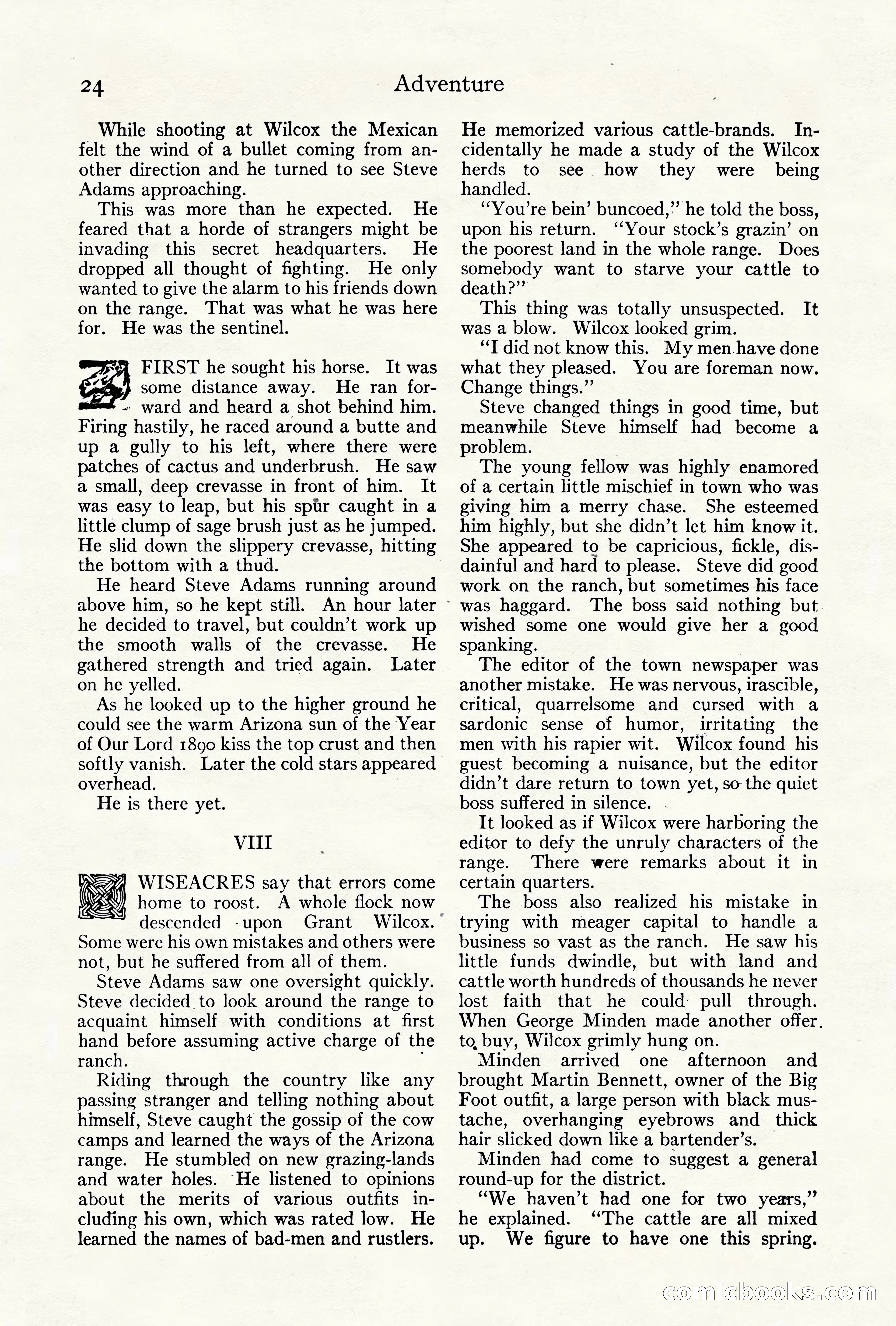
A restored page from Pulp Fiction, 1921. Page through the whole issue in the reader above.
📄 Transcribed text from this page (OCR, searchable)
Machine-transcribed from the original scan — historical spelling and the odd misread are preserved.
24 While shooting at Wilcox the Mexican felt the wind of a bullet coming from an- other direction and he turned to see Steve Adams approaching. This was more than he expected. He feared that a horde of strangers might be invading this secret headquarters. He dropped all thought of fighting. He only wanted to give the alarm to his friends down on the range. That was what he was here for. He was the sentinel. ee) some distance away. He ran for- eek. ward and heard a shot behind him. Firing hastily, he raced around a butte and up a gully to his left, where there were patches of cactus and underbrush. He saw a small, deep crevasse in front of him. It was easy to leap, but his sptr caught in a little clump of sage brush just as he jumped. FIRST he sought his horse. It was He slid down the slippery crevasse, hitting the bottom with a thud. He heard Steve Adams running around above him, so he kept still. An hour later he decided to travel, but couldn’t work up the smooth walls of the crevasse. He gathered strength and tried again. Later on he yelled. As he looked up to the higher ground he could see the warm Arizona sun of the Year of Our Lord 1890 kiss the top crust and then softly vanish. Later the cold stars appeared overhead. He is there yet. VIII uN RA WISEACRES say that errors come WS Ve) home to roost. A whole flock now descended -upon Grant Wilcox. Some were his own mistakes and others were not, but he suffered from all of them. Steve Adams saw one oversight quickly. Steve decided to Jook around the range to acquaint himself with conditions at first hand before assuming active charge of the ranch. Riding through the country like any passing stranger and telling nothing about himself, Steve caught the gossip of the cow camps and learned the ways of the Arizona range. He stumbled on new grazing-lands and water holes. He listened to opinions about the merits of various outfits in- cluding his own, which was rated low. He learned the names of bad-men and rustlers. Adventure He memorized various cattle-brands. In- cidentally he made a study of the Wilcox herds to see how they were being handled. ‘You're bein’ buncoed,”’ he told the boss, upon his return. ‘“‘Your stock’s grazin’ on the poorest land in the whole range. Does somebody want to starve your cattle to death?” This thing was totally unsuspected. It was a blow. Wilcox looked grim. “T did not know this. My men.have done what they pleased. You are foreman now. Change things.”’ Steve changed things in good time, but meanwhile Steve himself had become a problem. The young fellow was highly enamored of a certain little mischief in town who was giving him a merry chase. She esteemed him highly, but she didn’t let him know it. She appeared to be capricious, fickle, dis- dainful and hard to please. Steve did ‘good work on the ranch, but sometimes his face ’ was haggard. The boss said nothing but. wished some one would give her a good spanking. The editor of the town newspaper was another mistake. He was nervous, irascible, critical, quarrelsome and cursed with a sardonic sense of humor, irritating the men with his rapier wit. Wilcox found his guest becoming a nuisance, but the editor didn’t dare return to town yet, so the quiet boss suffered in silence. It looked as if Wilcox were harboring the editor to defy the unruly characters of the range. There were remarks about it in certain quarters. The boss also realized his mistake in trying with meager capital to handle a business so vast as the ranch. He saw his . little funds dwindle, but with land and cattle worth hundreds of thousands he never lost faith that he could: pull through. When George Minden made another offer. to, buy, Wilcox grimly hung on. Minden arrived one afternoon and brought Martin Bennett, owner of the Big Foot outfit, a large person with black mus- tache, overhanging eyebrows and _ thick hair slicked down like a bartender’s. | Minden had come to suggest a general round-up for the district. ‘‘We haven’t had one for two years,” he explained. ‘‘The cattle are all mixed up. We figure to have one this spring. COmiclbooks Cc C@