
Pulp Fiction, 1921 · page 37 of 204
Adventure Magazine Cover, October 10, 1921 — page 37: what you’re looking at
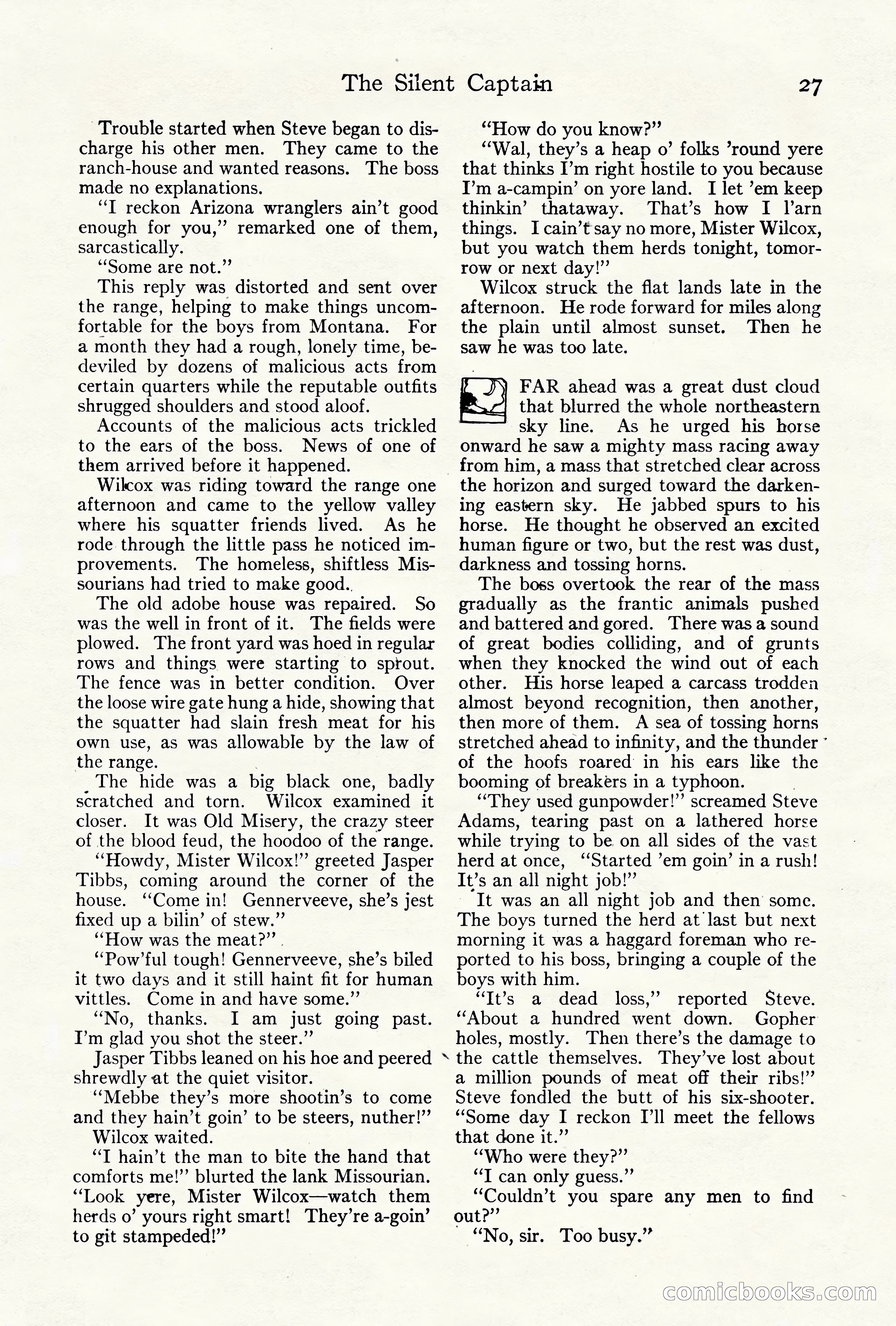
A restored page from Pulp Fiction, 1921. Page through the whole issue in the reader above.
📄 Transcribed text from this page (OCR, searchable)
Machine-transcribed from the original scan — historical spelling and the odd misread are preserved.
The Silent Captain Trouble started when Steve began to dis- charge his other men. They came to the ranch-house and wanted reasons. The boss made no explanations. ‘“T reckon Arizona wranglers ain’t good enough for you,” remarked one of them, sarcastically. “Some are not.” This reply was distorted and sent over the range, helping to make things uncom- fortable for the boys from Montana. For a month they had a rough, lonely time, be- deviled by dozens of malicious acts from certain quarters while the reputable outfits shrugged shoulders and stood aloof. Accounts of the malicious acts trickled to the ears of the boss. News of one of them arrived before it happened. Wilcox was riding toward the range one afternoon and came to the yellow valley where his squatter friends lived. As he rode through the little pass he noticed im- provements. The homeless, shiftless Mis- sourians had tried to make good.. The old adobe house was repaired. So was the well in front of it. The fields were plowed. The front yard was hoed in regular rows and things were starting to sprout. The fence was in better condition. Over the loose wire gate hung a hide, showing that the squatter had slain fresh meat for his own use, as was allowable by the law of the range. The hide was a big black one, badly scratched and torn. Wilcox examined it closer. It was Old Misery, the crazy steer of the blood feud, the hoodoo of the range. ‘Howdy, Mister Wilcox!” greeted Jasper Tibbs, coming around the corner of the house. “Come in! Gennerveeve, she’s jest fixed up a bilin’ of stew.” “How was the meat?”’. ‘Pow’ ful tough! Gennerveeve, she’s biled it two days and it still haint fit for human vittles. Come in and have some.” “No, thanks. I am just going past. I’m glad you shot the steer.”’ Jasper Tibbs leaned on his hoe and peered shrewdly at the quiet visitor. “Mebbe they’s more shootin’s to come and they hain’t goin’ to be steers, nuther!”’ Wilcox waited. “T hain’t the man to bite the hand that comforts me!’ blurted the lank Missourian. “Look yere, Mister Wilcox—watch them herds o’ yours right smart! They’re a-goin’ to git stampeded!”’ 27 “How do you know?” ‘“‘Wal, they’s a heap o’ folks ’round yere that thinks I’m right hostile to you because I’m a-campin’ on yore land. I let ’em keep thinkin’ thataway. That’s how I l’arn things. I cain’t say no more, Mister Wilcox, but you watch them herds tonight, tomor- row or next day!” Wilcox struck the flat lands late in the afternoon. He rode forward for miles along the plain until almost sunset. Then he saw he was too late. FAR ahead was a great dust cloud that blurred the whole northeastern sky line. As he urged his horse onward he saw a mighty mass racing away _ from him, a mass that stretched clear across “‘ the horizon and surged toward the darken- ing eastern sky. He jabbed spurs to his horse. He thought he observed an excited human figure or two, but the rest was dust, darkness and tossing horns. The boss overtook the rear of the mass gradually as the frantic animals pushed and battered and gored. There was a sound of great bodies colliding, and of grunts when they knocked the wind out of each other. His horse leaped a carcass trodden almost beyond recognition, then another, then more of them. A sea of tossing horns stretched ahead to infinity, and the thunder ° of the hoofs roared in his ears like the booming of breakers in a typhoon. ‘They used gunpowder!’ screamed Steve Adams, tearing past on a lathered horse while trying to be on all sides of the vast herd at once, “Started ’em goin’ in a rush! It’s an all night job!” - It was an all night job and then some. The boys turned the herd at last but next morning it was a haggard foreman who re- ported to his boss, bringing a couple of the boys with him. “Tt’s a dead loss,’’ reported Steve. “About a hundred went down. Gopher holes, mostly. Then there’s the damage to the cattle themselves. They’ve lost about a million pounds of meat off their ribs!” Steve fondled the butt of his six-shooter. “Some day I reckon I’ll meet the fellows that done it.” ‘‘Who were they?” “T can only guess.” “Couldn’t you spare any men to find out?” “No, sir. Too busy.” DOOLK (C©