
Pulp Fiction, 1921 · page 74 of 204
Adventure Magazine Cover, October 10, 1921 — page 74: what you’re looking at
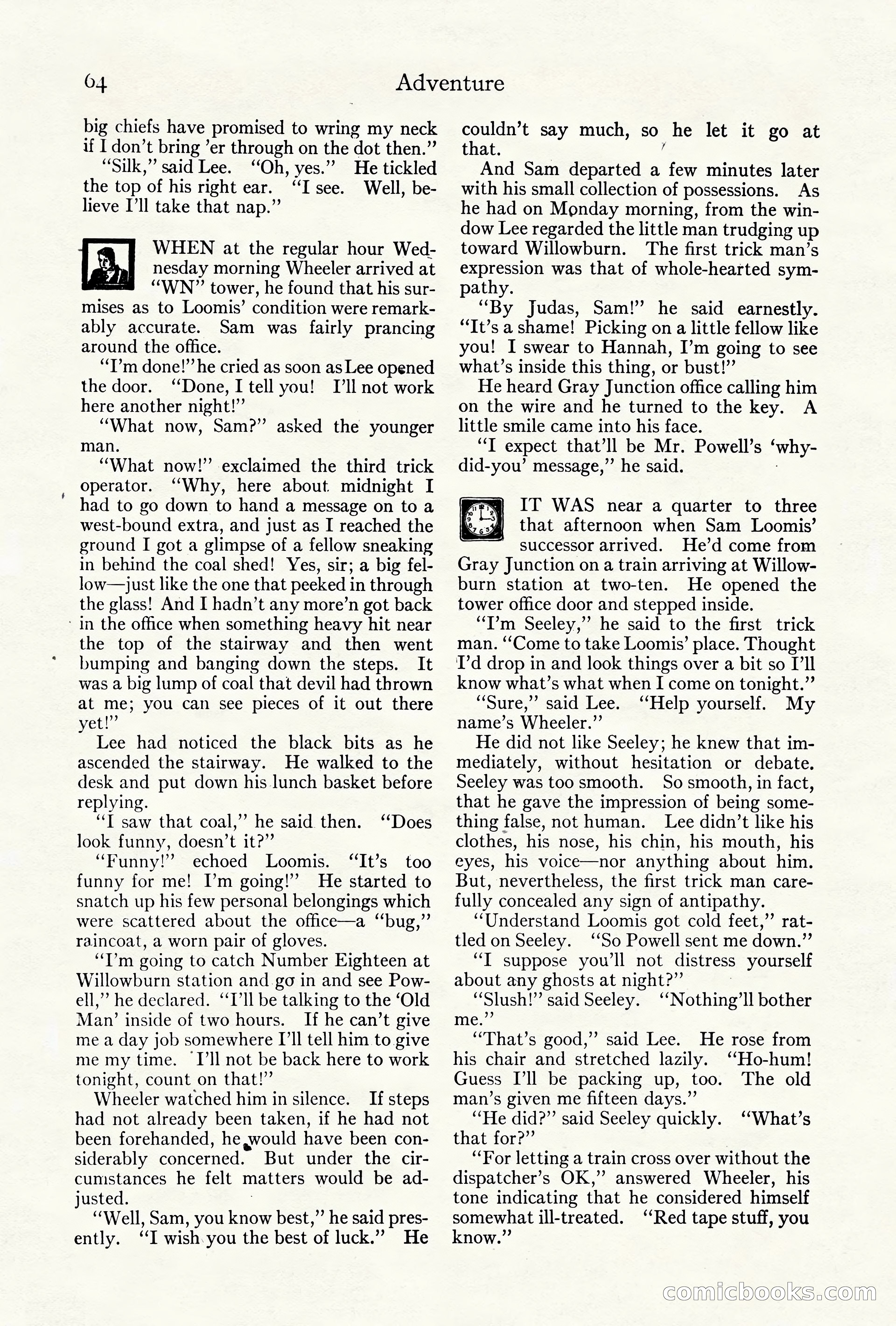
A restored page from Pulp Fiction, 1921. Page through the whole issue in the reader above.
📄 Transcribed text from this page (OCR, searchable)
Machine-transcribed from the original scan — historical spelling and the odd misread are preserved.
O4 big chiefs have promised to wring my neck if I don’t bring ’er through on the dot then.” “Silk,” said Lee. “Oh, yes.” He tickled the top ‘of his right ear. “Isee. Well, be- lieve I'll take that nap.” WHEN at the regular hour Wed- nesday morning Wheeler arrived at = “WN” tower, he found that his sur- mises as to Loomis’ condition were remark- ably accurate. Sam was fairly prancing around the office. | ‘I’m done!” he cried as soon as Lee opened the door. ‘Done, I tell you! Ill not work here another night!” “What now, Sam?” asked the younger man. “What now!’ exclaimed the third trick operator. ‘Why, here about. midnight I had to go down to hand a message on to a west-bound extra, and just as I reached the ground I got a glimpse of a fellow sneaking in behind the coal shed! Yes, sir; a big fel- low—just like the one that peeked in through the glass! And I hadn’t any more’n got back In the office when something heavy hit near the top of the stairway and then went bumping and banging down the steps. It was a big lump of coal that devil had thrown at me; you can see pieces of it out there yet!” Lee had noticed the black bits as he ascended the stairway. He walked to the desk and put down his lunch basket before replying. “T saw that coal,’ he said then. ‘‘Does look funny, doesn’t it?” “Funny!” echoed Loomis. “It’s too y. funny for me! I’m going!’ He started to snatch up his few personal belongings which were scattered about the office—a “bug,” raincoat, a worn pair of gloves. “Tm going to catch Number Eighteen at Willowburn station and go in and see Pow- ell,” he declared. “T’ll be talking to the ‘Old Man’ inside of two hours. If he can’t give me a day job somewhere [’ll tell him to give me my time. Ill not be back here to work tonight, count on that!’ Wheeler watched him in silence. If steps had not already been taken, if he had not been forehanded, he would have been con- siderably concerned. But under the cir- cumstances he felt matters would be ad- justed. “Well, Sam, you know best,” he said pres- ently. oy wish. you the best of luck.”” He Adventure couldn’t say much, $0 he let it go at that. And Sam departed a a minutes later with his small collection of possessions. As he had on Monday morning, from the win- dow Lee regarded the little man trudging up toward Willowburn. The first trick man’s expression was that of whole-hearted sym- pathy. “By Judas, Sam!” he said earnestly. “It’s ashame! Picking on a little fellow like you! I swear to Hannah, I’m going to see what’s inside this thing, or bust!” He heard Gray Junction office calling him on the wire and he turned to the key. A little smile came into his face. “T expect that’ll be Mr. Powell’s why- did-you’ message,” he said. IT WAS near a quarter to three that afternoon when Sam Loomis’ successor arrived. He’d come from Gray Junction on a train arriving at Willow- burn station at two-ten. He opened the tower office door and stepped inside. “I’m Seeley,” he said to the first trick man. “Come to take Loomis’ place. Thought I'd drop in and look things over a bit so I’ll know what’s what when I come on tonight.” “Sure,” said Lee. “Help yourself. My name’s Wheeler.”’ He did not like Seeley; he knew that im- mediately, without hesitation or debate. Seeley was too smooth. So smooth, in fact, that he gave the impression of being some- thing false, not human. Lee didn’t like his clothes, his nose, his chin, his mouth, his eyes, his voice—nor anything about him. But, nevertheless, the first trick man care- fully concealed any sign of antipathy. ‘Understand Loomis got cold feet,”’ rat- tled on Seeley. ‘‘So Powell sent me down.” “T suppose you'll not distress yourself about any ghosts at night?” “Slush!” said Seeley. ‘‘Nothing’ll bother me.”’ ‘“That’s good,” said Lee. He rose from his chair and stretched lazily. ‘‘Ho-hum! Guess I’ll be packing up, too. The old man’s given me fifteen days.” ‘He did?” said Seeley quickly. ‘‘What’s that for?”’ 7 “For letting a train cross over without the dispatcher’s OK,”’ answered Wheeler, his tone indicating that he considered himself somewhat ill-treated. ‘Red tape stuff, you know.” DOOLK C©