
Pulp Fiction, 1921 · page 82 of 204
Adventure Magazine Cover, October 10, 1921 — page 82: what you’re looking at
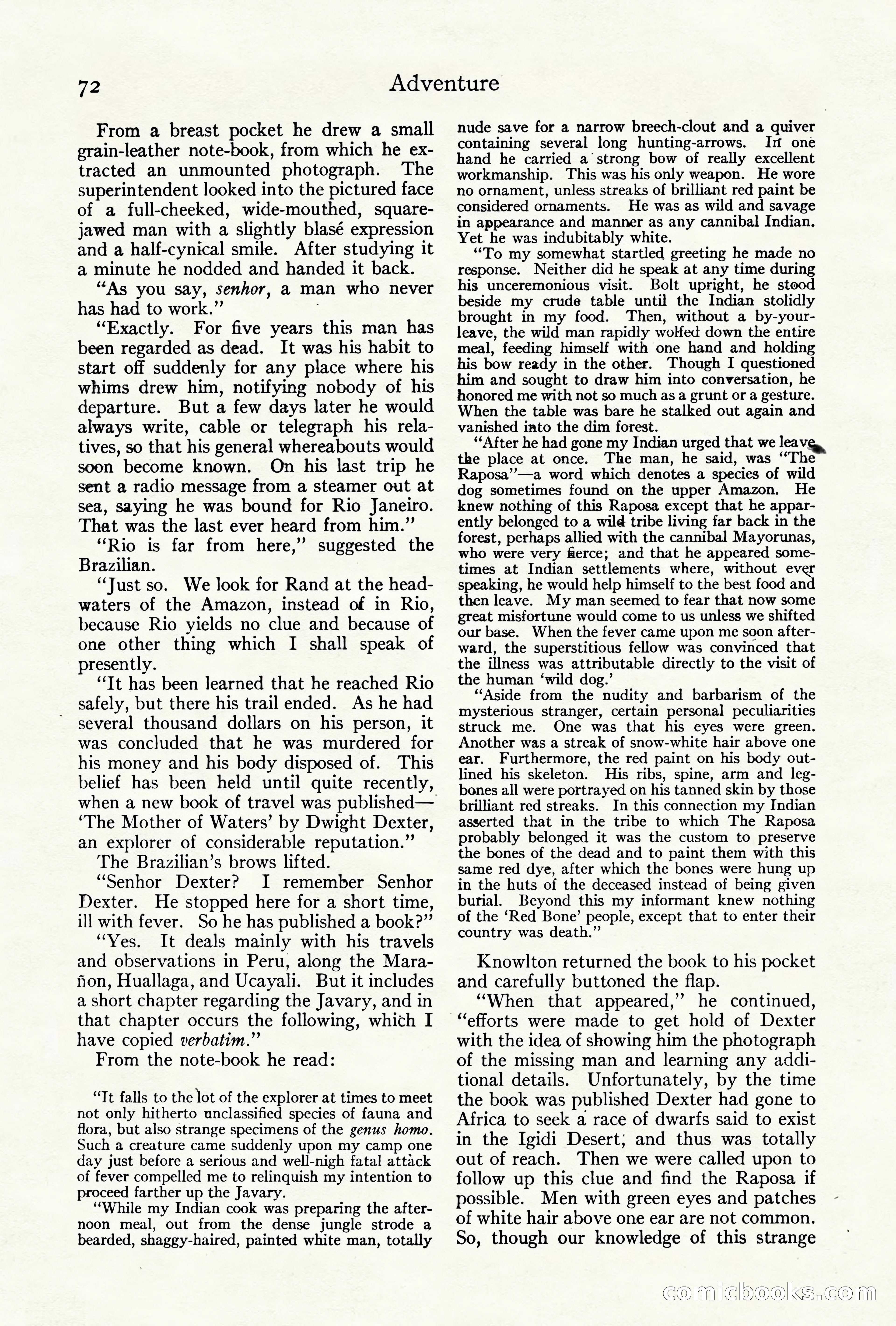
A restored page from Pulp Fiction, 1921. Page through the whole issue in the reader above.
📄 Transcribed text from this page (OCR, searchable)
Machine-transcribed from the original scan — historical spelling and the odd misread are preserved.
72 From a breast pocket he drew a small grain-leather note-book, from which he ex- tracted an unmounted photograph. The superintendent looked into the pictured face of a full-cheeked, wide-mouthed, square- jawed man with a slightly blasé expression and a half-cynical smile. After studying it a minute he nodded and handed it back. “As you say, senhor, a man who never has had to work.”’ “Exactly. For five years this man has been regarded as dead. It was his habit to start off suddenly for any place where his whims drew him, notifying nobody of his departure. But a few days later he would always write, cable or telegraph his rela- tives, so that his general whereabouts would soon become known. On his last trip he sent a radio message from a steamer out at sea, saying he was bound for Rio Janeiro. That was the last ever heard from him.” “Rio is far from here,” suggested the Brazilian. “Just so. We look for Rand at the head- waters of the Amazon, instead of in Rio, because Rio yields no clue and because of one other thing which I shall speak of presently. “Tt has been learned that he reached Rio safely, but there his trail ended. As he had several thousand dollars on his person, it was concluded that he was murdered for his money and his body disposed of. This belief has been held until quite recently, when a new book of travel was published— ‘The Mother of Waters’ by Dwight Dexter, an explorer of considerable reputation.” The Brazilian’s brows lifted. “Senhor Dexter? I remember Senhor Dexter. He stopped here for a short time, ill with fever. So he has published a book?” “Ves. It deals mainly with his travels and observations in Peru, along the Mara- fon, Huallaga, and Ucayali. But it includes a short chapter regarding the Javary, and in that chapter occurs the following, which I have copied verbatim.” From the note-book he read: “Tt falls to the lot of the explorer at times to meet not only hitherto unclassified species of fauna and flora, but also strange specimens of the genus homo. Such a creature came suddenly upon my camp one day just before a serious and well-nigh fatal attack of fever compelled me to relinquish my intention to proceed farther up the Javary. “While my Indian cook was preparing the after- noon meal, out from the dense jungle strode a bearded, shaggy-haired, painted white man, totally Adventure nude save for a narrow breech-clout and a quiver containing several long hunting-arrows. Inf one hand he carried a strong bow of really excellent workmanship. This was his only weapon. He wore no ornament, unless streaks of brilliant red paint be considered ornaments. He was as wild and savage in appearance and manner as any cannibal Indian. Yet he was indubitably white. “To my somewhat startled greeting he made no response. Neither did he speak at any time during his unceremonious visit. Bolt upright, he stood beside my crude table until the Indian stolidly brought in my food. Then, without a by-your- leave, the wild man rapidly wolfed down the entire meal, feeding himself with one hand and holding his bow ready in the other. Though I questioned him and sought to draw him into conversation, he honored me with not so much as a grunt or a gesture. When the table was bare he stalked out again and vanished into the dim forest. ‘‘After he had gone my Indian urged that we leavg, the place at once. The man, he said, was ‘The Raposa”’—a word which denotes a species of wild dog sometimes found on the upper Amazon. He knew nothing of this Raposa except that he appar- ently belonged to a wild tribe living far back in the forest, perhaps allied with the cannibal Mayorunas, who were very fierce; and that he appeared some- times at Indian settlements where, without ever speaking, he would help himself to the best food an then leave. My man seemed to fear that now some great misfortune would come to us unless we shifted our base. When the fever came upon me soon after- ward, the superstitious fellow was convinced that the illness was attributable directly to the visit of the human ‘wild dog.’ ‘Aside from the nudity and barbarism of the mysterious stranger, certain personal peculiarities struck me. One was that his eyes were green. Another was a streak of snow-white hair above one ear. Furthermore, the red paint on his body out- lined his skeleton. His ribs, spine, arm and leg- bones all were portrayed on his tanned skin by those brilliant red streaks. In this connection my Indian asserted that in the tribe to which The Raposa probably belonged it was the custom to preserve the bones of the dead and to paint them with this same red dye, after which the bones were hung up in the huts of the deceased instead of being given burial. Beyond this my informant knew nothing of the ‘Red Bone’ people, except that to enter their country was death.” Knowlton returned the book to his pocket and carefully buttoned the flap. “When that appeared,” he continued, “efforts were made to get hold of Dexter with the idea of showing him the photograph of the missing man and learning any addi- tional details. Unfortunately, by the time the book was published Dexter had gone to Africa to seek a race of dwarfs said to exist in the Igidi Desert; and thus was totally out of reach. Then we were called upon to follow up this clue and find the Raposa if possible. Men with green eyes and patches of white hair above one ear are not common. So, though our knowledge of this strange MICLO©OKS Cc C©