
Pulp Fiction, 1921 · page 199 of 204
Adventure Magazine Cover — page 199: what you’re looking at
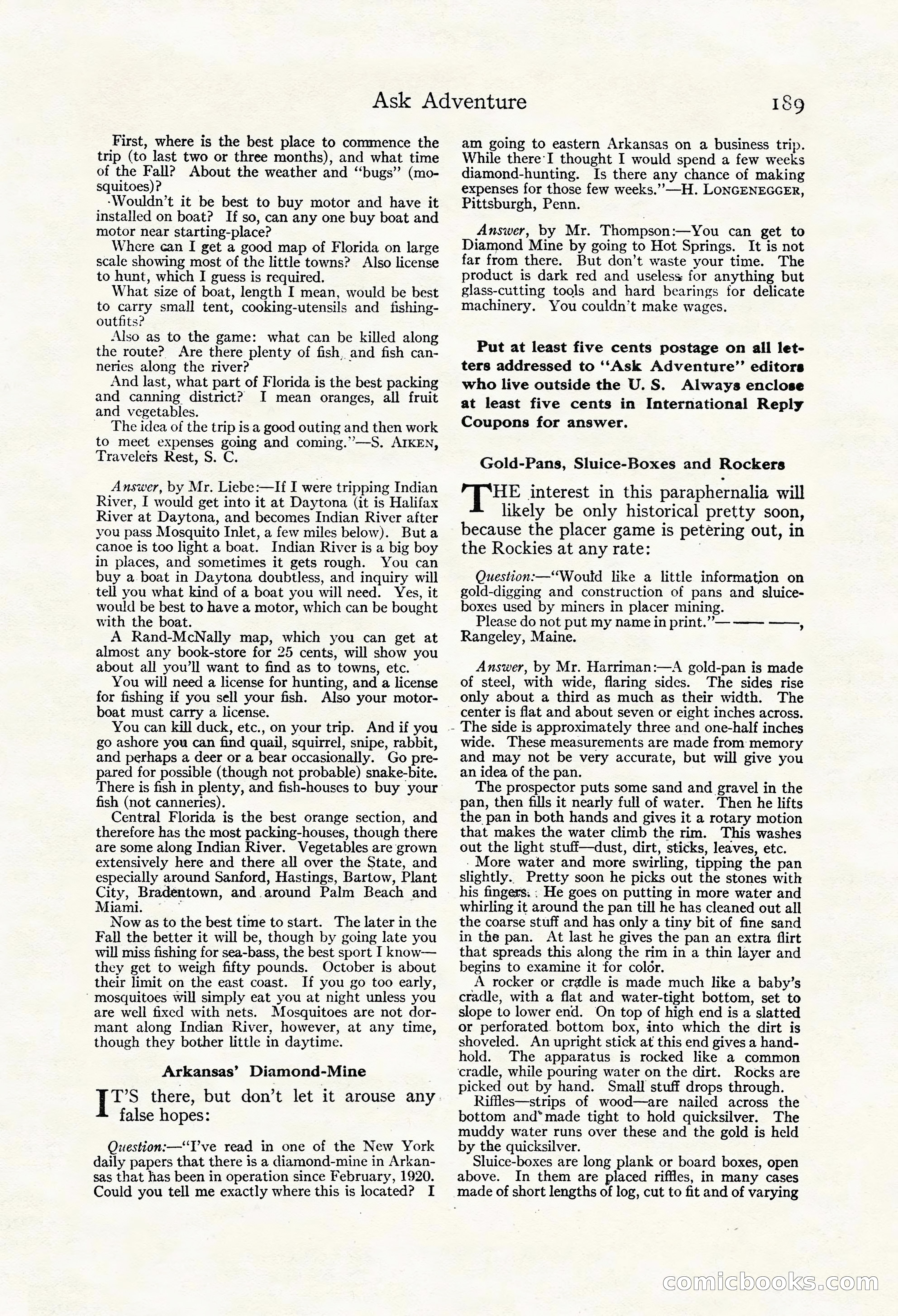
A restored page from Pulp Fiction, 1921. Page through the whole issue in the reader above.
📄 Transcribed text from this page (OCR, searchable)
Machine-transcribed from the original scan — historical spelling and the odd misread are preserved.
Ask Adventure First, where is the best place to commence the trip (to last two or three months), and what time of the Fall? About the weather and ‘‘bugs” (mo- squitoes) ?P -Wouldn’t it be best to buy motor and have it installed on boat? If so, can any one buy boat and motor near starting-place? Where can I get a good map of Florida on large scale showing most of the little towns? Also license to hunt, which I guess is required. What size of boat, length I mean, would be best to carry small tent, cooking-utensils and fishing- outfits? Also as to the game: what can be killed along the route? Are there plenty of fish, and fish can- neries along the river? And last, what part of Florida is the best packing and canning district? I mean oranges, all fruit and vegetables. The idea of the trip is a good outing and then work to meet expenses going and coming.”—S, AIKEN, Travelers Rest, S. C. Answer, by Mr. Liebe:—If I were tripping Indian River, I would get into it at Daytona (it is Halifax River at Daytona, and becomes Indian River after you pass Mosquito Inlet, a few miles below). Buta canoe is too light a boat. Indian River is a big boy in places, and sometimes it gets rough. You can buy a. boat in Daytona doubtless, and inquiry will tell you what kind of a boat you will need. Yes, it would be best to have a motor, which can be bought with the boat. A Rand-McNally map, which you can get at almost any book-store for 25 cents, will show you about all you’ll want to find as to towns, etc. You will need a license for hunting, and a license for fishing if you sell your fish. Also your motor- boat must carry a license. You can kill duck, etc., on your trip. And if you | go ashore you can find quail, squirrel, snipe, rabbit, and perhaps a deer or a bear occasionally. Go pre- pared for possible (though not probable) snake-bite. There is fish in plenty, and fish-houses to buy your fish (not canneries). Central Florida is the best orange section, and therefore has the most packing-houses, though there are some along Indian River. Vegetables are grown extensively here and there all over the State, and especially around Sanford, Hastings, Bartow, Plant City, Bradentown, and around Palm Beach and Miami. : Now as to the best time to start. The later in the Fall the better it will be, though by going late you will miss fishing for sea-bass, the best sport I know— they get to weigh fifty pounds. October is about their limit on the east coast. If you go too early, ‘mosquitoes will simply eat you at night unless you are well fixed with nets. Mosquitoes are not dor- mant along Indian River, however, at any time, though they bother little in daytime. Arkansas’ Diamond-Mine | Be there, but don’t let it arouse any. false hopes: Question: —“T’ve read in one of the New York daily papers that there is a diamond-mine in Arkan- sas that has been in operation since February, 1920. Could you tell me exactly where this is located? I 1&9 am going to eastern Arkansas on a business trip. While there'I thought I would spend a few weeks diamond-hunting. Is there any chance of making expenses for those few weeks.’”—H. LONGENEGGER, Pittsburgh, Penn. Answer, by Mr. Thompson:—You can get to Diamond Mine by going to Hot Springs. It is not far from there. But don’t waste your time. The product is dark red and useless for anything but glass-cutting tools and hard bearings for delicate machinery. You couldn’t make wages. Put at least five cents postage on all let- ters addressed to ‘‘Ask Adventure’”’ editors who live outside the U. S. Always enclose at least five cents in International Reply Coupons for answer. Gold-Pans, Sluice-Boxes and Rockers Te * interest in this paraphernalia will likely be only historical pretty soon, because the placer game is petering out, in the Rockies at any rate: 3 Question: —“Would like a little information on gold-digging and construction of pans and sluice- boxes used by miners in placer mining. Please do not put my name in print.”— ——- ——_, Rangeley, Maine. Answer, by Mr. Harriman:—A gold-pan is made of steel, with wide, flaring sides. The sides rise only about a third as much as their width. The - center is flat and about seven or eight inches across. The side is approximately three and one-half inches wide. These measurements are made from memory and may not be very accurate, but will give you an idea of the pan. The prospector puts some sand and gravel in the pan, then fills it nearly full of water. Then he lifts the pan in both hands and gives it a rotary motion that makes the water climb the rim. This washes out the light stuff—dust, dirt, sticks, leaves, etc. - More water and more swirling, tipping the pan slightly. Pretty soon he picks out the stones with his fingers. : He goes on putting in more water and whirling it around the pan till he has cleaned out all the coarse stuff and has only a tiny bit of fine sand in the pan. At last he gives the pan an extra flirt that spreads this along the rim in a thin layer and begins to examine it for color. A rocker or cradle is made much like a baby’s cradle, with a flat and water-tight bottom, set to slope to lower end. On top of high end is a slatted or perforated. bottom box, into which the dirt is shoveled. An upright stick at this end gives a hand- hold. The apparatus is rocked like a common cradle, while pouring water on the dirt. Rocks are picked out by hand. Small stuff drops through. Riffles—strips of wood—are nailed across the bottom and*made tight to hold quicksilver. The muddy water runs over these and the gold is held by the quicksilver. : Sluice-boxes are long plank or board boxes, open above. In them are placed riffles, in many cases made of short lengths of log, cut to fit and of varying CONMUG te) DOOKS (© iin