
Pulp Fiction, 1921 · page 200 of 204
Adventure Magazine Cover — page 200: what you’re looking at
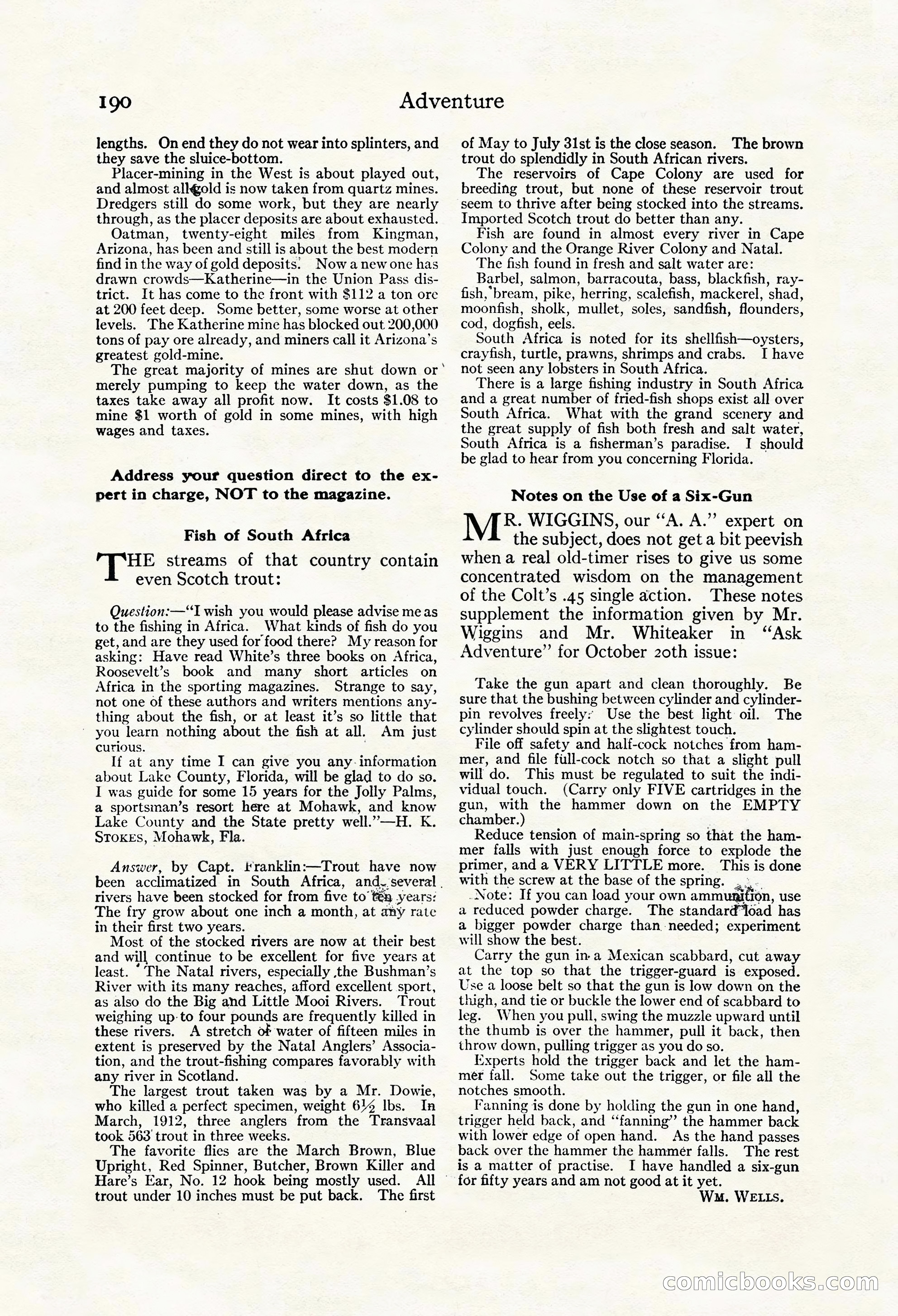
A restored page from Pulp Fiction, 1921. Page through the whole issue in the reader above.
📄 Transcribed text from this page (OCR, searchable)
Machine-transcribed from the original scan — historical spelling and the odd misread are preserved.
190 lengths. On end they do not wear into splinters, and they save the sluice-bottom. Placer-mining in the West is about played out, and almost allgold is now taken from quartz mines. Dredgers still do some work, but they are nearly through, as the placer deposits are about exhausted. Oatman, twenty-eight miles from Kingman, Arizona, has been and still is about the best modern find in the way of gold deposits!) Nowanewone has drawn crowds—Katherine—in the Union Pass dis- trict. It has come to the front with $112 a ton ore at 200 feet deep. Some better, some worse at other levels. The Katherine mine has blocked out 200,000 tons of pay ore already, and miners call it Arizona’s greatest gold-mine. The great majority of mines are shut down or merely pumping to keep the water down, as the taxes take away all profit now. It costs $1.08 to mine $1 worth of gold in some mines, with high wages and taxes. Address your question direct to the ex- pert in charge, NOT to the magazine. Fish of South Africa Oe streams of that country contain even Scotch trout: Question: —“I wish you would please advise me as to the fishing in Africa. What kinds of fish do you get, and are they used for food there? My reason for asking: Have read White’s three books on Africa, Roosevelt’s book and many short articles on Africa in the sporting magazines. Strange to say, not one of these authors and writers mentions any- thing about the fish, or at least it’s so little that ' you learn nothing about the fish at all. Am just curious. If at any time I can give you any- information about Lake County, Florida, will be glad to do so. I was guide for some 15 years for the Jolly Palms, a sportsman’s resort here at Mohawk, and know Lake County and the State pretty well.”—H. K. SToKEs, Mohawk, Fla. Answer, by Capt. tranklin:—Trout have now been acclimatized in South Africa, and..several . rivers have been stocked for from five to’ téy -years: The fry grow about one inch a month, at any rate in their first two years. Most of the stocked rivers are now at their best and will continue to be excellent for five years at least. “The Natal rivers, especially the Bushman’s River with its many reaches, afford excellent sport, as also do the Big and Little Mooi Rivers. Trout weighing up-to four pounds are frequently killed in these rivers. A stretch of water of fifteen miles in extent is preserved by the Natal Anglers’ Associa- tion, and the trout-fishing compares favorably with any river in Scotland. | The largest trout taken was by a Mr. Dowie, who killed a perfect specimen, weight 614 lbs. In March, 1912, three anglers from the Transvaal took 563 trout in three weeks. The favorite flies are the March Brown, Blue Upright, Red Spinner, Butcher, Brown Killer and Hare’s Ear, No. 12 hook being mostly used. All © trout under 10 inches must be put back. The first Adventure of May to July 31st is the close season. The brown trout do splendidly in South African rivers. The reservoirs of Cape Colony are used for breeding trout, but none of these reservoir trout seem to thrive after being stocked into the streams. Imported Scotch trout do better than any. Fish are found in almost every river in Cape Colony and the Orange River Colony and Natal. The fish found in fresh and salt water are: Barbel, salmon, barracouta, bass, blackfish, ray- fish, bream, pike, herring, scalefish, mackerel, shad, moonfish, sholk, mullet, soles, sandfish, flounders, cod, dogfish, eels. South Africa is noted for its shellfish—oysters, crayfish, turtle, prawns, shrimps and crabs. I have not seen any lobsters in South Africa. There is a large fishing industry in South Africa and a great number of fried-fish shops exist all over South Africa. What with the grand scenery and the great supply of fish both fresh and salt water, South Africa is a fisherman’s paradise. I should be glad to hear from you concerning Florida. Notes on the Use of a Six-Gun R. WIGGINS, our “A. A.”’ expert on the subject, does not get a bit peevish when a real old-timer rises to give us some concentrated wisdom on the management of the Colt’s .45 single action. These notes supplement the information given by Mr. Wiggins and Mr. Whiteaker in ‘Ask Adventure” for October 2oth issue: Take the gun apart and clean thoroughly. Be sure that the bushing between cylinder and cylinder- pin revolves freely: Use the best light oil. The cylinder should spin at the slightest touch. File off safety and half-cock notches from ham- mer, and file full-cock notch so that a slight pull will do. This must be regulated to suit the indi- vidual touch. (Carry only FIVE cartridges in the gun, with the hammer down on the EMPTY chamber.) Reduce tension of main-spring so that the ham- mer falls with just enough force to explode the primer, anda VERY LITTLE more. This is done with the screw at the base of the spring. .... .Note: If you can load your own ammunition, use a reduced powder charge. The standard“load has a bigger powder charge than needed; experiment will show the best. Carry the gun in-a Mexican scabbard, cut away at the top so that the trigger-guard is exposed. Use a loose belt so that the gun is low down on the thigh, and tie or buckle the lower end of scabbard to leg. When you pull, swing the muzzle upward until the thumb is over the hammer, pull it back, then throw down, pulling trigger as you do so. [experts hold the trigger back and let the ham- mer fall. Some take out the trigger, or file all the notches smooth. Fanning is done by holding the gun in one hand, trigger held back, and ‘“‘fanning’’ the hammer back with lower edge of open hand. As the hand passes back over the hammer the hammer falls. The rest is a matter of practise. I have handled a six-gun for fifty years and am not good at it yet. Wm. WELLS. cCoOmiiclbook O) S (© iin