
Pulp Fiction, 1922 · page 126 of 196
Adventure, January 20, 1922 — page 126: what you’re looking at
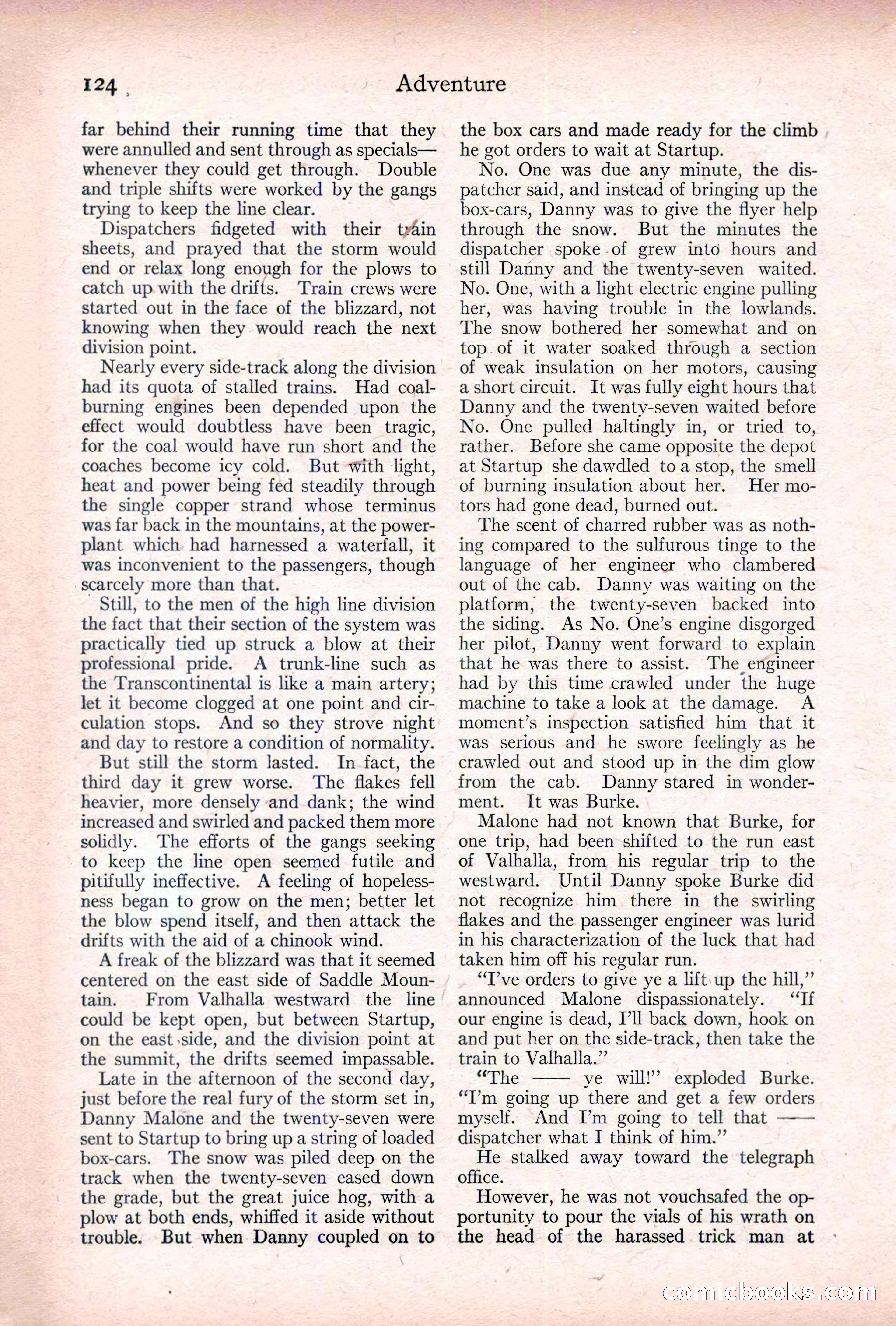
A restored page from Pulp Fiction, 1922. Page through the whole issue in the reader above.
📄 Transcribed text from this page (OCR, searchable)
Machine-transcribed from the original scan — historical spelling and the odd misread are preserved.
124. far behind their running time that they were annulled and sent through as specials— whenever they could get through. Double and triple shifts were worked by the gangs trying to keep the line clear. Dispatchers fidgeted with their ty4in sheets, and prayed that the storm would end or relax long enough for the plows to catch up with the drifts. Train crews were started out in the face of the blizzard, not knowing when they would reach the next division point. Nearly every side-track along the division had its quota of stalled trains. Had coal- burning engines been depended upon the effect would doubtless have been tragic, for the coal would have run short and the coaches become icy cold. But with light, heat and power being fed steadily through the single copper strand whose terminus was far back in the mountains, at the power- plant which. had harnessed a waterfall, it was inconvenient to the passengers, though scarcely more than that. Still, to the men of the high line division the fact that their section of the system was practically tied up struck a blow at their professional pride. A trunk-line such as the Transcontinental is like a main artery; let it become clogged at one point and cir- culation stops. And so they strove night and day to restore a condition of normality. But still the storm lasted. In fact, the third day it grew worse. The flakes fell heavier, more densely ‘and dank; the wind increased and swirled and packed them more solidly. The efforts of the gangs seeking to keep the line open seemed futile and pitifully ineffective. A feeling of hopeless- ness began to grow on the men; better let the blow spend itself, and then attack the drifts with the aid of a chinook wind. A freak of the blizzard was that it seemed centered on the east side of Saddle Moun- tain. From Valhalla westward the line could be kept open, but between Startup, on the eastside, and the division point at the summit, the drifts seemed impassable. Late in the afternoon of the second day, just before the real fury of the storm set in, Danny Malone and the twenty-seven were sent to Startup to bring up a string of loaded box-cars. The snow was piled deep on the track when the twenty-seven eased down the grade, but the great juice hog, with a plow at both ends, whiffed it aside without trouble. But when Danny coupled on to Adventure the box cars and made ready for the climb he got orders to wait at Startup. No. One was due any minute, the dis- patcher said, and instead of bringing up the box-cars, Danny was to give the flyer help through the snow. But the minutes the dispatcher spoke of grew into hours and still Danny and the twenty-seven waited. No. One, with a light electric engine pulling her, was having trouble in the lowlands. The snow bothered her somewhat and on top of it water soaked through a section of weak insulation on her motors, causing a short circuit. It was fully eight hours that Danny and the twenty-seven waited before No. One pulled haltingly in, or tried to, rather. Before she came opposite the depot at Startup she dawdled toa stop, the smell of burning insulation about her. Her mo- tors had gone dead, burned out. The scent of charred rubber was as noth- ing compared to the sulfurous tinge to the language of her engineer who clambered out of the cab. Danny was waiting on the platform, the twenty-seven backed into the siding. As No. One’s engine disgorged her pilot, Danny went forward to explain that he was there to assist. The engineer had by this time crawled under the huge machine to take a look at the damage. A moment’s inspection satisfied him that it was serious and he swore feelingly as he crawled out and stood up in the dim glow from the cab. Danny stared in wonder- ment. It was Burke. Malone had not known that Burke, for one trip, had been shifted to the run east of Valhalla, from his regular trip to the westward. Until Danny spoke Burke did not recognize him there in the swirling flakes and the passenger engineer was lurid in his characterization of the luck that had taken him off his regular run. “T’ve orders to give ye a lift. up the hill,” announced Malone dispassionately. “If our engine is dead, I’ll back down, hook on and put her on the side-track, then take the train to Valhalla.” “The ve will!” exploded Burke. “T’m going up there and get a few orders myself. And I’m going to tell that dispatcher what I think of him.”’ He stalked away toward the telegraph office. However, he was not vouchsafed the op- portunity to pour the vials of his wrath on the head of the harassed trick man at |?? COmmiclboooks (C@