
Pulp Fiction, 1922 · page 127 of 196
Adventure, January 20, 1922 — page 127: what you’re looking at
A restored page from Pulp Fiction, 1922. Page through the whole issue in the reader above.
📄 Transcribed text from this page (OCR, searchable)
Machine-transcribed from the original scan — historical spelling and the odd misread are preserved.
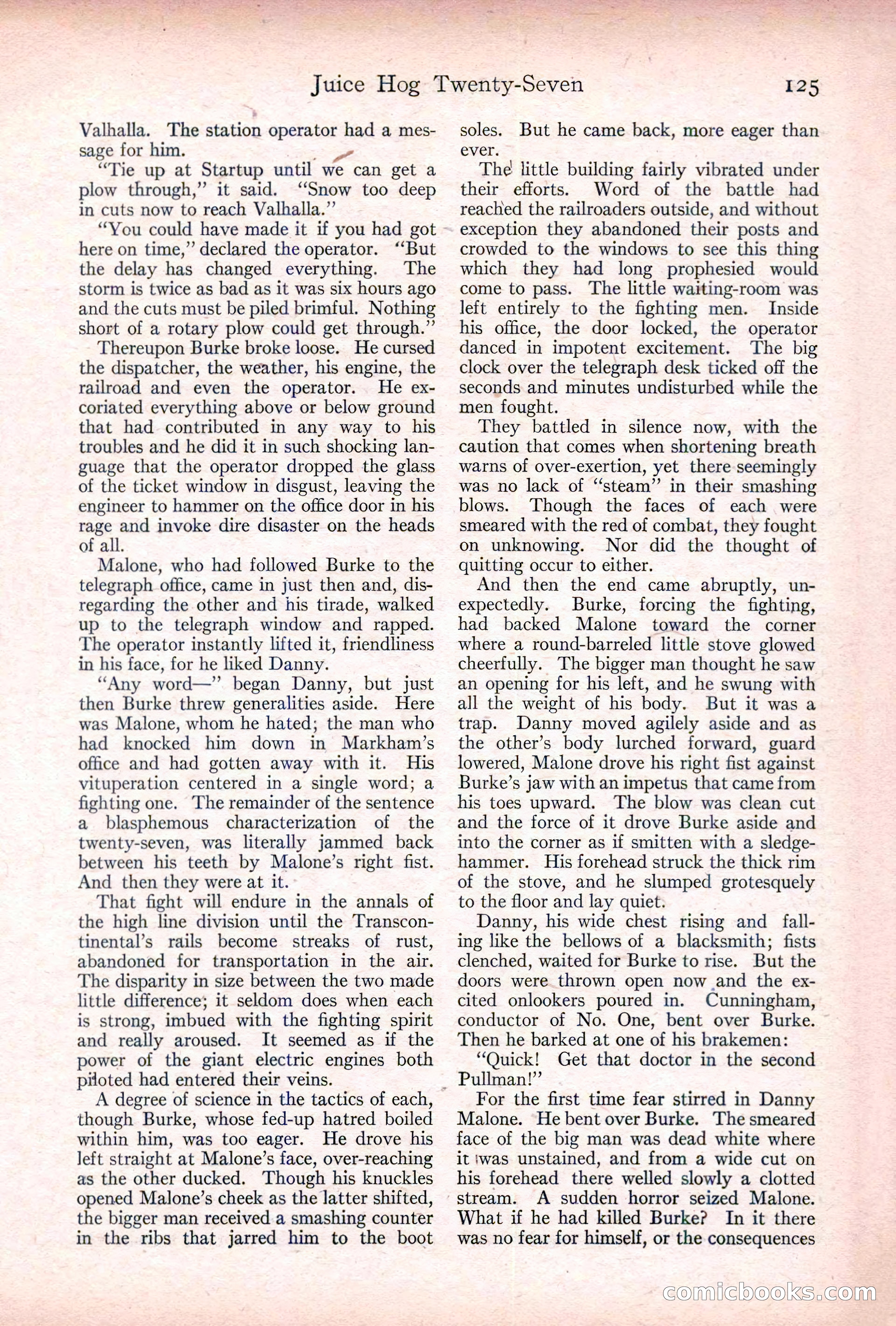
Juice Hog Twenty-Seven Valhalla. The station operator had a mes- sage for him. << “Tie up at Startup until we can get a plow through,” it said. “Snow too deep in cuts now to reach Valhalla.” “You could have made it if you had got here on time,’ declared the operator. “But the delay has changed everything. The storm is twice as bad as it was six hours ago and the cuts must be piled brimful. Nothing short of a rotary plow could get through.”’ Thereupon Burke broke loose. He cursed the dispatcher, the weather, his engine, the railroad and even the operator. He ex- coriated everything above or below ground that had contributed in any way to his troubles and he did it in such shocking lan- guage that the operator dropped the glass of the ticket window in disgust, leaving the engineer to hammer on the office door in his rage and invoke dire disaster on the heads of all. Malone, who had followed Burke to the telegraph office, came in just then and, dis- regarding the other and his tirade, walked up to the telegraph window and rapped. The operator instantly lifted it, friendliness in his face, for he liked Danny. “Any word—” began Danny, but just then Burke threw generalities aside. Here was Malone, whom he hated; the man who had knocked him down in Markham’s office and had gotten away with it. His vituperation centered in a single word; a fighting one. The remainder of the sentence a blasphemous characterization of the twenty-seven, was literally jammed back between his teeth by Malone’s right fist. And then they were at it. That fight will endure in the annals of the high line division until the Transcon- tinental’s rails become streaks of rust, abandoned for transportation in the air. The disparity in size between the two made little difference; it seldom does when each is strong, imbued with the fighting spirit and really aroused. It seemed as if the power of the giant electric engines both piloted had entered their veins. A degree of science in the tactics of each, though Burke, whose fed-up hatred boiled within him, was too eager. He drove his left straight at Malone’s face, over-reaching as the other ducked. Though his knuckles opened Malone’s cheek as the latter shifted, the bigger man received a smashing counter in the ribs that jarred him to the boot 125 soles. But he came back, more eager than ever. The little building fairly vibrated under their efforts. Word of the battle had reached the railroaders outside, and without exception they abandoned their posts and crowded to the windows to see this thing which they had long prophesied would come to pass. The little waiting-room was left entirely to the fighting men. Inside his office, the door locked, the operator danced in impotent excitement. The big clock over the telegraph desk ticked off the seconds and minutes undisturbed while the men fought. They battled in silence now, with the caution that comes when shortening breath warns of over-exertion, yet there seemingly was no lack of “steam” in their smashing blows. Though the faces of each were smeared with the red of combat, they fought on unknowing. Nor did the thought of quitting occur to either. And then the end came abruptly, un- expectedly. Burke, forcing the fighting, had backed Malone toward the corner where a round-barreled little stove glowed cheerfully. The bigger man thought he saw an opening for his left, and he swung with all the weight of his body. But it was a trap. Danny moved agilely aside and as the other’s body lurched forward, guard lowered, Malone drove his right fist against Burke’s jaw with an impetus that came from his toes upward. The blow was clean cut and the force of it drove Burke aside and into the corner as if smitten with a sledge- hammer. His forehead struck the thick rim of the stove, and he slumped grotesquely to the floor and lay quiet. Danny, his wide chest rising and _fall- ing like the bellows of a blacksmith; fists clenched, waited for Burke to rise. But the doors were thrown open now and the ex- cited onlookers poured in. Cunningham, conductor of No. One, bent over Burke. Then he barked at one of his brakemen: “Quick! Get that doctor in the second — Pullman!’’ For the first time fear stirred in Danny Malone. He bent over Burke. The smeared face of the big man was dead white where it was unstained, and from a wide cut on his forehead there welled slowly a clotted stream. A sudden horror seized Malone. What if he had killed Burke? In it there was no fear for himself, or the consequences COmiclboooks (C@