
Pulp Fiction, 1922 · page 111 of 202
Adventure Magazine Cover — page 111: what you’re looking at
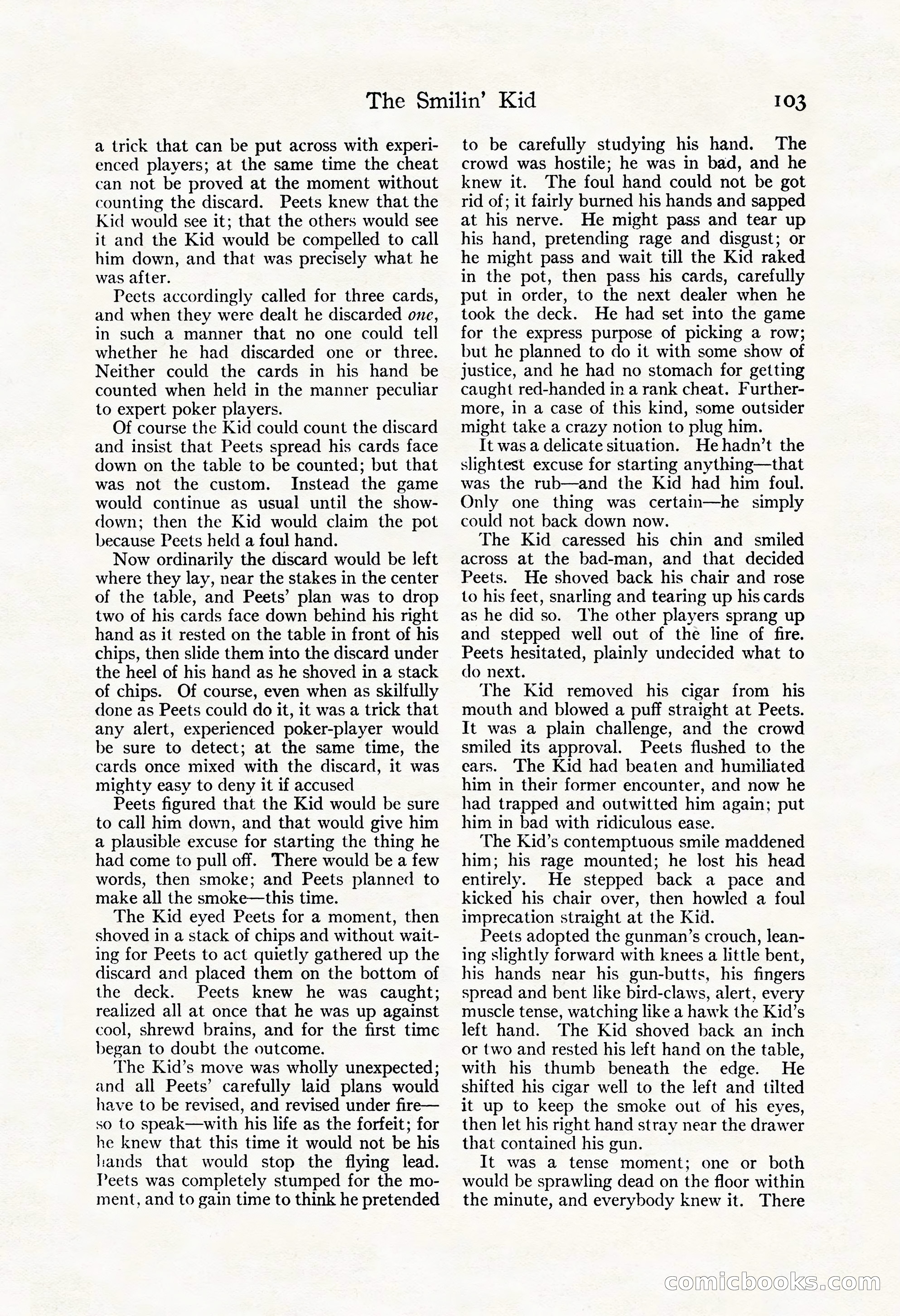
A restored page from Pulp Fiction, 1922. Page through the whole issue in the reader above.
📄 Transcribed text from this page (OCR, searchable)
Machine-transcribed from the original scan — historical spelling and the odd misread are preserved.
The Smilin’ Kid a trick that can be put across with experi- enced players; at the same time the cheat can not be proved at the moment without counting the discard. Peets knew that the Kid would see it; that the others would see it and the Kid would be compelled to call him down, and that was precisely what he was after. Peets accordingly called for three cards, and when they were dealt he discarded one, in such a manner that no one could tell whether he had discarded one or three. Neither could the cards in his hand be counted when held in the manner peculiar to expert poker players. Of course the Kid could count the discard and insist that Peets spread his cards face down on the table to be counted; but that was not the custom. Instead the game would continue as usual until the show- down; then the Kid would claim the pot because Peets held a foul hand. Now ordinarily the discard would be left where they lay, near the stakes in the center of the table, and Peets’ plan was to drop two of his cards face down behind his right hand as it rested on the table in front of his chips, then slide them into the discard under the heel of his hand as he shoved in a stack of chips. Of course, even when as skilfully done as Peets could do it, it was a trick that any alert, experienced poker-player would be sure to detect; at the same time, the cards once mixed with the discard, it was mighty easy to deny it if accused Peets figured that the Kid would be sure to call him down, and that would give him a plausible excuse for starting the thing he had come to pull off. There would be a few words, then smoke; and Peets planned to make all the smoke—this time. The Kid eyed Peets for a moment, then shoved in a stack of chips and without wait- ing for Peets to act quietly gathered up the discard and placed them on the bottom of the deck. Peets knew he was caught; realized all at once that he was up against cool, shrewd brains, and for the first time began to doubt the outcome. The Kid’s move was wholly unexpected; and all Peets’ carefully laid plans would have to be revised, and revised under fire— so to speak—with his life as the forfeit; for he knew that this time it would not be his lands that would stop the flying lead. Peets was completely stumped for the mo- ment, and to gain time to think he pretended 103 to be carefully studying his hand. The crowd was hostile; he was in bad, and he knew it. The foul hand could not be got rid of; it fairly burned his hands and sapped at his nerve. He might pass and tear up his hand, pretending rage and disgust; or he might pass and wait till the Kid raked in the pot, then pass his cards, carefully put in order, to the next dealer when he took the deck. He had set into the game for the express purpose of picking a row; but he planned to do it with some show of justice, and he had no stomach for getting caught red-handed in a rank cheat. Further- more, in a case of this kind, some outsider might take a crazy notion to plug him. It was a delicate situation. Hehadn’t the slightest excuse for starting anything—that was the rub—and the Kid had him foul. Only one thing was certain—he simply could not back down now. The Kid caressed his chin and smiled across at the bad-man, and that decided Peets. He shoved back his chair and rose to his feet, snarling and tearing up his cards as he did so. The other players sprang up and stepped well out of the line of fire. Peets hesitated, plainly undecided what to do next. The Kid removed his cigar from his mouth and blowed a puff straight at Peets. It was a plain challenge, and the crowd smiled its approval. Peets flushed to the ears. The Kid had beaten and humiliated him in their former encounter, and now he had trapped and outwitted him again; put him in bad with ridiculous ease. The Kid’s contemptuous smile maddened him; his rage mounted; he lost his head entirely. He stepped back a pace and kicked his chair over, then howled a foul imprecation straight at the Kid. Peets adopted the gunman’s crouch, lean- ing slightly forward with knees a little bent, his hands near his gun-butts, his fingers spread and bent like bird-claws, alert, every muscle tense, watching like a hawk the Kid’s left hand. The Kid shoved back an inch or two and rested his left hand on the table, with his thumb beneath the edge. He shifted his cigar well to the left and tilted it up to keep the smoke out of his eves, then let his right hand stray near the drawer that contained his gun. It was a tense moment; one or both would be sprawling dead on the floor within the minute, and everybody knew it. There GOMIIGooo S C@