
Pulp Fiction, 1922 · page 121 of 202
Adventure Magazine Cover — page 121: what you’re looking at
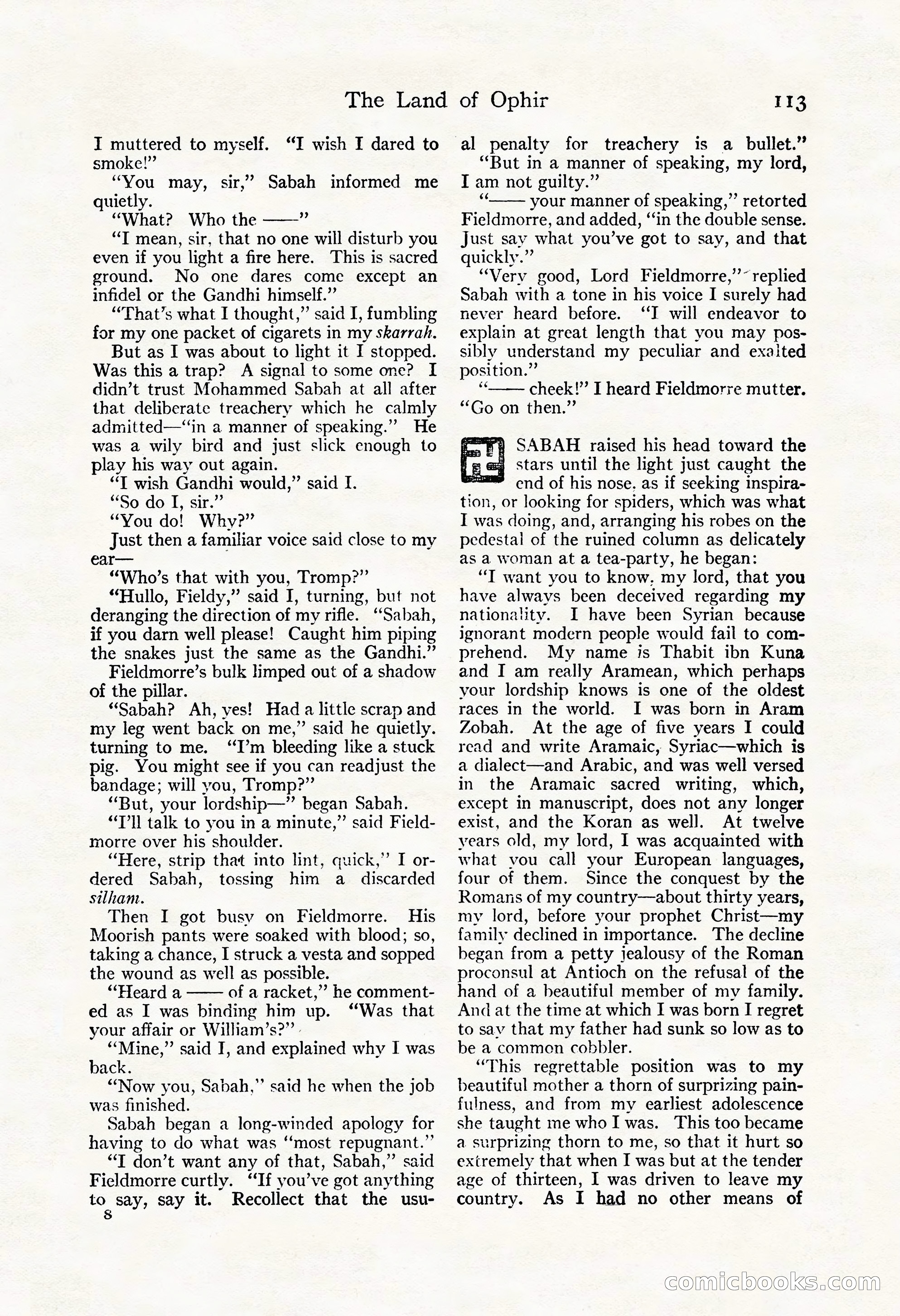
A restored page from Pulp Fiction, 1922. Page through the whole issue in the reader above.
📄 Transcribed text from this page (OCR, searchable)
Machine-transcribed from the original scan — historical spelling and the odd misread are preserved.
The Land I muttered to myself. “I wish I dared to smoke!” “You may, sir,’ Sabah quietly. “What? Who the se “T mean, sir, that no one will disturb you even if you light a fire here. This is sacred ground. No one dares come except an infidel or the Gandhi himself.” “‘That’s what I thought,” said I, fumbling for my one packet of cigarets in my skarrah. But as I was about to light it I stopped. Was this a trap? A signal to some one? I didn’t trust Mohammed Sabah at all after that deliberate treachery which he calmly admitted—“in a manner of speaking.” He was a wily bird and just slick enough to play his way out again. “T wish Gandhi would,” said I. “So do I, sir.” “You do! Why?” Just then a familiar voice said close to my ear— “Who’s that with you, Tromp?” “Hullo, Fieldy,” said I, turning, but not deranging the direction of my rifle. “Sabah, if you darn well please! Caught him piping the snakes just the same as the Gandhi.” Fieldmorre’s bulk limped out of a shadow of the pillar. “Sabah? Ah, ves! Had a little scrap and my leg went back on me,” said he quietly. turning to me. “I’m bleeding like a stuck pig. You might see if you can readjust the bandage; will you, Tromp?” “But, your lordship—” began Sabah. “T’ll talk to you in a minute,” said Field- morre over his shoulder. “Here, strip that into lint, quick,’ I or- dered Sabah, tossing him a_ discarded silhant. Then I got busv on Fieldmorre. His Moorish pants were soaked with blood; so, taking a chance, I struck a vesta and sopped the wound as well as possible. “Heard a of a racket,”’ he comment- ed as I was binding him up. “Was that your affair or William’s?”’ - “Mine,” said I, and explained why I was back. “‘Now you, Sabah,”’ said he when the job was finished. Sabah began a long-winded apology for having to do what was “‘most repugnant.” “T don’t want any of that, Sabah,” said Fieldmorre curtly. “If you’ve got anything my say, say it. Recollect that the usu- informed me of Ophir 113 al penalty for treachery is a bullet.” “But in a manner of speaking, my lord, I am not guilty.” = your manner of speaking,” retorted Fieldmorre, and added, ‘‘in the double sense. Just say what you’ve got to say, and that quickly.” ‘“Verv good, Lord Fieldmorre,’’~ replied Sabah with a tone in his voice I surely had never heard before. ‘J will endeavor to explain at great length that you may pos- sibly understand my peculiar and exaited position.” cheek!” I heard Fieldmorre mutter. “Go on then.” EF} SABAH raised his head toward the fe @, Stars until the light just caught the sme ond of his nose. as if seeking inspira- tion, or looking for spiders, which was what I was doing, and, arranging his robes on the pedestal of the ruined column as delicately as a woman at a tea-party, he began: “T want you to know. my lord, that you have alwavs been deceived regarding my nationality. I have been Syrian because ignorant modern people would fail to com- prehend. My name is Thabit ibn Kuna and I am really Aramean, which perhaps your lordship knows is one of the oldest races In the world. I was born in Aram Zobah. At the age of five years I could read and write Aramaic, Syriac—which is a dialect—and Arabic, and was well versed in the Aramaic sacred writing, which, except In manuscript, does not any longer exist, and the Koran as well. At twelve vears old, my lord, I was acquainted with what vou call your European languages, four of them. Since the conquest by the Romans of my country—about thirty years, my lord, before your prophet Christ—my family declined in importance. The decline began from a petty jealousy of the Roman proconsul at Antioch on the refusal of the hand of a beautiful member of mv family. And at the time at which I was born I regret to sav that my father had sunk so low as to be a common cobbler. “This regrettable position was to my beautiful mother a thorn of surprizing pain- fulness, and from my earliest adolescence she taught me whoI was. This too became a surprizing thorn to me, so that it hurt so extremely that when I was but at the tender age of thirteen, I was driven to leave my country. As I had no other means of C@ DOOK S C@ iin