
Pulp Fiction, 1922 · page 140 of 202
Adventure Magazine Cover — page 140: what you’re looking at
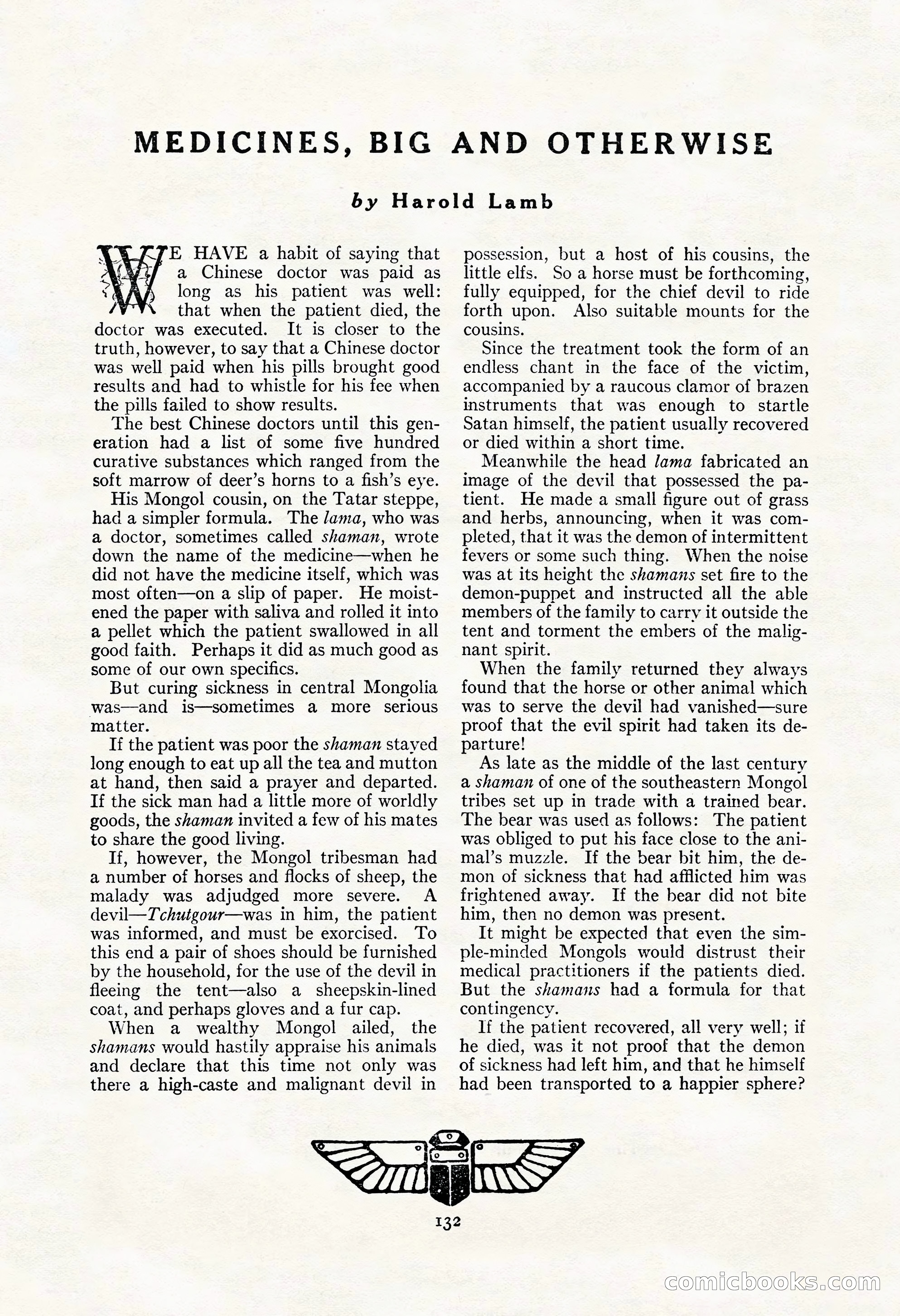
A restored page from Pulp Fiction, 1922. Page through the whole issue in the reader above.
📄 Transcribed text from this page (OCR, searchable)
Machine-transcribed from the original scan — historical spelling and the odd misread are preserved.
MEDICINES, BIG AND OTHERWISE by Harold Lamb TE HAVE a habit of saying that a Chinese doctor was paid as long as his patient was well: that when the patient died, the doctor was executed. It is closer to the truth, however, to say that a Chinese doctor was well paid when his pills brought good results and had to whistle for his fee when the pills failed to show results. The best Chinese doctors until this gen- eration had a list of some five hundred curative substances which ranged from the soft marrow of deer’s horns to a fish’s eye. His Mongol cousin, on the Tatar steppe, had a simpler formula. The Jama, who was a doctor, sometimes called shaman, wrote down the name of the medicine—when he did not have the medicine itself, which was most often—on a slip of paper. He moist- ened the paper with saliva and rolled it into a pellet which the patient swallowed in all good faith. Perhaps it did as much good as some of our own specifics. But curing sickness in central Mongolia was—and is—sometimes a more serious matter. If the patient was poor the shaman stayed long enough to eat up all the tea and mutton at hand, then said a prayer and departed. If the sick man had a little more of worldly goods, the shaman invited a few of his mates to share the good living. If, however, the Mongol tribesman had a number of horses and flocks of sheep, the malady was adjudged more severe. A devil—Tchutgour—was in him, the patient was informed, and must be exorcised. To this end a pair of shoes should be furnished by the household, for the use of the devil in fleeing the tent—also a_ sheepskin-lined coat, and perhaps gloves and a fur cap. When a wealthy Mongol ailed, the shamans would hastily appraise his animals and declare that this time not only was there a high-caste and malignant devil in Sig possession, but a host of his cousins, the little elfs. So a horse must be forthcoming, fully equipped, for the chief devil to ride forth upon. Also suitable mounts for the cousins. Since the treatment took the form of an endless chant in the face of the victim, accompanied by a raucous clamor of brazen instruments that was enough to startle Satan himself, the patient usually recovered or died within a short time. Meanwhile the head Jama fabricated an image of the devil that possessed the pa- tient. He made a small figure out of grass and herbs, announcing, when it was com- pleted, that it was the demon of intermittent fevers or some such thing. When the noise was at its height the skamams set fire to the demon-puppet and instructed all the able members of the family to carry it outside the tent and torment the embers of the malig- nant spirit. When the family returned they always found that the horse or other animal which was to serve the devil had vanished—sure proof that the evil spirit had taken its de- parture! As late as the middle of the last century a shaman of one of the southeastern Mongol tribes set up in trade with a trained bear. The bear was used as follows: The patient was obliged to put his face close to the ani- mal’s muzzle. If the bear bit him, the de- mon of sickness that had afflicted him was frightened away. If the bear did not bite him, then no demon was present. It might be expected that even the sim- ple-minded Mongols would distrust their medical practitioners if the patients died. But the shamans had a formula for that contingency. lf the patient recovered, all very well; if he died, was it not proof that the demon of sickness had left him, and that he himself had been transported to a happier sphere? GOMIIGooOo S (©