
Pulp Fiction, 1922 · page 145 of 202
Adventure Magazine Cover — page 145: what you’re looking at
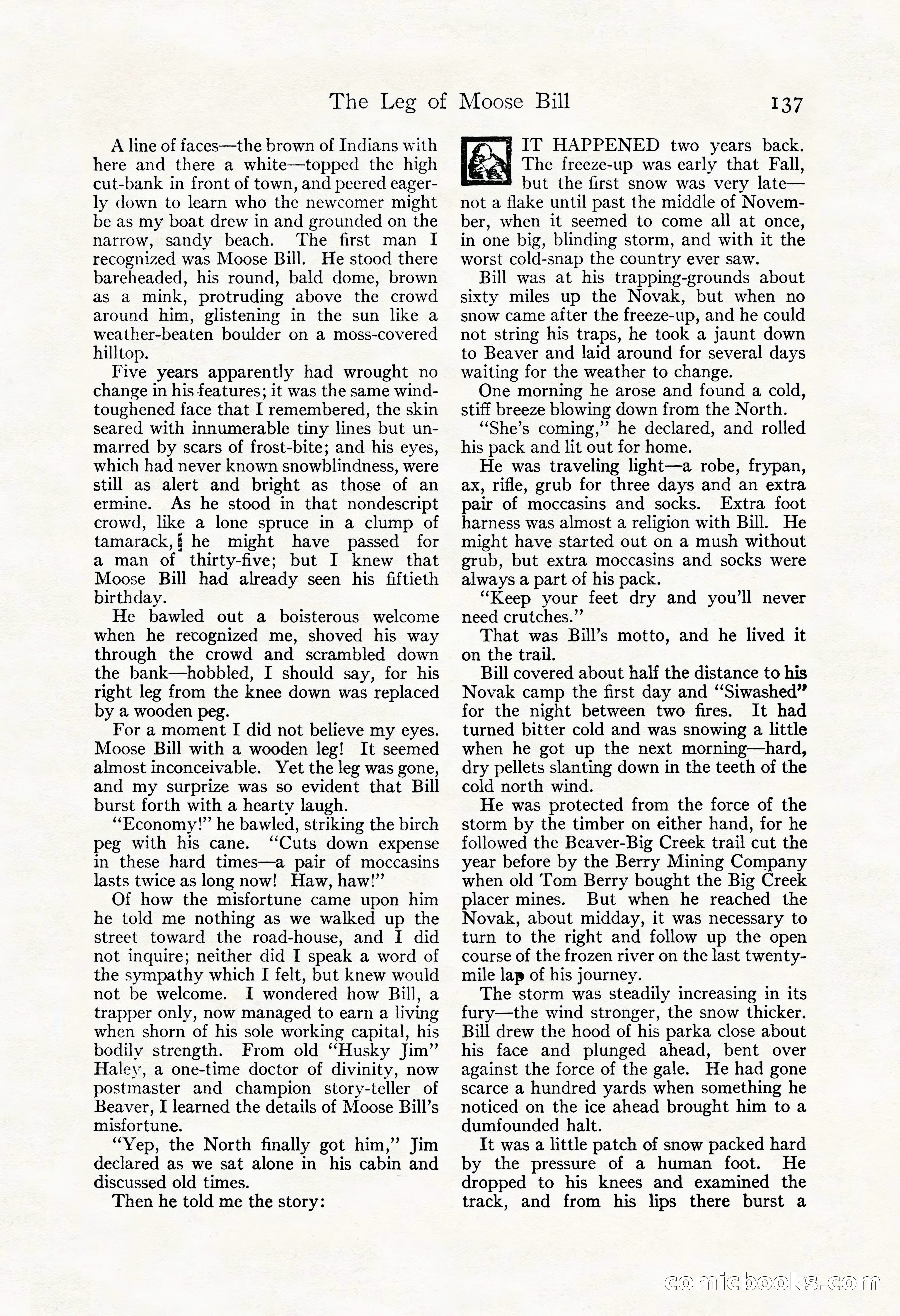
A restored page from Pulp Fiction, 1922. Page through the whole issue in the reader above.
📄 Transcribed text from this page (OCR, searchable)
Machine-transcribed from the original scan — historical spelling and the odd misread are preserved.
The Leg of Moose Bill A line of faces—the brown of Indians with here and there a white—topped the high cut-bank in front of town, and peered eager- ly down to learn who the newcomer might be as my boat drew in and grounded on the narrow, sandy beach. The first man I recognized was Moose Bill. He stood there bareheaded, his round, bald dome, brown as a mink, protruding above the crowd around him, glistening in the sun like a weather-beaten boulder on a moss-covered hilltop. Five years apparently had wrought no change in his features; it was the same wind- toughened face that I remembered, the skin seared with innumerable tiny lines but un- marred by scars of frost-bite; and his eyes, which had never known snowblindness, were still as alert and bright as those of an ermine. As he stood in that nondescript crowd, like a lone spruce in a clump of tamarack,{ he might have passed for a man of thirty-five; but I knew that Moose Bill had already seen his fiftieth birthday. He bawled out a boisterous welcome when he recognized me, shoved his way through the crowd and scrambled down the bank—hobbled, I should say, for his right leg from the knee down was replaced by a wooden peg. For a moment I did not believe my eyes. Moose Bill with a wooden leg! It seemed almost inconceivable. Yet the leg was gone, and my surprize was so evident that Bill burst forth with a hearty laugh. “Economy!”’ he bawled, striking the birch peg with his cane. “Cuts down expense in these hard times—a pair of moccasins lasts twice as long now! Haw, haw!” Of how the misfortune came upon him he told me nothing as we walked up the street toward the road-house, and I did not inquire; neither did I speak a word of the sympathy which I felt, but knew would not be welcome. I wondered how Bill, a trapper only, now managed to earn a living when shorn of his sole working capital, his bodily strength. From old ‘‘Husky Jim” Haley, a one-time doctor of divinity, now postmaster and champion story-teller of Beaver, I learned the details of Moose Bill’s misfortune. “Yep, the North finally got him,” Jim declared as we sat alone in his cabin and discussed old times. Then he told me the story: 137 # IT HAPPENED two years back. The freeze-up was early that Fall, = but the first snow was very late— not a flake until past the middle of Novem- ber, when it seemed to come all at once, in one big, blinding storm, and with it the worst cold-snap the country ever saw. Bill was at his trapping-grounds about sixty miles up the Novak, but when no snow came after the freeze-up, and he could not string his traps, he took a jaunt down to Beaver and laid around for several days waiting for the weather to change. One morning he arose and found a cold, stiff breeze blowing down from the North. ‘“She’s coming,” he declared, and rolled his pack and lit out for home. He was traveling light—a robe, frypan, ax, rifle, grub for three days and an extra pair of moccasins and socks. Extra foot harness was almost a religion with Bill. He might have started out on a mush without grub, but extra moccasins and socks were always a part of his pack. “Keep your feet dry and you'll never need crutches.”’ That was Bill’s motto, and he lived it on the trail. Bill covered about half the distance to his Novak camp the first day and “‘Siwashed” for the night between two fires. It had turned bitter cold and was snowing a little when he got up the next morning—hard, dry pellets slanting down in the teeth of the cold north wind. He was protected from the force of the storm by the timber on either hand, for he followed the Beaver-Big Creek trail cut the year before by the Berry Mining Company when old Tom Berry bought the Big Creek placer mines. But when he reached the Novak, about midday, it was necessary to turn to the right and follow up the open course of the frozen river on the last twenty- mile lap of his journey. The storm was steadily increasing in its fury—the wind stronger, the snow thicker. Bill drew the hood of his parka close about his face and plunged ahead, bent over against the force of the gale. He had gone scarce a hundred yards when something he noticed on the ice ahead brought him to a dumfounded halt. It was a little patch of snow packed hard by the pressure of a human foot. He dropped to his knees and examined the track, and from his lips there burst a | ge y GOMIIGooOo S C@