
Pulp Fiction, 1922 · page 154 of 202
Adventure Magazine Cover — page 154: what you’re looking at
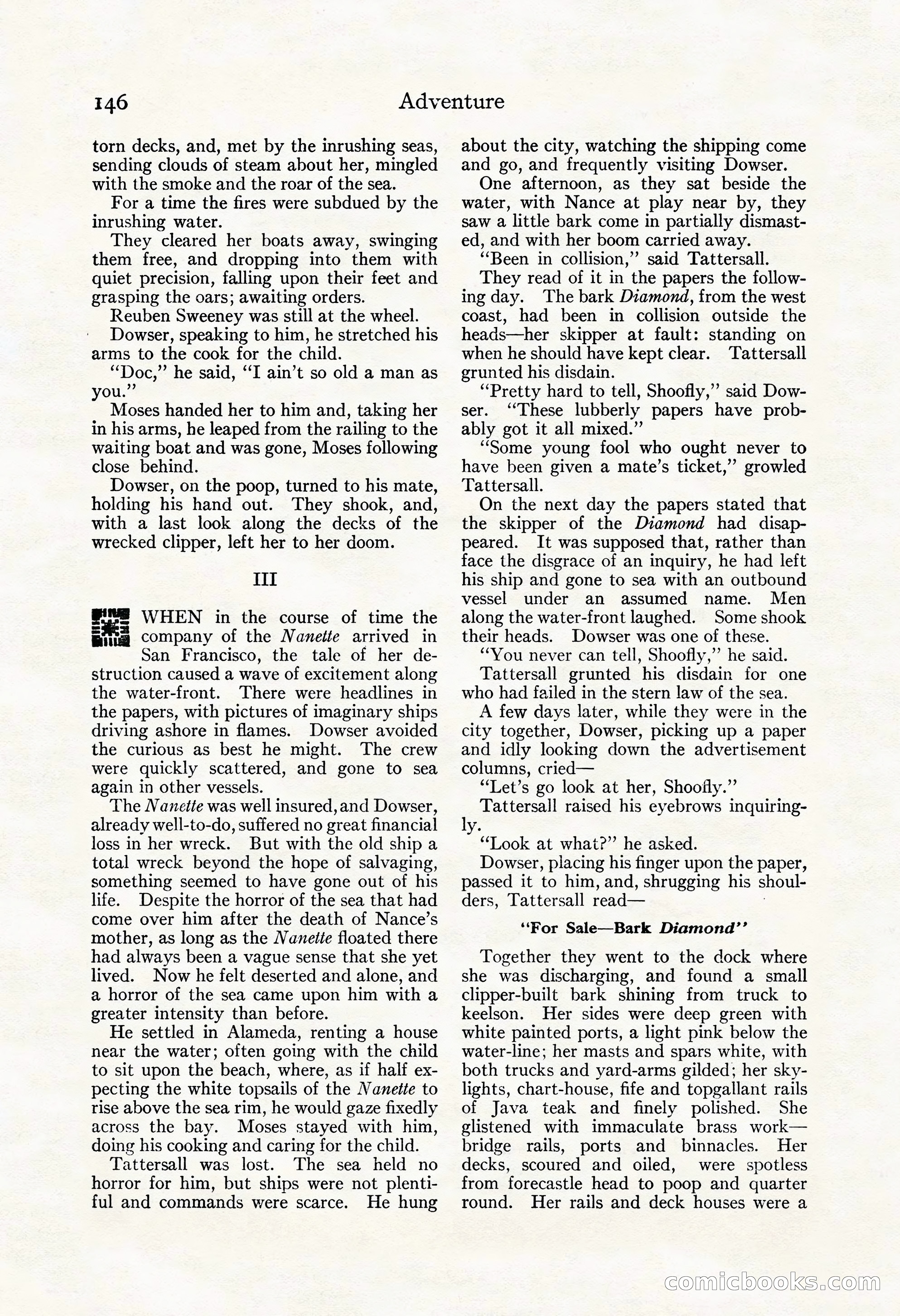
A restored page from Pulp Fiction, 1922. Page through the whole issue in the reader above.
📄 Transcribed text from this page (OCR, searchable)
Machine-transcribed from the original scan — historical spelling and the odd misread are preserved.
146 torn decks, and, met by the inrushing seas, sending clouds of steam about her, mingled with the smoke and the roar of the sea. For a time the fires were subdued by the inrushing water. They cleared her boats away, swinging them free, and dropping into them with quiet precision, falling upon their feet and grasping the oars; awaiting orders. Reuben Sweeney was still at the wheel. Dowser, speaking to him, he stretched his arms to the cook for the child. “Doc,” he said, ‘‘I ain’t so old a man as you.” Moses handed her to him and, taking her in his arms, he leaped from the railing to the waiting boat and was gone, Moses following close behind. Dowser, on the poop, turned to his mate, holding his hand out. They shook, and, with a last look along the decks of the wrecked clipper, left her to her doom. III us WHEN in the course of time the Big company of the Nanette arrived in San Francisco, the tale of her de- struction caused a wave of excitement along the water-front. There were headlines in the papers, with pictures of imaginary ships driving ashore in flames. Dowser avoided the curious as best he might. The crew were quickly scattered, and gone to sea again in other vessels. The Nanette was well insured, and Dowser, already well-to-do, suffered no great financial loss in her wreck. But with the old ship a total wreck beyond the hope of salvaging, something seemed to have gone out of his life. Despite the horror of the sea that had come over him after the death of Nance’s mother, as long as the NVaneiie floated there had always been a vague sense that she yet lived. Now he felt deserted and alone, and a horror of the sea came upon him with a greater intensity than before. He settled in Alameda, renting a house near the water; often going with the child to sit upon the beach, where, as if half ex- pecting the white topsails of the Nanette to rise above the sea rim, he would gaze fixedly across the bay. Moses stayed with him, doing his cooking and caring for the child. Tattersall was lost. The sea held no horror for him, but ships were not plenti- ful and commands were scarce. He hung Adventure about the city, watching the shipping come and go, and frequently visiting Dowser. One afternoon, as they sat beside the water, with Nance at play near by, they saw a little bark come in partially dismast- ed, and with her boom carried away. ‘‘Been in collision,” said Tattersall. They read of it in the papers the follow- ing day. The bark Diamond, from the west coast, had been in collision outside the heads—her skipper at fault: standing on when he should have kept clear. Tattersall grunted his disdain. “Pretty hard to tell, Shoofly,”’ said Dow- ser. ‘“‘These lubberly papers have prob- ably got it all mixed.” ‘Some young fool who ought never to have been given a mate’s ticket,’ growled Tattersall. On the next day the papers stated that the skipper of the Diamond had disap- peared. It was supposed that, rather than face the disgrace of an inquiry, he had left his ship and gone to sea with an outbound vessel under an assumed name. Men along the water-front laughed. Some shook their heads. Dowser was one of these. “You never can tell, Shoofly,” he said. Tattersall grunted his disdain for one who had failed in the stern law of the sea. A few days later, while they were in the city together, Dowser, picking up a paper and idly looking down the advertisement columns, cried— ““Let’s go look at her, Shoofly.”’ Tattersall raised his eyebrows inquiring- ly. “Look at what?” he asked. Dowser, placing his finger upon the paper, passed it to him, and, shrugging his shoul- ders, Tattersall read— | ‘‘For Sale—Bark Diamond’’ Together they went to the dock where she was discharging, and found a small clipper-built bark shining from truck to keelson. Her sides were deep green with white painted ports, a light pink below the water-line; her masts and spars white, with both trucks and yard-arms gilded; her sky- lights, chart-house, fife and topgallant rails of Java teak and finely polished. She glistened with immaculate brass work— bridge rails, ports and binnacles. Her decks, scoured and oiled, were spotless from forecastle head to poop and quarter round. Her rails and deck houses were a GOMIIGooOo <S) (©