
Pulp Fiction, 1922 · page 164 of 202
Adventure Magazine Cover — page 164: what you’re looking at
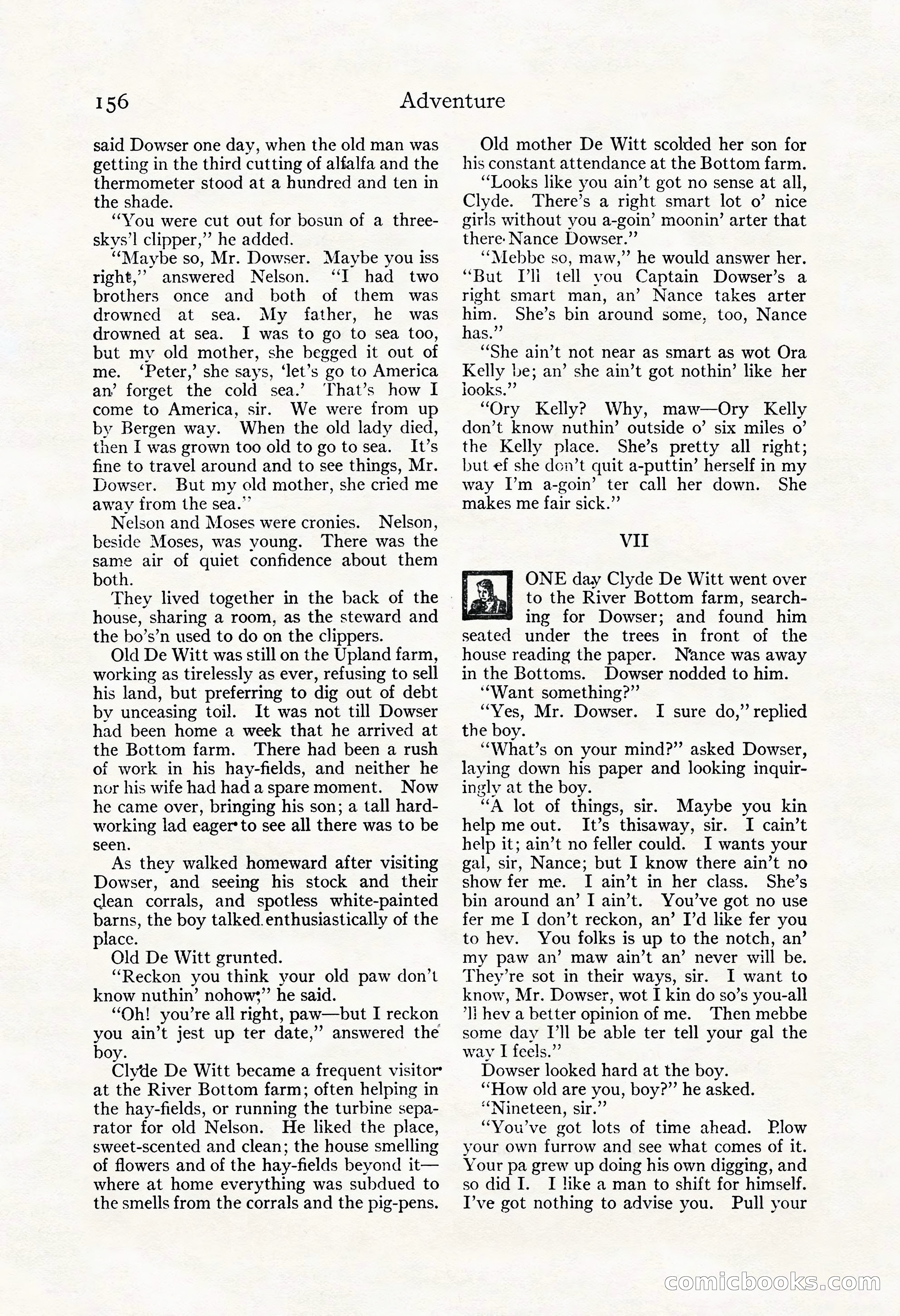
A restored page from Pulp Fiction, 1922. Page through the whole issue in the reader above.
📄 Transcribed text from this page (OCR, searchable)
Machine-transcribed from the original scan — historical spelling and the odd misread are preserved.
156 said Dowser one day, when the old man was getting in the third cutting of alfalfa and the thermometer stood at a hundred and ten in the shade. “You were cut out for bosun of a three- skys’l clipper,’ he added. “Maybe so, Mr. Dowser. Maybe you iss right,’ answered Nelson. “I had two brothers once and both of them was drowned at sea. My father, he was drowned at sea. I was to go to sea too, but my old mother, she begged it out of me. ‘Peter,’ she says, ‘let’s go to America an’ forget the cold sea.’ That’s how I come to America, sir. We were from up by Bergen way. When the old lady died, then I was grown too old to go to sea. It’s fine to travel around and to see things, Mr. Dowser. But my old mother, she cried me away from the sea.”’ Nelson and Moses were cronies. Nelson, beside Moses, was young. ‘There was the same air of quiet confidence about them both. house, sharing a room, as the steward and the bo’s’n used to do on the clippers. Old De Witt was still on the Upland farm, working as tirelessly as ever, refusing to sell his land, but preferring to dig out of debt by unceasing toil. It was not till Dowser had been home a week that he arrived at the Bottom farm. ‘There had been a rush of work in his hay-fields, and neither he ior his wife had had a spare moment. Now he came over, bringing his son; a tall hard- working lad eager*to see all there was to be seen. As they walked homeward after visiting Dowser, and seeing his stock and their clean corrals, and spotless white-painted barns, the boy talked. enthusiastically of the lace. Old De Witt grunted. “Reckon you think your old paw don’t know nuthin’ nohow;” he said. “Oh! youre all right, paw—but I reckon you ain’t jest up ter date,’’ answered the boy. Clyde De Witt became a frequent visitor at the River Bottom farm; often helping in the hay-fields, or running the turbine sepa- rator for old Nelson. He liked the place, sweet-scented and clean; the house smelling of flowers and of the hay-fields beyond it— where at home everything was subdued to the smells from the corrals and the pig-pens. They lived together in the back of the - f <4 Adventure Old mother De Witt scolded her son for his constant attendance at the Bottom farm. “Looks like you ain’t got no sense at all, Clyde. There’s a right smart lot o’ nice girls without you a-goin’ moonin’ arter that there: Nance Dowser.”’ ‘“Mebbe so, maw,” he would answer her. “But Dili tell vou Captain Dowser’s a right smart man, an’ Nance takes arter him. She’s bin around some, too, Nance has.” “She ain’t not near as smart as wot Ora Kelly be; an’ she ain’t got nothin’ like her looks.” “Ory Kelly? Why, maw—Ory Kelly don’t know nuthin’ outside o’ six miles o’ the Kelly place. She’s pretty all right; but ef she don’t quit a-puttin’ herself in my way I’m a-goin’ ter call her down. She makes me fair sick.” VII ONE day Clyde De Witt went over to the River Bottom farm, search- ing for Dowser; and found him seated under the trees in front of the house reading the paper. Nance was away in the Bottoms. Dowser nodded to him. “Want something?”’ “Yes, Mr. Dowser. the boy. ‘“‘What’s on your mind?” asked Dowser, laying down his paper and looking inquir- ingly at the boy. “A lot of things, sir. Maybe you kin help me out. It’s thisaway, sir. I cain’t help it; ain’t no feller could. I wants your gal, sir, Nance; but I know there ain’t no show fer me. I ain’t in her class. She’s bin around an’ I ain’t. You’ve got no use fer me I don’t reckon, an’ I’d like fer you to hev. You folks is up to the notch, an’ my paw an’ maw ain’t an’ never will be. They’re sot in their ways, sir. I want to know, Mr. Dowser, wot I kin do so’s you-all li hev a better opinion of me. Then mebbe some day I'll be able ter tell your gal the way I feels.” Dowser looked hard at the boy. “How old are you, boy?” he asked. ‘Nineteen, sir.” “Vou’ve got lots of time ahead. Plow your own furrow and see what comes of it. Your pa grew up doing his own digging, and so did I. I like a man to shift for himself. I’ve got nothing to advise you. Pull your I sure do,” replied CoOmnilcloooks C@