
Pulp Fiction, 1922 · page 175 of 202
Adventure Magazine Cover — page 175: what you’re looking at
A restored page from Pulp Fiction, 1922. Page through the whole issue in the reader above.
📄 Transcribed text from this page (OCR, searchable)
Machine-transcribed from the original scan — historical spelling and the odd misread are preserved.
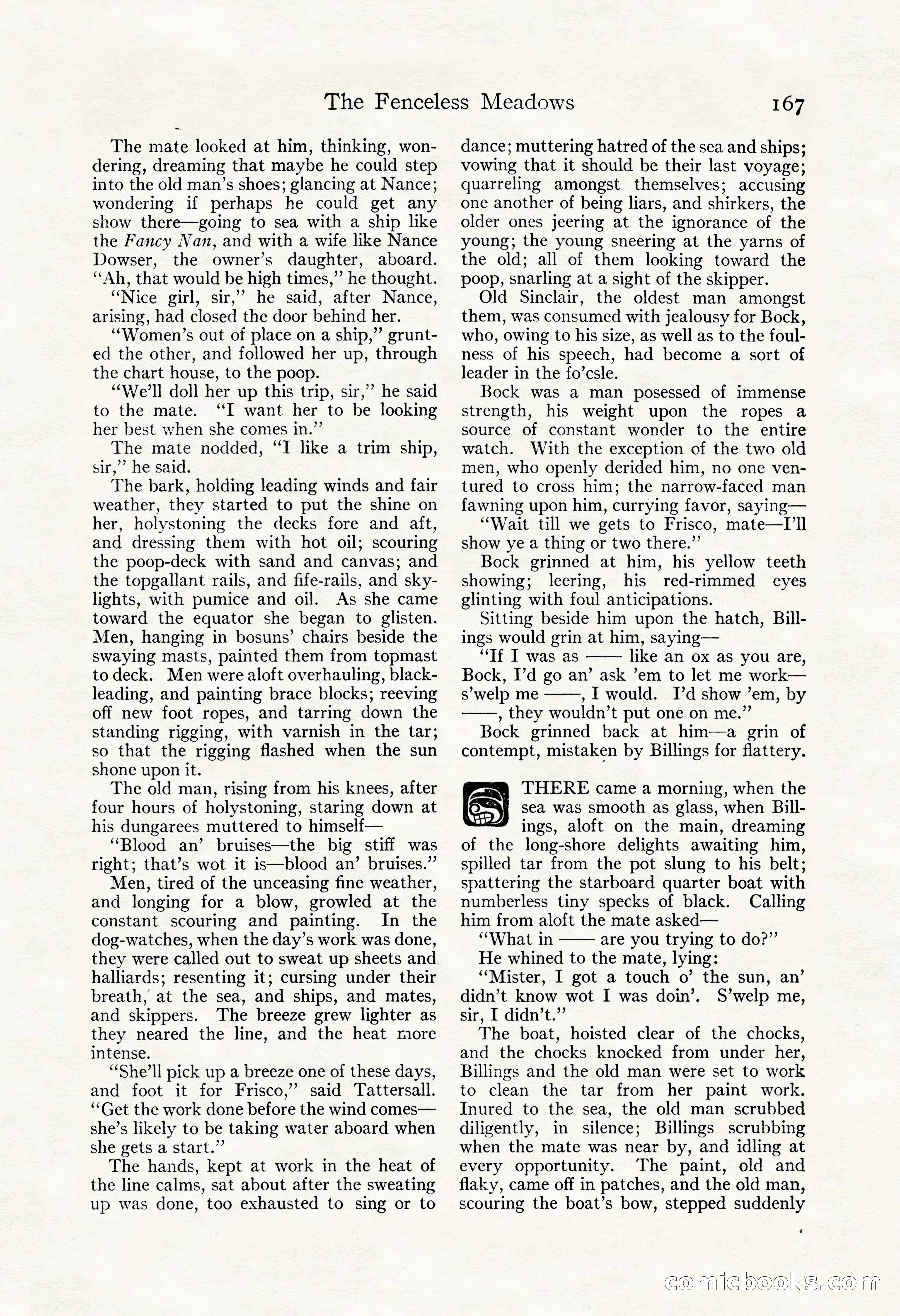
The Fenceless Meadows ~ The mate looked at him, thinking, won- dering, dreaming that maybe he could step into the old man’s shoes; glancing at Nance; wondering if perhaps he could get any show there—going to sea with a ship like the Fancy Nan, and with a wife like Nance Dowser, the owner’s daughter, aboard. ‘“‘Ah, that would be high times,” he thought. “Nice girl, sir,’ he said, after Nance, arising, had closed the door behind her. ‘“‘Women’s out of place on a ship,” grunt- ed the other, and followed her up, through the chart house, to the poop. “We'll doll her up this trip, sir,” he said to the mate. ‘I want her to be looking her best when she comes in.” The mate nodded, “I like a trim ship, sir,” he said. The bark, holding leading winds and fair weather, they started to put the shine on her, holystoning the decks fore and aft, and dressing them with hot oil; scouring the poop-deck with sand and canvas; and the topgallant rails, and fife-rails, and sky- lights, with pumice and oil. As she came toward the equator she began to glisten. Men, hanging in bosuns’ chairs beside the swaying masts, painted them from topmast to deck. Men were aloft overhauling, black- leading, and painting brace blocks; reeving off new foot ropes, and tarring down the standing rigging, with varnish in the tar; so that the rigging flashed when the sun shone upon it. The old man, rising from his knees, after four hours of holystoning, staring down at his dungarees muttered to himself— “Blood an’ bruises—the big stiff was right; that’s wot it is—blood an’ bruises.” Men, tired of the unceasing fine weather, and longing for a blow, growled at the constant scouring and painting. In the dog-watches, when the day’s work was done, they were called out to sweat up sheets and halliards; resenting it; cursing under their breath, at the sea, and ships, and mates, and skippers. The breeze grew lighter as they neared the line, and the heat more intense. “‘She’ll pick up a breeze one of these days, and foot it for Frisco,” said Tattersall. ‘‘Get the work done before the wind comes— she’s likely to be taking water aboard when she gets a start.” The hands, kept at work in the heat of the line calms, sat about after the sweating up was done, too exhausted to sing or to 167 dance; muttering hatred of the sea and ships; vowing that it should be their last voyage; quarreling amongst themselves; accusing one another of being liars, and shirkers, the older ones jeering at the ignorance of the young; the young sneering at the yarns of the old; all of them looking toward the poop, snarling at a sight of the skipper. Old Sinclair, the oldest man amongst them, was consumed with jealousy for Bock, who, owing to his size, as well as to the foul- ness of his speech, had become a sort of leader in the fo’csle. Bock was a man posessed of immense strength, his weight upon the ropes a source of constant wonder to the entire watch. With the exception of the two old men, who openly derided him, no one ven- tured to cross him; the narrow-faced man fawning upon him, currying favor, saying— “Wait till we gets to Frisco, mate—I’ll show ye a thing or two there.”’ Bock grinned at him, his yellow teeth showing; leering, his red-rimmed eyes glinting with foul anticipations. Sitting beside him upon the hatch, Bill- ings would grin at him, saying— “Tf I was as like an ox as you are, Bock, I’d go an’ ask ’em to let me work— s’welp me , | would. I’d show ’em, by , they wouldn’t put one on me.” Bock grinned back at him—a grin of contempt, mistaken by Billings for flattery. § THERE came a morning, when the “\f sea was smooth as glass, when Bill- <# ings, aloft on the main, dreaming of the long-shore delights awaiting him, spilled tar from the pot slung to his belt; spattering the starboard quarter boat with numberless tiny specks of black. Calling him from aloft the mate asked— ‘What in are you trying to do?” He whined to the mate, lying: ‘Mister, I got a touch o’ the sun, an’ didn’t know wot I was doin’. S’welp me, sir, I didn’t.” The boat, hoisted clear of the chocks, and the chocks knocked from under her, Billings and the old man were set to work to clean the tar from her paint work. Inured to the sea, the old man scrubbed diligently, in silence; Billings scrubbing when the mate was near by, and idling at every opportunity. The paint, old and flaky, came off in patches, and the old man, scouring the boat’s bow, stepped suddenly € Conn DOOKS © iin