
Pulp Fiction, 1922 · page 180 of 202
Adventure Magazine Cover — page 180: what you’re looking at
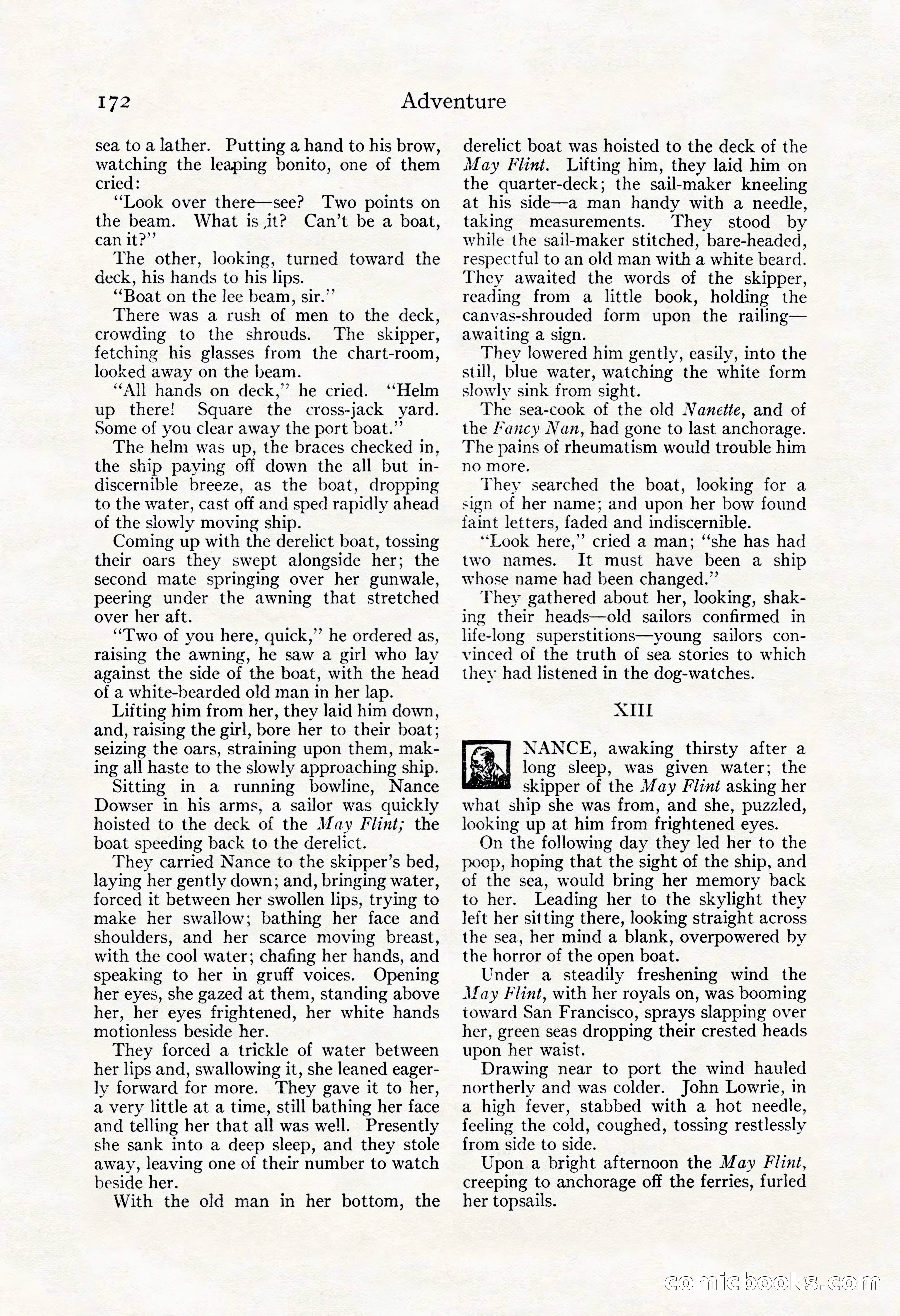
A restored page from Pulp Fiction, 1922. Page through the whole issue in the reader above.
📄 Transcribed text from this page (OCR, searchable)
Machine-transcribed from the original scan — historical spelling and the odd misread are preserved.
172 sea toa lather. Putting a hand to his brow, watching the leaping bonito, one of them cried: “Look over there—see? Two points on the beam. What is it? Can’t be a boat, can it?”’ The other, looking, turned toward the deck, his hands to his lips. ‘“‘Boat on the lee beam, sir.”’ There was a rush of men to the deck, crowding to the shrouds. The skipper, fetching his glasses from the chart-room, looked away on the beam. ‘“‘All hands on deck,” he cried. ‘‘Helm up there! Square the cross-jack yard. Some of you clear away the port boat.” The helm was up, the braces checked in, the ship paying off down the all but in- discernible breeze, as the boat, dropping to the water, cast off and sped rapidly ahead of the slowly moving ship. Coming up with the derelict boat, tossing their oars they swept alongside her; the second mate springing over her gunwale, peering under the awning that stretched over her aft. “Two of you here, quick,” he ordered as, raising the awning, he saw a girl who lay against the side of the boat, with the head of a white-bearded old man in her lap. Lifting him from her, they laid him down, and, raising the girl, bore her to their boat; seizing the oars, straining upon them, mak- ing all haste to the slowly approaching ship. Sitting in a running bowline, Nance Dowser in his arms, a sailor was quickly hoisted to the deck of the May Flint; the boat speeding back to the derelict. They carried Nance to the skipper’s bed, laying her gently down; and, bringing water, forced it between her swollen lips, trying to make her swallow; bathing her face and shoulders, and her scarce moving breast, with the cool water; chafing her hands, and speaking to her in gruff voices. Opening her eyes, she gazed at them, standing above her, her eyes frightened, her white hands motionless beside her. They forced a trickle of water between her lips and, swallowing it, she leaned eager- ly forward for more. They gave it to her, a very little at a time, still bathing her face and telling her that all was well. Presently she sank into a deep sleep, and they stole away, leaving one of their number to watch beside her. With the old man in her bottom, the Adventure derelict boat was hoisted to the deck of the May Flint. Lifting him, they laid him on the quarter-deck; the sail-maker kneeling at his side—a man handy with a needle, taking measurements. They stood by while the sail-maker stitched, bare-headed, respectful to an old man with a white beard. They awaited the words of the skipper, reading from a little book, holding the canvas-shrouded form upon the railing— awaiting a sign. Thev lowered him gently, easily, into the sull, blue water, watching the white form slowly sink from sight. The sea-cook of the old Nanette, and of the Fancy Nan, had gone to last anchorage. The pains of rheumatism would trouble him no more. They searched the boat, looking for a sign of her name; and upon her bow found faint letters, faded and indiscernible. ‘Look here,” cried a man; “‘she has had two names. It must have been a ship whose name had been changed.” They gathered about her, looking, shak- ing their heads—old sailors confirmed in life-long superstitions—young sailors con- vinced of the truth of sea stories to which they had listened in the dog-watches. NII » | NANCE, awaking thirsty after a : wi long sleep, was given water; the seas skipper of the May Flint asking her Ww hat ship she was from, and she, puzzled, looking up at him from frightened eyes. On the following day they led her to the poop, hoping that the sight of the ship, and of the sea, would bring her memory back to her. Leading her to the skylight they left her sitting there, looking straight across the sea, her mind a blank, overpowered by the horror of the open boat. Under a steadily freshening wind the May Flint, with her royals on, was booming ioward San Francisco, sprays slapping over her, green seas dropping their crested heads upon her waist. Drawing near to port the wind hauled northerly and was colder. John Lowrie, in a high fever, stabbed with a hot needle, feeling the cold, coughed, tossing restlessly from side to side. Upon a bright afternoon the May Flint, creeping to anchorage off the ferries, furled her topsails. GOMIIGooo <S) co iin