
Pulp Fiction, 1922 · page 195 of 202
Adventure Magazine Cover — page 195: what you’re looking at
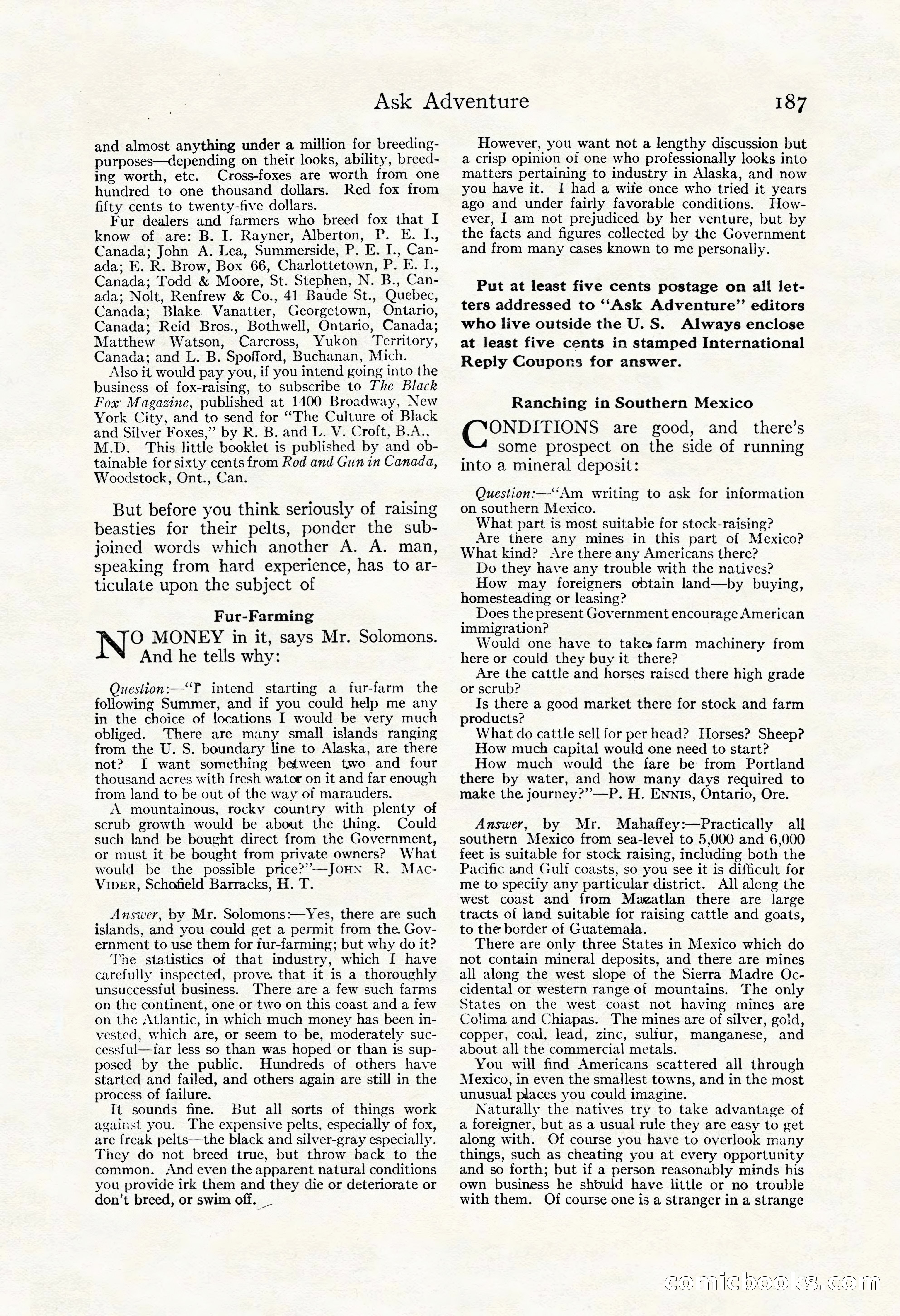
A restored page from Pulp Fiction, 1922. Page through the whole issue in the reader above.
📄 Transcribed text from this page (OCR, searchable)
Machine-transcribed from the original scan — historical spelling and the odd misread are preserved.
Ask Adventure and almost anything under a million for breeding- purposes—depending on their looks, ability, breed- ing worth, etc. Cross-foxes are worth from one hundred to one thousand dollars. Red fox from fifty cents to twenty-five dollars. Fur dealers and farmers who breed fox that I know of are: B. I. Rayner, Alberton, P. E. I., Canada; John A. Lea, Summerside, P. E. I., Can- ada; E. R. Brow, Box 66, Charlottetown, P. E. I., Canada; Todd & Moore, St. Stephen, N. B., Can- ada; Nolt, Renfrew & Co., 41 Baude St., Quebec, Canada; Blake Vanatter, Georgetown, Ontario, Canada; Reid Bros., Bothwell, Ontario, Canada; Matthew Watson, Carcross, Yukon Territory, Canada; and L. B. Spofford, Buchanan, Mich. Also it would pay you, if you intend going into the business of fox-raising, to subscribe to The Black Fox Magazine, published at 1400 Broadway, New York City, and to send for “The Culture of Black and Silver Foxes,” by R. B. and L. V. Croft, B.A., M.D. This little booklet is published by and ob- tainable for sixty cents from Rod and Gun in Canada, Woodstock, Ont., Can. But before you think seriously of raising beasties for their pelts, ponder the sub- joined words which another A. A. man, speaking from hard experience, has to ar- ticulate upon the subject of Fur-Farming O MONEY in it, says Mr. Solomons. And he tells why: Question:—‘T intend starting a fur-farm the following Summer, and if you could help me any in the choice of locations I would be very much obliged. There are many small islands ranging from the U. S. boundary line to Alaska, are there not? I want something between two and four thousand acres with fresh water on it and far enough from land to be out of the way of marauders. A mountainous, rocky country with plenty of scrub growth would be about the thing. Could such land be bought direct from the Government, or must it be bought from private owners? What would be the possible price?”—JOHN R. Mac- VipER, Schofield Barracks, H. T. Answer, by Mr. Solomons:—Yes, there are such islands, and you could get a permit from the. Gov- ernment to use them for fur-farming; but why do it? The statistics of that industry, which I[ have carefully inspected, prove that it is a thoroughly unsuccessful business. There are a few such farms on the continent, one or two on this coast and a few on the Atlantic, in which much money has been in- vested, which are, or seem to be, moderately suc- cessful—far less so than was hoped or than is sup- posed by the public. Hundreds of others have started and failed, and others again are still in the process of failure. It sounds fine. But all sorts of things work against you. The expensive pelts, especially of fox, are freak pelts—the black and silver-gray especially. They do not breed true, but throw back to the common. And even the apparent natural conditions you provide irk them and they die or deteriorate or don’t breed, or swim off. _ 187 However, you want not a lengthy discussion but a crisp opinion of one who professionally looks into matters pertaining to industry in Alaska, and now you have it. I had a wife once who tried it years ago and under fairly favorable conditions. How- ever, I am not prejudiced by her venture, but by the facts and figures collected by the Government and from many cases known to me personally. Put at least five cents postage on all let- ters addressed to ‘‘Ask Adventure’”’ editors who live outside the U. S. Always enclose at least five cents in stamped International Reply Coupors for answer. Ranching in Southern Mexico COS DONS are good, and there’s some prospect on the side of running into a mineral deposit: Question:—“‘Am writing to ask for information on southern Mexico. What part is most suitabie for stock-raising? Are there any mines in this part of MexicoP What kind? -\re there any Amcricans there? Do they have any trouble with the natives? How may foreigners obtain land—by buying, homesteading or leasing? Does the present Government encourage American immigration? Would one have to takes farm machinery from here or could they buy it there? Are the cattle and horses raised there high grade or scrub? Is there a good market there for stock and farm products? What do cattle sell for per head? Horses? Sheep? How much capital would one need to start? How much would the fare be from Portland there by water, and how many days required to make the journey?”—P. H. ENnis, Ontario, Ore. Answer, by Mr. Mahaffey:—Practically all southern Mexico from sea-level to 5,000 and 6,000 feet is suitable for stock raising, including both the Pacific and Gulf coasts, so you see it is difficult for me to specify any particular district. All along the west coast and from Mavzatlan there are large tracts of land suitable for raising cattle and goats, to the border of Guatemala. There are only three States in Mexico which do not contain mineral deposits, and there are mines all along the west slope of the Sierra Madre Oc- cidental or western range of mountains. The only States on the west coast not having mines are Colima and Chiapas. The mines are of silver, gold, copper, coal, lead, zinc, sulfur, manganese, and about all the commercial metals. You will find Americans scattered all through Mexico, in even the smallest towns, and in the most unusual pdaces you could imagine. Naturally the natives try to take advantage of a foreigner, but as a usual rule they are easy to get along with. Of course you have to overlook many things, such as cheating you at every opportunity and so forth; but if a person reasonably minds his own business he should have little or no trouble with them. Of course one is a stranger in a strange COmiclool (Cc S C@