
Pulp Fiction, 1922 · page 39 of 202
Adventure Magazine Cover — page 39: what you’re looking at
A restored page from Pulp Fiction, 1922. Page through the whole issue in the reader above.
📄 Transcribed text from this page (OCR, searchable)
Machine-transcribed from the original scan — historical spelling and the odd misread are preserved.
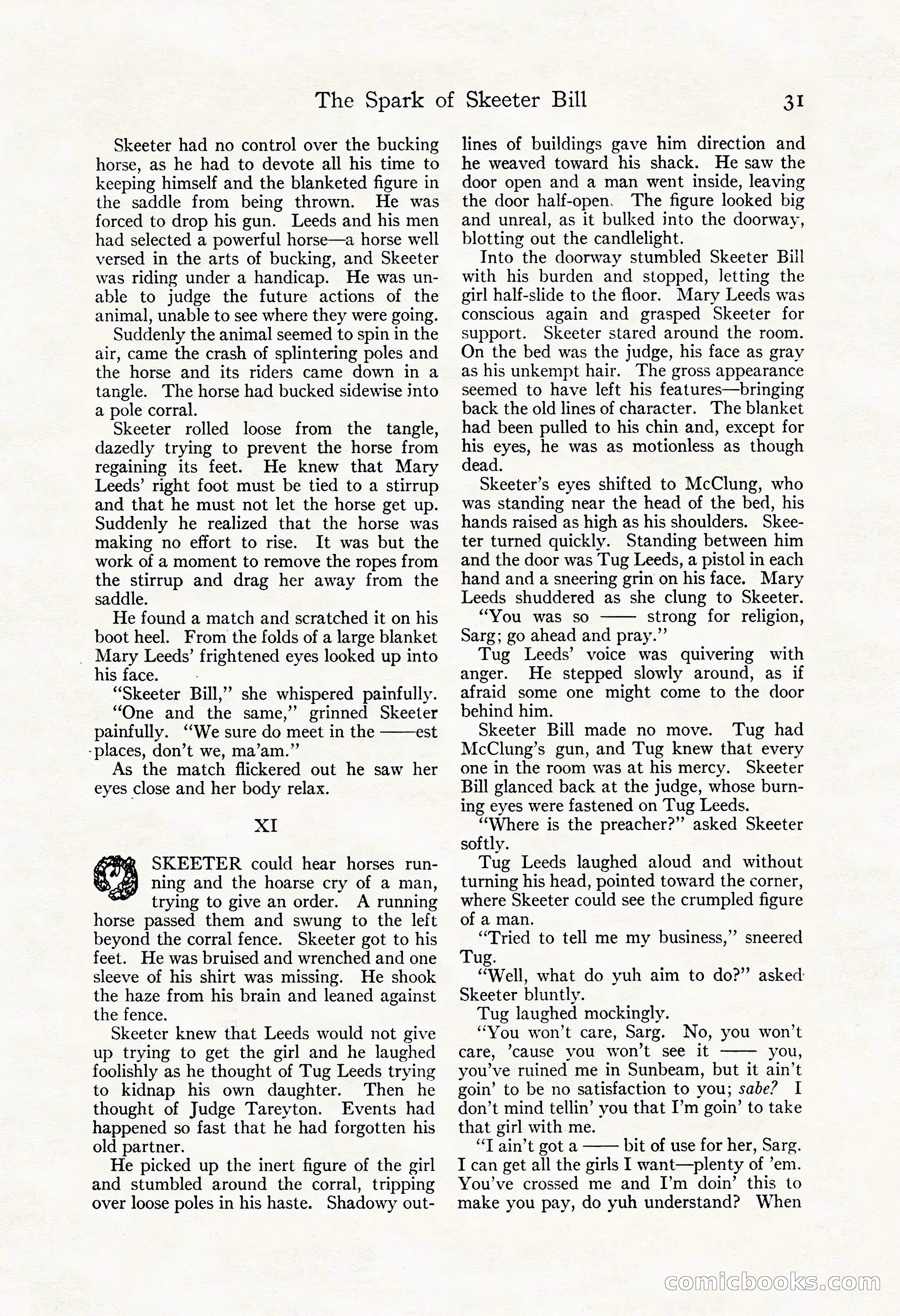
The Spark of Skeeter Bill Skeeter had no control over the bucking horse, as he had to devote all his time to keeping himself and the blanketed figure in the saddle from being thrown. He was forced to drop his gun. Leeds and his men had selected a powerful horse—a horse well versed in the arts of bucking, and Skeeter was riding under a handicap. He was un- able to judge the future actions of the animal, unable to see where they were going. Suddenly the animal seemed to spin in the air, came the crash of splintering poles and the horse and its riders came down in a tangle. The horse had bucked sidewise into a pole corral. Skeeter rolled loose from the tangle, dazedly trying to prevent the horse from regaining its feet. He knew that Mary Leeds’ right foot must be tied to a stirrup and that he must not let the horse get up. Suddenly he realized that the horse was making no effort to rise. It was but the work of a moment to remove the ropes from the stirrup and drag her away from the saddle. He found a match and scratched it on his boot heel. From the folds of a large blanket _ Mary Leeds’ frightened eyes looked up into his face. : “Skeeter Bill,’ she whispered painfully. “One and the same,” grinned Skeeter painfully. ‘“‘We sure do meet in the ——est -places, don’t we, ma’am.”’ As the match flickered out he saw her eyes close and her body relax. XI SKEETER could hear horses run- ning and the hoarse cry of a man, trying to give an order. A running horse passed them and swung to the left beyond the corral fence. Skeeter got to his feet. He was bruised and wrenched and one sleeve of his shirt was missing. He shook the haze from his brain and leaned against the fence. Skeeter knew that Leeds would not give up trying to get the girl and he laughed foolishly as he thought of Tug Leeds trying to kidnap his own daughter. Then he thought of Judge Tareyton. Events had happened so fast that he had forgotten his old partner. He picked up the inert figure of the girl and stumbled around the corral, tripping over loose poles in his haste. Shadowy out- 31 lines of buildings gave him direction and he weaved toward his shack. He saw the door open and a man went inside, leaving the door half-open. The figure looked big and unreal, as it bulked into the doorway, blotting out the candlelight. Into the doorway stumbled Skeeter Bill with his burden and stopped, letting the girl half-slide to the floor. Mary Leeds was conscious again and grasped Skeeter for support. Skeeter stared around the room. On the bed was the judge, his face as gray as his unkempt hair. The gross appearance seemed to have left his features—bringing back the old lines of character. The blanket had been pulled to his chin and, except for his eyes, he was as motionless as though dead. Skeeter’s eyes shifted to McClung, who was standing near the head of the bed, his hands raised as high as his shoulders. Skee- ter turned quickly. Standing between him and the door was Tug Leeds, a pistol in each hand and a sneering grin on his face. Mary Leeds shuddered as she clung to Skeeter. “You was so strong for religion, Sarg; go ahead and pray.” Tug Leeds’ voice was quivering with anger. He stepped slowly around, as if afraid some one might come to the door behind him. Skeeter Bill made no move. Tug had McClung’s gun, and Tug knew that every one in the room was at his mercy. Skeeter Bill glanced back at the judge, whose burn- ing eyes were fastened on Tug Leeds. ‘“‘Where is the preacher?” asked Skeeter softly. Tug Leeds laughed aloud and without turning his head, pointed toward the corner, where Skeeter could see the crumpled figure of a man. “Tried to tell me my business,’ Tug. b) sneered “Well, what do yuh aim to do?” asked: Skeeter bluntly. Tug laughed mockingly. “Vou won't care, Sarg. No, you won’t care, ‘cause you won’t see it you, you’ve ruined me in Sunbeam, but it ain’t goin’ to be no satisfaction to you; sabe? I don’t mind tellin’ you that I’m goin’ to take that girl with me. “T ain’t gota bit of use for her, Sarg. I can get all the girls I want—plenty of ’em. You’ve crossed me and I’m doin’ this to make you pay, do yuh understand? When GOMIIGooOo S C@ iin