
Pulp Fiction, 1922 · page 54 of 202
Adventure Magazine Cover — page 54: what you’re looking at
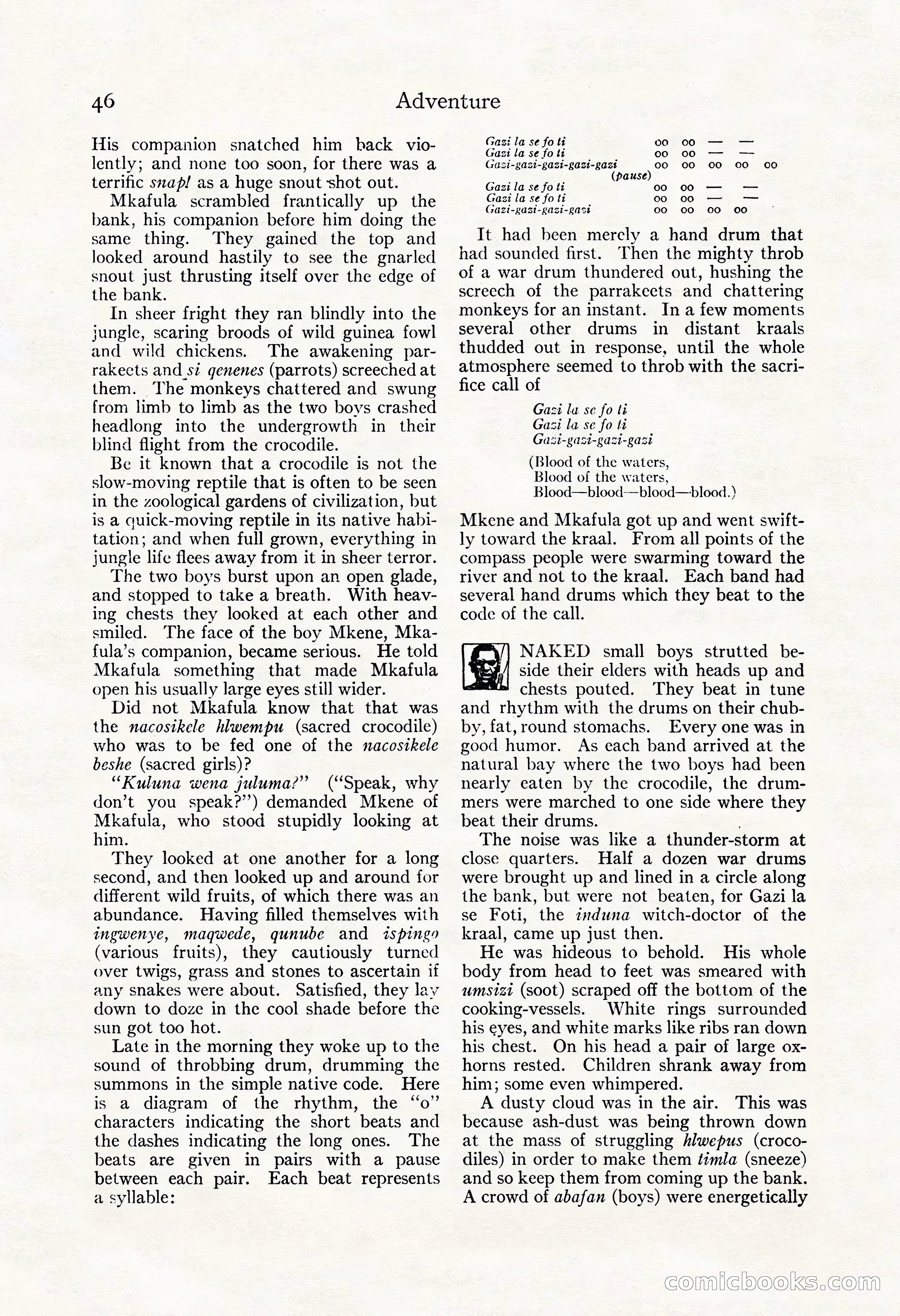
A restored page from Pulp Fiction, 1922. Page through the whole issue in the reader above.
📄 Transcribed text from this page (OCR, searchable)
Machine-transcribed from the original scan — historical spelling and the odd misread are preserved.
46 His companion snatched him back vio- lently; and none too soon, for there was a terrific swap! as a huge snout shot out. Mkafula scrambled frantically up the bank, his companion before him doing the same thing. They gained the top and looked around hastily to see the gnarled snout just thrusting itself over the edge of the bank. In sheer fright they ran blindly into the jungle, scaring broods of wild guinea fowl and wild chickens. The awakening par- rakeets and_si genenes (parrots) screeched at them. The monkeys chattered and swung from limb to limb as the two boys crashed headlong into the undergrowth in their blind flight from the crocodile. Be it known that a crocodile is not the slow-moving reptile that is often to be seen in the zoological gardens of civilization, but is a quick-moving reptile in its native habi- tation; and when full grown, everything in jungle life flees away from it in sheer terror. The two boys burst upon an open glade, and stopped to take a breath. With heav- ing chests they looked at each other and smiled. The face of the boy Mkene, Mka- fula’s companion, became serious. He told Mkafula something that made Mkafula open his usually large eyes still wider. Did not Mkafula know that that was the nacosikele hlwempu (sacred crocodile) who was to be fed one of the sacostkele beshe (sacred girls)? “Kuluna wena juluma?” (“Speak, why don’t you speak?’’) demanded Mkene of Mkafula, who stood stupidly looking at him. They looked at one another for a long second, and then looked up and around for different wild fruits, of which there was an abundance. Having filled themselves with ingwenye, maqwede, qunube and ispingo (various fruits), they cautiously turned over twigs, grass and stones to ascertain if any snakes were about. Satisfied, they lav down to doze in the cool shade before the sun got too hot. Late in the morning they woke up to the sound of throbbing drum, drumming the summons in the simple native code. Here is a diagram of the rhythm, the “o” characters indicating the short beats and the dashes indicating the long ones. The beats are given in pairs with a pause between each pair. Each beat represents a syllable: Adventure Gazi la se fo tt 00 00 —_—- — Gazt la se fo ti 00.00 -— — Gazi-gdzt-ZaZt-gaZt-gazt 00 00 00 OO oO (pause) Gazi la se fo tt 00 00 — — Gazi la se fo ti 00 00 — ee Gazt-gazi-gazi-gast 00 0O OO OO It had been merely a hand drum that had sounded first. Then the mighty throb of a war drum thundered out, hushing the screech of the parrakeets and chattering monkeys for an instant. In afew moments several other drums in distant kraals thudded out in response, until the whole atmosphere seemed to throb with the sacri- fice call of Gazi la se fo tt Gazi la se fo tt Gazi-gast-gazt-gasi (Blood of the waters, Blood of the waters, Blood—blood-——blood—blood.) Mkene and Mkafula got up and went swift- ly toward the kraal. From all points of the compass people were swarming toward the river and not to the kraal. Each band had several hand drums which they beat to the code of the call. NAKED small boys strutted be- side their elders with heads up and ome chests pouted. They beat in tune and rhythm with the drums on their chub- by, fat, round stomachs. Every one was in good humor. As each band arrived at the natural bay where the two boys had been nearly eaten by the crocodile, the drum- mers were marched to one side where they beat their drums. The noise was like a thunder-storm at close quarters. Half a dozen war drums were brought up and lined in a circle along the bank, but were not beaten, for Gazi la se Foti, the i#duna witch-doctor of the kraal, came up just then. He was hideous to behold. His whole body from head to feet was smeared with umsizi (soot) scraped off the bottom of the cooking-vessels. White rings surrounded his eyes, and white marks like ribs ran down his chest. On his head a pair of large ox- horns rested. Children shrank away from him; some even whimpered. A dusty cloud was in the air. This was because ash-dust was being thrown down at the mass of struggling hlwepus (croco- diles) in order to make them timla (sneeze) and so keep them from coming up the bank. A crowd of abafan (boys) were energetically COIN Clooolkks C@