
Pulp Fiction, 1922 · page 60 of 202
Adventure Magazine Cover — page 60: what you’re looking at
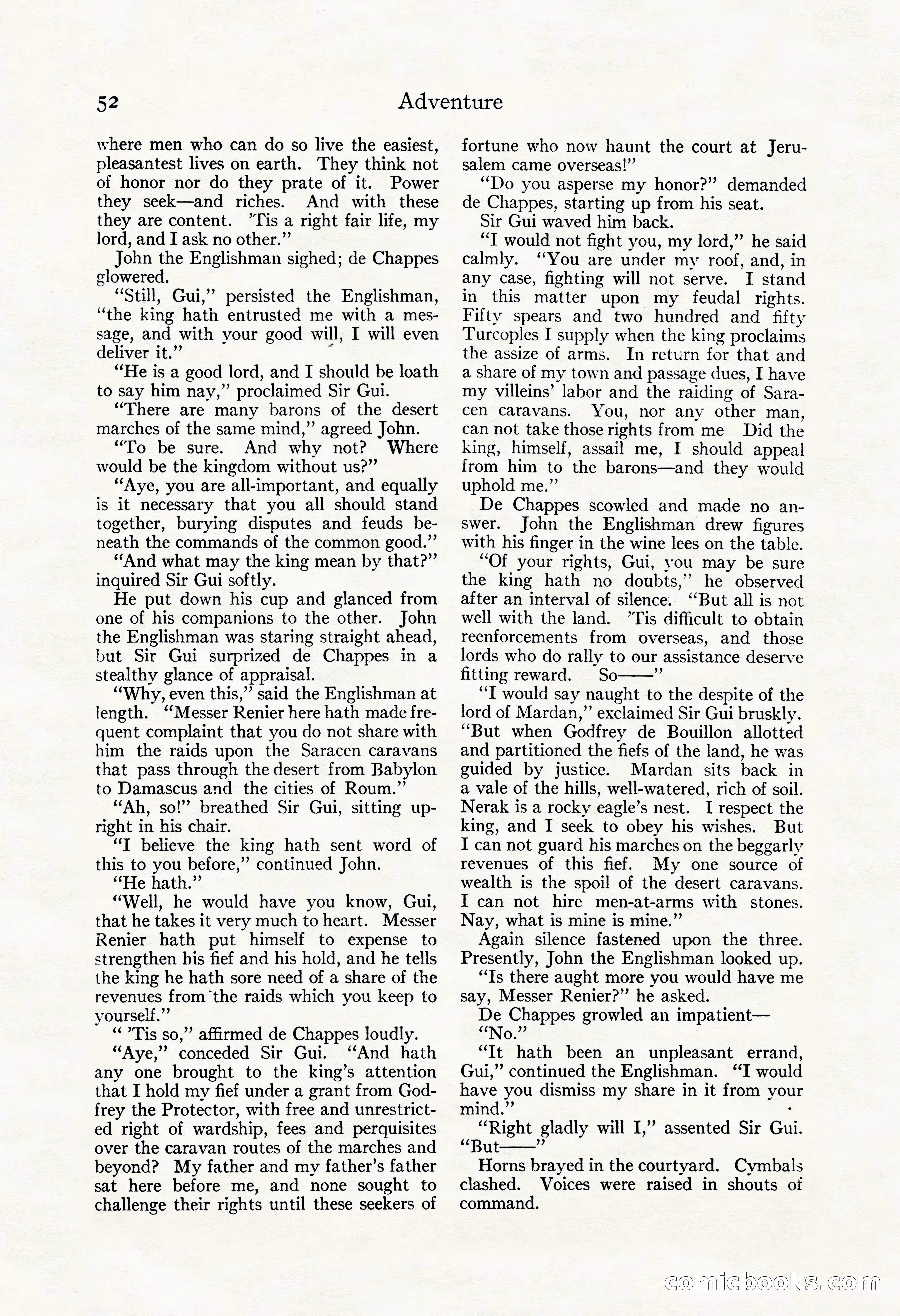
A restored page from Pulp Fiction, 1922. Page through the whole issue in the reader above.
📄 Transcribed text from this page (OCR, searchable)
Machine-transcribed from the original scan — historical spelling and the odd misread are preserved.
52 where men who can do so live the easiest, pleasantest lives on earth. They think not of honor nor do they prate of it. Power they seek—and riches. And with these they are content. ’Tis a right fair life, my lord, and I ask no other.”’ John the Englishman sighed; de Chappes clowered. “Still, Gui,” persisted the Englishman, “the king hath entrusted me with a mes- sage, and with vour good will, I will even deliver it.” : “He is a good lord, and I should be loath to say him nay,” proclaimed Sir Gut. “There are many barons of the desert marches of the same mind,” agreed John. “To be sure. And why not? Where would be the kingdom without us?” “Aye, you are all-important, and equally is it necessary that you all should stand together, burying disputes and feuds be- neath the commands of the common good.” ‘And what may the king mean by that?” inquired Sir Gui softly. He put down his cup and glanced from one of his companions to the other. John the Englishman was staring straight ahead, but Sir Gui surprized de Chappes in a stealthy glance of appraisal. “Why, even this,” said the Englishman at length. ‘Messer Renier here hath made fre- quent complaint that you do not share with him the raids upon the Saracen caravans that pass through the desert from Babylon to Damascus and the cities of Roum.” “Ah, so!” breathed Sir Gui, sitting up- right in his chair. “T believe the king hath sent word of this to you before,” continued John. “He hath.” “Well, he would have you know, Gui, that he takes it very much to heart. Messer Renier hath put himself to expense to strengthen his fief and his hold, and he tells the king he hath sore need of a share of the revenues from the raids which you keep to yourself.” “Tis so,” affirmed de Chappes loudly. “Aye,” conceded Sir Gui. ‘And hath any one brought to the king’s attention that I hold my fief under a grant from God- frey the Protector, with free and unrestrict- ed right of wardship, fees and perquisites over the caravan routes of the marches and beyond? My father and my father’s father sat here before me, and none sought to challenge their rights until these seekers of Adventure fortune who now haunt the court at Jeru- salem came overseas!” “Do you asperse my honor?” demanded de Chappes, starting up from his seat. Sir Gui waved him back. “T would not fight you, my lord,” he said calmly. ‘You are under my roof, and, in any case, fighting will not serve. I stand in this matter upon my feudal rights. Fifty spears and two hundred and fifty Turcoples I supply when the king proclaims the assize of arms. In return for that and a share of my town and passage dues, I have my villeins’ labor and the raiding of Sara- cen caravans. You, nor any other man, can not take those rights from me _ Did the king, himself, assail me, I should appeal from him to the barons—and they would uphold me.”’ De Chappes scowled and made no an- swer. John the Englishman drew figures with his finger in the wine lees on the table. “Of your rights, Gui, you may be sure the king hath no doubts,” he observed after an interval of silence. “But all is not well with the land. ’Tis difficult to obtain reenforcements from overseas, and those lords who do rally to our assistance deserve fitting reward. So——” “T would say naught to the despite of the lord of Mardan,”’ exclaimed Sir Gui bruskly. “But when Godfrey de Bouillon allotted and partitioned the fiefs of the land, he was guided by justice. Mardan sits back in a vale of the hills, well-watered, rich of soil. Nerak is a rocky eagle’s nest. I respect the king, and I seek to obey his wishes. But I can not guard his marches on the beggarly revenues of this fief. My one source of wealth is the spoil of the desert caravans. I can not hire men-at-arms with stones. Nay, what is mine is mine.” Again silence fastened upon the three. Presently, John the Englishman looked up. “Is there aught more you would have me say, Messer Renier?”’ he asked. De Chappes growled an impatient— “No. “Tt hath been an unpleasant errand, Gui,” continued the Englishman. “TI would have you dismiss my share in it from you mind.” : “Right gladly will I,” assented Sir Gui. ay ee “BR Horns brayed in the courtyard. Cymbals clashed. Voices were raised in shouts oi command. COMmicaoo® S C@