
Pulp Fiction, 1922 · page 74 of 202
Adventure Magazine Cover — page 74: what you’re looking at
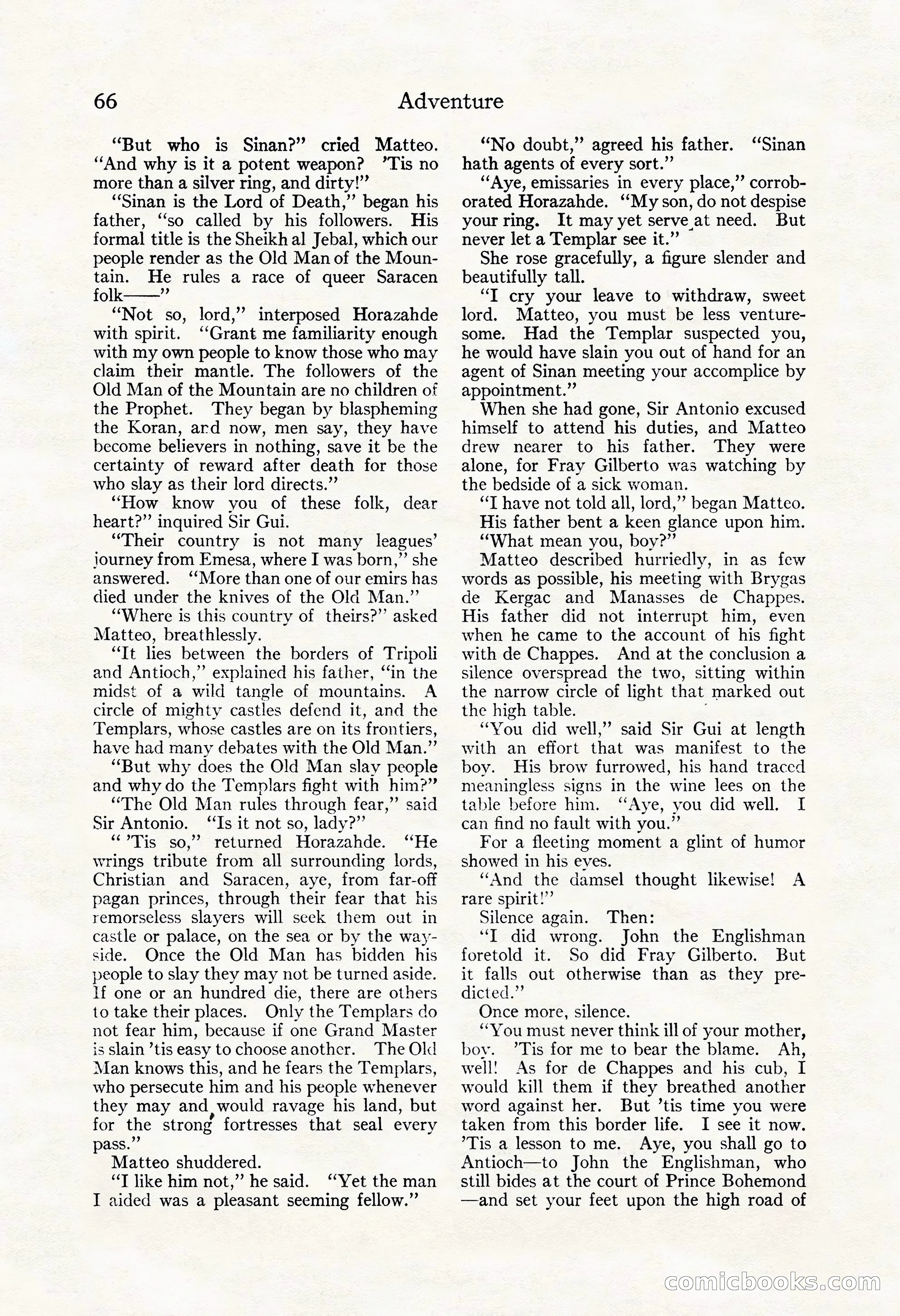
A restored page from Pulp Fiction, 1922. Page through the whole issue in the reader above.
📄 Transcribed text from this page (OCR, searchable)
Machine-transcribed from the original scan — historical spelling and the odd misread are preserved.
66 cried Matteo. *Tis no “But who is Sinan?” “And why is it a potent weapon? more than a silver ring, and dirty!” ‘Sinan is the Lord of Death,’ began his father, “so called by his followers. His formal title is the Sheikh al Jebal, which our people render as the Old Man of the Moun- tain. He rules a race of queer Saracen folk——”’ “Not so, lord,” interposed Horazahde with spirit. ‘“‘Grant me familiarity enough with my own people to know those who may claim their mantle. The followers of the Old Man of the Mountain are no children of the Prophet. They began by blaspheming the Koran, ard now, men say, they have become believers in nothing, save it be the certainty of reward after death for those who slay as their lord directs.” “How know you of these folk, dear heart?” inquired Sir Gui. “Their country is not many leagues’ journey from Emesa, where I was born,” she answered. “More than one of our emirs has died under the knives of the Old Man.” “Where is this country of theirs?’’ asked Matteo, breathlessly. “It lies between the borders of Tripoli and Antioch,” explained his father, “‘in the midst of a wild tangle of mountains. A circle of mighty castles defend it, and the Templars, whose castles are on its frontiers, have had many debates with the Old Man.” “But why does the Old Man slay people and why do the Templars fight with him?” ‘The Old Man rules through fear,” said Sir Antonio. “Is it not so, lady?” “Tis -so,” returned. Horazahde. “He wrings tribute from all surrounding lords, Christian and Saracen, aye, from far-off pagan princes, through their fear that his remorseless slayers will seek them out in castle or palace, on the sea or by the way- side. Once the Old Man has bidden his people to slay they may not be turned aside. lf one or an hundred die, there are others to take their places. Only the Templars do not fear him, because if one Grand Master is slain ’tis easy to choose anothcr. The Old Man knows this, and he fears the Templars, who persecute him and his people whenever they may and would ravage his land, but for the strong fortresses that seal every pass.” Matteo shuddered. “T like him not,” he said. ‘‘Yet the man I aided was a pleasant seeming fellow.” Adventure “No doubt,” agreed his father. ‘Sinan hath agents of every sort.” ‘“‘Aye, emissaries in every place,” corrob- orated Horazahde. ‘‘Myson, do not despise your ring. It may yet serve at need. But never let a Templar see it.” She rose gracefully, a figure slender and beautifully tall. “T cry your leave to withdraw, sweet lord. Matteo, you must be less venture- some. Had the Templar suspected you, he would have slain you out of hand for an agent of Sinan meeting your accomplice by appointment.” When she had gone, Sir Antonio excused himself to attend his duties, and Matteo drew nearer to his father. They were alone, for Fray Gilberto was watching by the bedside of a sick woman. “T have not told all, lord,” began Matteo. His father bent a keen glance upon him. ‘‘What mean you, boy?” Matteo described hurriedly, in as few words as possible, his meeting with Brygas de Kergac and Manasses de Chappes. His father did not interrupt him, even when he came to the account of his fight with de Chappes. And at the conclusion a silence overspread the two, sitting within the narrow circle of light that marked out the high table. “Vou did well,” said Sir Gui at length with an effort that was manifest to the boy. His brow furrowed, his hand traced meaningless signs in the wine lees on the table before him. ‘‘Aye, you did well. I can find no fault with you.”’ For a fleeting moment a glint of humor showed in his eves. ‘“And the damsel thought likewise! A rare spirit!” Silence again. “T did wrong. John the Englishman foretold it. So did Fray Gilberto. But it falls out otherwise than as they pre- dicted.” Once more, silence. “You must never think ill of your mother, boy. ’Tis for me to bear the blame. Ah, well! As for de Chappes and his cub, I would kill them if they breathed another word against her. But ’tis time you were taken from this border life. I see it now. ’Tis a lesson to me. Aye, you shall go to Antioch—to John the Englishman, who still bides at the court of Prince Bohemond —and set your feet upon the high road of Then: COIN Clooolkks C@