
Pulp Fiction, 1922 · page 183 of 200
Adventure Magazine Cover — page 183: what you’re looking at
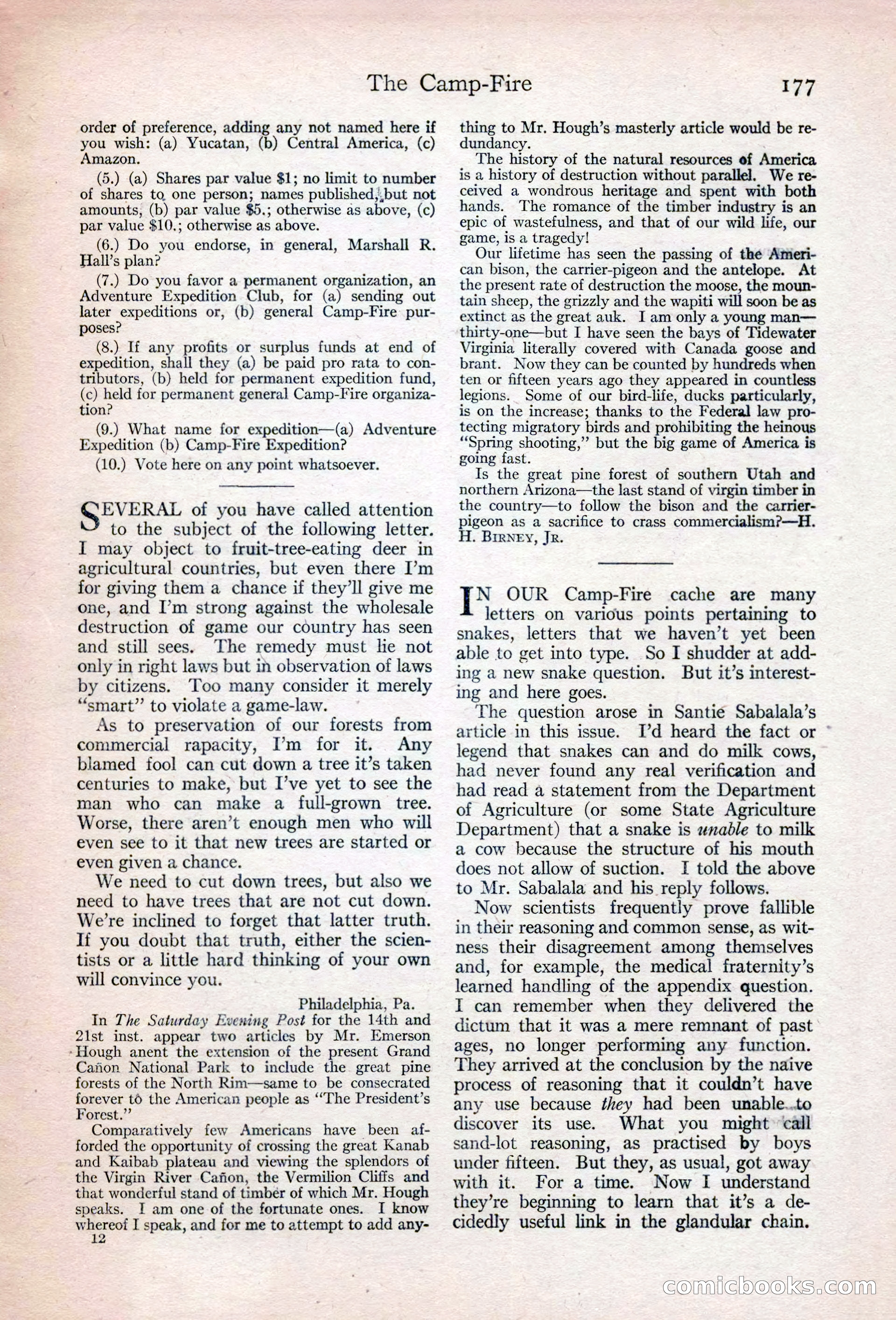
A restored page from Pulp Fiction, 1922. Page through the whole issue in the reader above.
📄 Transcribed text from this page (OCR, searchable)
Machine-transcribed from the original scan — historical spelling and the odd misread are preserved.
The Camp-Fire order of preference, adding any not named here if you wish: (a) Yucatan, (b) Central America, (c) Amazon. (5.) (a) Shares par value $1; no limit to number of shares to one person; names published,,but not amounts, (b) par value $5.; otherwise as above, (c) par value $10.; otherwise as above. (6.) Do you endorse, in general, Marshall R. Hall’s plan? (7.) Do you favor a permanent organization, an Adventure Expedition Club, for (a) sending out later expeditions or, (b) general Camp-Fire: pur- poses? (8.) If any profits or surplus funds at end of expedition, shall they (a) be paid pro rata to con- tributors, (b) held for permanent expedition fund, (c) held for permanent general Camp-Fire organiza- tion? (9.) What name for expedition—(a) Adventure Expedition (b) Camp-Fire Expedition? (10.) Vote here on any point whatsoever. ee eel of you have called attention to the subject of the following letter. I may object to fruit-tree-eating deer in agricultural countries, but even there I’m for giving them a chance if they’ll give me one, and I’m strong against the wholesale destruction of game our country has seen and still sees. The remedy must lie not only in right laws but in observation of laws by citizens. Too many consider it merely “smart” to violate a game-law. As to preservation of our forests from commercial rapacity, I’m for it. Any blamed fool can cut down a tree it’s taken centuries to make, but I’ve yet to see the man who can make a full-grown tree. Worse, there aren’t enough men who will even see to it that new trees are started or even given a chance. We need to cut down trees, but also we need to have trees that are not cut down. We’re inclined to forget that latter truth. If you doubt that truth, either the scien- tists or a little hard thinking of your own will convince you. Philadelphia, Pa. In The Saturday Evening Post for the 14th and 2lst inst. appear two articles by Mr. Emerson -Hough anent the extension of the present Grand Canon National Park to include the great pine forests of the North Rim—same to be consecrated forever to the American people as ““The President’s Forest.” Comparatively few Americans have been af- forded the opportunity of crossing the great Kanab and Kaibab plateau and viewing the splendors of the Virgin River Cafion, the Vermilion Cliffs and that wonderful stand of timber of which Mr. Hough speaks. I am one of the fortunate ones. I know oo I speak, and for me to attempt to add any- 177 thing to Mr. Hough’s masterly article would be re- dundancy. The history of the natural resources of America is a history of destruction without parallel. We re- ceived a wondrous heritage and spent with both hands. The romance of the timber industry is an epic of wastefulness, and that of our wild life, our game, is a tragedy! Our lifetime has seen the passing of the Ameri- can bison, the carrier-pigeon and the antelope. At the present rate of destruction the moose, the moun- tain sheep, the grizzly and the wapiti will soon be as extinct as the great auk. I am only a young man— thirty-one—but I have seen the bays of Tidewater Virginia literally covered with Canada goose and brant. Now they can be counted by hundreds when ten or fifteen years ago they appeared in countless legions. Some of our bird-life, ducks particularly, is on the increase; thanks to the Federal law pro- tecting migratory birds and prohibiting the heinous “Spring shooting,” but the big game of America is going fast. Is the great pine forest of southern Utah and northern Arizona—the last stand of virgin timber in the country—to follow the bison and the carrier- pigeon as a sacrifice to crass commercialism?—H. H. Brraney, JR. | OUR Camp-Fire cache are many letters on various points pertaining to snakes, letters that we haven’t yet been able to get into type. So I shudder at add- ing a new snake question. But it’s interest- ing and here goes. The question arose in Santie Sabalala’s article in this issue. legend that snakes can and do milk cows, had never found any real verification and had read a statement from the Department of Agriculture (or some State Agriculture Department) that a snake is unable to milk a cow because the structure of his mouth does not allow of suction. I told the above to Mr. Sabalala and his reply follows. Now scientists frequently prove fallible in their reasoning and common sense, as wit- ness their disagreement among themselves and, for example, the medical fraternity’s learned handling of the appendix question. I can remember when they delivered the dictum that it was a mere remnant of past ages, no longer performing any function. They arrived at the conclusion by the naive process of reasoning that it couldn’t have any use because they had been unable..to discover its use. What you might ‘call sand-lot reasoning, as practised by boys under fifteen. But they, as usual, got away with it. For a time. Now I understand they’re beginning to learn that it’s a de- cidedly useful link in the glandular chain. COMmicloooks I’d heard the fact or ° (C@