
Pulp Fiction, 1922 · page 184 of 200
Adventure Magazine Cover — page 184: what you’re looking at
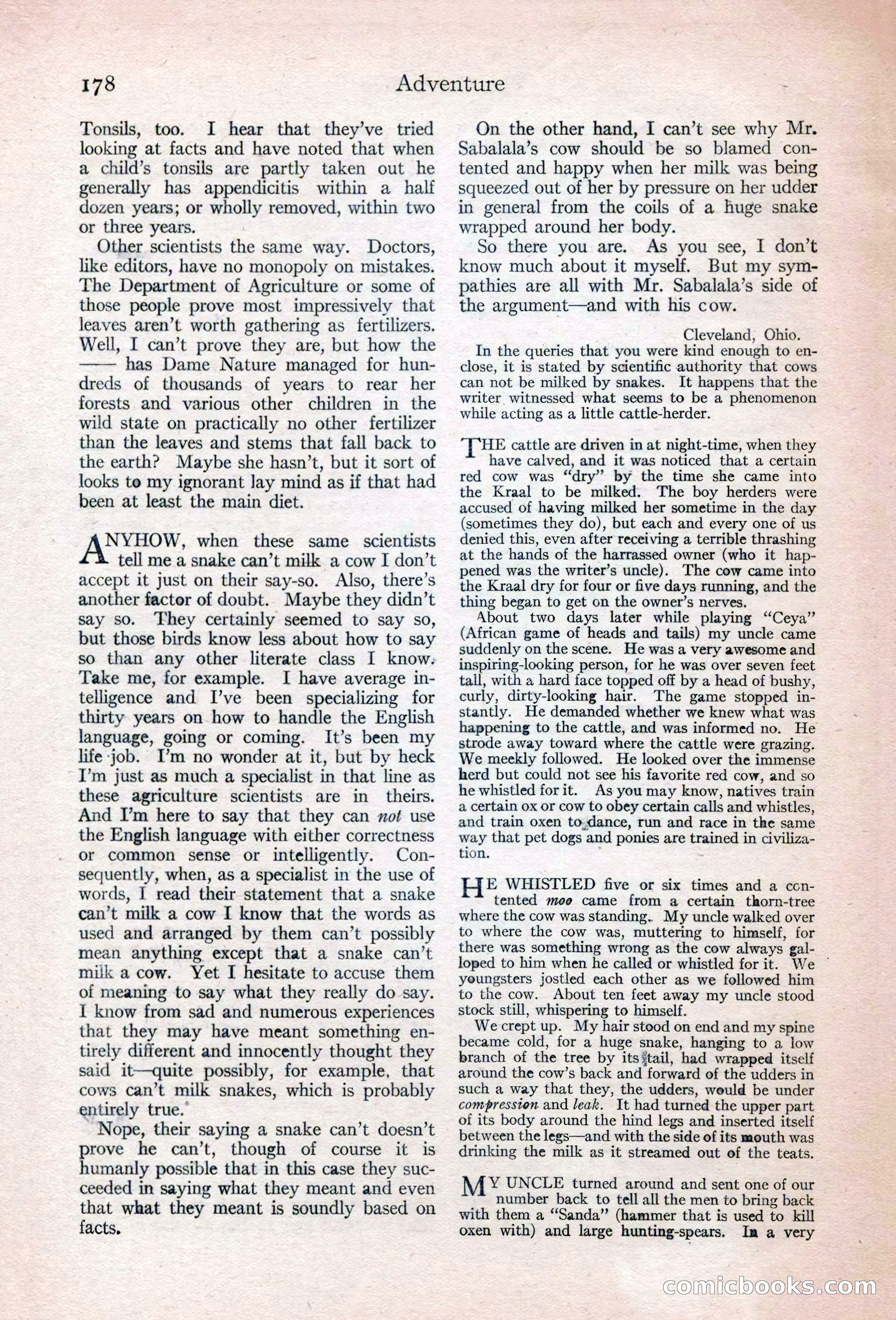
A restored page from Pulp Fiction, 1922. Page through the whole issue in the reader above.
📄 Transcribed text from this page (OCR, searchable)
Machine-transcribed from the original scan — historical spelling and the odd misread are preserved.
178 Tonsils, too. I hear that they’ve tried looking at facts and have noted that when a child’s tonsils are partly taken out he generally has appendicitis within a half dozen years; or wholly removed, within two or three years. Other scientists the same way. Doctors, like editors, have no monopoly on mistakes. The Department of Agriculture or some of those people prove most impressively that leaves aren’t worth gathering as fertilizers. Well, I can’t prove they are, but how the has Dame Nature managed for hun- dreds of thousands of years to rear her forests and various other children in the wild state on practically no other fertilizer than the leaves and stems that fall back to the earth? Maybe she hasn’t, but it sort of looks te my ignorant Jay mind as if that had been at least the main diet. NYHOW, when these same scientists tell me a snake can’t milk a cow I don’t accept it just on their say-so. Also, there’s another factor of doubt. Maybe they didn’t say so. They certainly seemed to say so, but those birds know less about how to say so than any other literate class I know. Take me, for example. I have average in- telligence and I’ve been specializing for thirty years on how to handle the English language, going or coming. It’s been my life job. Um no wonder at it, but by heck I’m just as much a specialist in that line as these agriculture scientists are in theirs. And I’m here to say that they can nof use the English language with either correctness or common sense or intelligently. Con- sequently, when, as a specialist in the use of words, I read their statement that a snake can’t milk a cow I know that the words as used and arranged by them can’t possibly mean anything except that a snake can’t mikacow. Yet I hesitate to accuse them of meaning to say what they really do say. I know from sad and numerous experiences that they may have meant something en- tirely different and innocently thought they said it—quite possibly, for example, that cows can’t milk snakes, which is probably entirely true. Nope, their saying a snake can’t doesn’t prove he can’t, though of course it is humanly possible that in this case they suc- ceeded in saying what they meant and even that what they meant is soundly based on facts. Adventure On the other hand, I can’t see why Mr. Sabalala’s cow should be so blamed con- tented and happy when her milk was being squeezed out of her by pressure on her udder in general from the coils of a huge snake wrapped around her body. So there you are. As you see, I don’t know much about it myself. But my sym- pathies are all with Mr. Sabalala’s side of the argument—and with his cow. Cleveland, Ohio. In the queries that you were kind enough to en- close, it is stated by scientific authority that cows can not be milked by snakes. It happens that the writer witnessed what seems to be a phenomenon while acting as a little cattle-herder. HE cattle are driven in at night-time, when they have calved, and it was noticed that a certain red cow was “dry” by the time she came into the Kraal to be milked. The boy herders were accused of having milked her sometime in the day (sometimes they do), but each and every one of us denied this, even after receiving a terrible thrashing at the hands of the harrassed owner (who it hap- pened was the writer’s uncle). The cow came into the Kraal dry for four or five days running, and the thing began to get on the owner’s nerves. About two days later while playing “Ceya” (African game of heads and tails) my uncle came suddenly on the scene. He was a very awesome and inspiring-looking person, for he was over seven feet tall, with a hard face topped off by a head of bushy, curly, dirty-looking hair. The game stopped in- stantly. He demanded whether we knew what was happening to the cattle, and was informed no. He strode away toward where the cattle were grazing. We meekly followed. He looked over the immense herd but could not see his favorite red cow, and so he whistled forit. As you may know, natives train a certain ox or cow to obey certain calls and whistles, and train oxen to.dance, run and race in the same way that pet dogs and ponies are trained in civiliza- tion. HE WHISTLED five or six times and a ccn- tented moo came from a certain thorn-tree where the cow was standing. My uncle walked over to where the cow was, muttering to himself, for there was something wrong as the cow always gal- loped to him when he called or whistled for it. We — youngsters jostled each other as we followed him to the cow. About ten feet away my uncle stood stock still, whispering to himself. Wecrept up. My hair stood on end and my spine became cold, for a huge snake, hanging to a low branch of the tree by itsitail, had wrapped itself around the cow’s back and forward of the udders in such a way that they, the udders, weuld be under compresston and leak. It had turned the upper part of its body around the hind legs and inserted itself between the legs—and with the side of its mouth was drinking the milk as it streamed out of the teats. MY UNCLE turned around and sent one of our number back to tell all the men to bring back with them a “Sanda” (hammer that is used to kill oxen with) and large hunting-spears. Im a very CORMICLOOOKS (E@)