
Pulp Fiction, 1922 · page 192 of 200
Adventure Magazine Cover — page 192: what you’re looking at
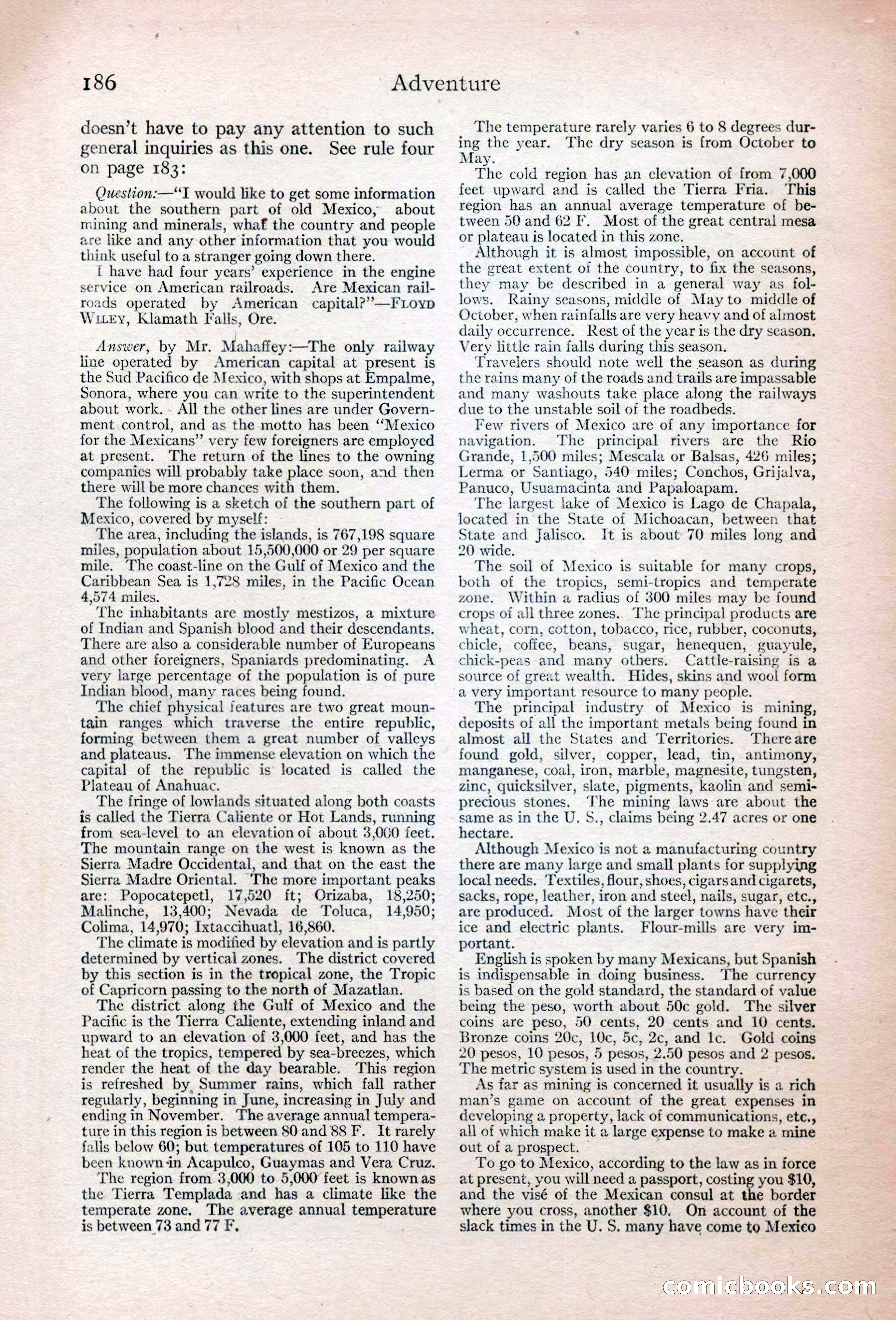
A restored page from Pulp Fiction, 1922. Page through the whole issue in the reader above.
📄 Transcribed text from this page (OCR, searchable)
Machine-transcribed from the original scan — historical spelling and the odd misread are preserved.
186 doesn’t have to pay any attention to such general inquiries as this one. See rule four on page 183: Question: —“TI would like to get some information about the southern part of old Mexico, about mining and minerals, whaf the country and people ace like and any other information that you would think useful to a stranger going down there. { have had four years’ experience in the engine service on American railroads. Are Mexican rail- roads operated by American capital?’”—FLoyp WitrEy, Klamath Falls, Ore. Answer, by Mr. Mahaffey:—The only railway line operated by American capital at present is the Sud Pacifico de Mexico, with shops at Empalme, Sonora, where you can write to the superintendent about work. - All the other lines are under Govern- ment control, and as the motto has been ‘‘Mexico for the Mexicans”’ very few foreigners are employed at present. The return of the lines to the owning companies will probably take place soon, and then there will be more chances with them. The following is a sketch of the southern part of Mexico, covered by myself: The area, including the islands, is 767,198 square miles, population about 15,500,000 or 29 per square mile. The coast-line on the Gulf of Mexico and the Caribbean Sea is 1,728 miles, in the Pacific Ocean 4,574 miles. The inhabitants are mostly mestizos, a mixture of Indian and Spanish blood and their descendants. There are also a considerable number of Europeans and other foreigners, Spaniards predominating. A very large percentage of the population is of pure Indian blood, many races being found. The chief physical features are two great moun- tain ranges which traverse the entire republic, forming between them a great number of valleys and plateaus. The immense elevation on which the capital of the republic is located is called the Plateau of Anahuac. The fringe of lowlands situated along both coasts is called the Tierra Caliente or Hot Lands, running from sea-level to an elevation of about 3,060 feet. The mountain range on the west is known as the Sierra Madre Occidental, and that on the east the Sierra Madre Oriental. ‘The more important peaks are: Popocatepetl, 17,520 ft; Orizaba, 18,250; Malinche, 13,400; Nevada de Toluca, 14,950; Colima, 14,970; Ixtaccihuatl, 16,860. The climate is modified by elevation and is partly determined by vertical zones. The district covered by this section is in the tropical zone, the Tropic of Capricorn passing to the north of Mazatlan. The district along the Gulf of Mexico and the Pacific is the Tierra Caliente, extending inland and upward to an elevation of 3,000 feet, and has the heat of the tropics, tempered by sea-breezes, which render the heat of the day bearable. This region is refreshed by, Summer rains, which fall rather regularly, beginning in June, increasing in July and ending in November. The average annual tempera- ture in this region is between 80 and 88 F. It rarely falis below 60; but temperatures of 105 to 110 have been known-in Acapulco, Guaymas and Vera Cruz. The region from 3,000 to 5,000 feet is knownas the Tierra Templada and has a climate like the temperate zone. The average annual temperature is between 73 and 77 F, Adventure The temperature rarely varies 6 to 8 degrees dur- ing the year. The dry season is from October to May. The cold region has an elevation of from 7,000 feet upward and is called the Tierra Fria. This region has an annual average temperature of be- tween 50 and 62 F. Most of the great central mesa or plateau is located in this zone. Although it is almost impossible, on account of the great extent of the country, to fix the seasons, they may be described in a general way as fol- lows. Rainy seasons, middle of May to middle of October, when rainfalls are very heavy and of almost daily occurrence. Rest of the year is the dry season, Very little rain falls during this season. Travelers should note well the season as during the rains many of the roads and trails are impassable and many washouts take place along the railways due to the unstable soil of the roadbeds. Few rivers of Mexico are of any importance for navigation. The principal rivers are the Rio Grande, 1,500 miles; Mescala or Balsas, 426 miles; Lerma or Santiago, 540 miles; Conchos, Grijalva, Panuco, Usuamacinta and Papaloapam. The largest lake of Mexico is Lago de Chapala, located in the State of Michoacan, between that State and Jalisco. It is about 70 miles long and 20 wide. The soil of Mexico is suitable for many crops, both of the tropics, semi-tropics and temperate zone. Within a radius of 300 miles may be found crops of all three zones.. The principal products are wheat, corn, cotton, tobacco, rice, rubber, coconuts, chicle, coffee, beans, sugar, henequen, guayule, chick-peas and many others. Cattle-raising is a source of great wealth. Hides, skins and wool form a very important resource to many people. The principal industry of Mexico is mining, deposits of all the important metals being found in almost all the States and Territories. There are found gold, silver, copper, lead, tin, antimony, manganese, coal, iron, marble, magnesite, tungsten, zinc, quicksilver, slate, pigments, kaolin and semi- precious stones. ‘The mining laws are about the same as in the U. 5., claims being 2.47 acres or one hectare. Although Mexico is not a manufacturing country there are many large and small plants for supplying local needs. ‘Textiles, flour, shoes, cigars and cigarets, sacks, rope, leather, iron and steel, nails, sugar, etc., are produced. Most of the larger towns have their ice and electric plants. Flour-mills are very im- portant. English is spoken by many Mexicans, but Spanish is indispensable in doing business. ‘The currency is based on the gold standard, the standard of value being the peso, worth about 50c gold. The silver coins are peso, 50 cents, 20 cents and 10 cents. Bronze coins 20c, 10c, 5c, 2c, and 1c. Gold coins 20 pesos, 10 pesos, 5 pesos, 2.50 pesos and 2 pesos. The metric system is used in the country. As far as mining is concerned it usually is a rich man’s game on account of the great expenses in developing a property, lack of communications, etc., all of which make it a large expense to make a mine out of a prospect. © To go to Mexico, according to the law as in force at present, you will need a passport, costing you $10, and the visé of the Mexican consul at the border where you cross, another $10. On account of the slack times in the U. S. many have come to Mexico COPMICLOOO cS (E)