
Pulp Fiction, 1922 · page 193 of 200
Adventure Magazine Cover — page 193: what you’re looking at
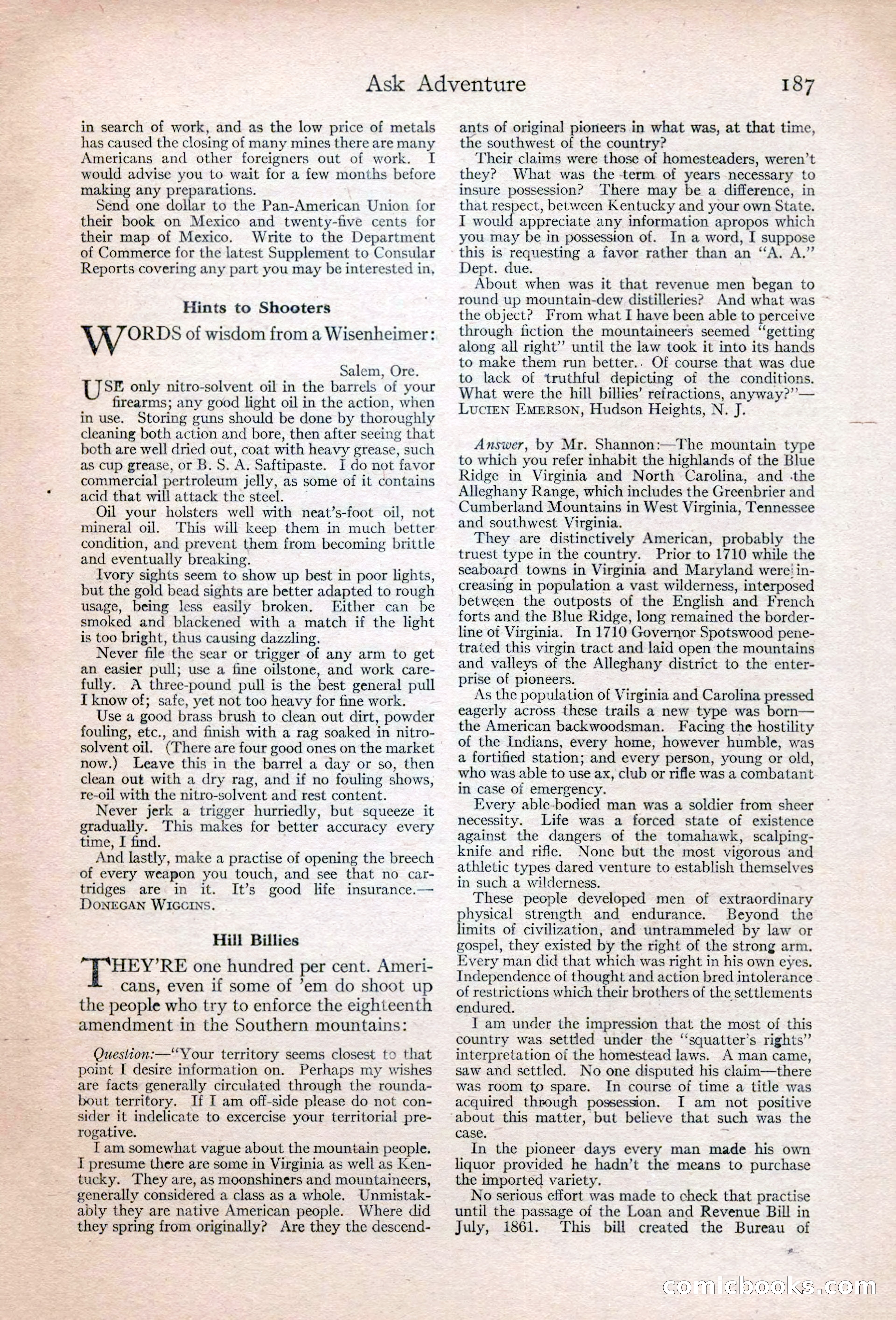
A restored page from Pulp Fiction, 1922. Page through the whole issue in the reader above.
📄 Transcribed text from this page (OCR, searchable)
Machine-transcribed from the original scan — historical spelling and the odd misread are preserved.
Ask Adventure in search of work, and as the low price of metals has caused the closing of many mines there are many Americans and other foreigners out of work. I would advise you to wait for a few months before making any preparations. Send one dollar to the Pan-American Union for their book on Mexico and twenty-five cents for their map of Mexico. Write to the Department of Commerce for the latest Supplement to Consular Reports covering any part you may be interested in, Hints to Shooters \ ' JORDS of wisdom from a Wisenheimer: Salem, Ore. USE only nitro-solvent oil in the barrels of your firearms; any good light oil in the action, when in use. Storing guns should be done by thoroughly cleaning both action and bore, then after seeing that both are well dried out, coat with heavy grease, such as cup grease, or B.S. A. Saftipaste. I do not favor commercial pertroleum jelly, as some of it contains acid that will attack the steel. Oil your holsters well with neat’s-foot oil, not mineral oil. This will keep them in much better condition, and prevent them from becoming brittle and eventually breaking. Ivory sights seem to show up best in poor lights, but the gold bead sights are better adapted to rough usage, being less easily broken. Either can be smoked and blackened with a match if the light is too bright, thus causing dazzling. Never file the sear or trigger of any arm to get an easier pull; use a fine oilstone, and work care- fully. A three-pound pull is the best general pull I know of; safe, yet not too heavy for fine work. Use a good brass brush to clean out dirt, powder fouling, etc., and finish with a rag soaked in nitro- solvent oil. (There are four good ones on the market now.) Leave this in the barrel a day or so, then clean out with a dry rag, and if no fouling shows, re-oil with the nitro-solvent and rest content. Never jerk a trigger hurriedly, but squeeze it gradually. This makes for better accuracy every time, I find. And lastly, make a practise of opening the breech of every weapon you touch, and see that no car- tridges are in it. It’s good life insurance.— DOoONEGAN WIGCINS. Hill Billies -p HEV'RE one hundred per cent. Ameri- cans, even if some of ’em do shoot up the people who try to enforce the eighteenth amendment in the Southern mountains: Question: —“Your territory seems closest to that point I desire information on. Perhaps my wishes are facts generally circulated through the rounda- bout territory. If I am off-side please do not con- sider it indelicate to excercise your territorial pre- rogative. I am somewhat vague about the mountain people. I presume there are some in Virginia as well as Ken- tucky. They are, as moonshiners and mountaineers, generally considered a class as a whole. Unmistak- ably they are native American people. Where did they spring from originally? Are they the descend- 187 ants of original pioneers in what was, at that time, the southwest of the country? Their claims were those of homesteaders, weren’t they? What was the term of years necessary to insure possession? There may be a difference, in that respect, between Kentucky and your own State. I would appreciate any information apropos which you may be in possession of. In a word, I suppose this is requesting a favor rather than an ‘“‘A. A.” Dept. due. About when was it that revenue men began to round up mountain-dew distilleries? And what was ~ the object? From what I have been able to perceive through fiction the mountaineers seemed ‘“‘getting along all right’ until the law took it into its hands to make them run better.. Of course that was due to lack of truthful depicting of the conditions. What were the hill billies’ refractions, anyway?’’— LucIEN EMERSON, Hudson Heights, N. J. Answer, by Mr. Shannon:—The mountain type to which you refer inhabit the highlands of the Blue Ridge in Virginia and North Carolina, and .the Alleghany Range, which includes the Greenbrier and Cumberland Mountains in West Virginia, Tennessee and southwest Virginia. They are distinctively American, probably the truest type in the country. Prior to 1710 while the seaboard towns in Virginia and Maryland were: in- creasing in population a vast wilderness, interposed between the outposts of the English and French forts and the Blue Ridge, long remained the border- line of Virginia. In 1710 Governor Spotswood pene- trated this virgin tract and laid open the mountains and valleys of the Alleghany district to the enter- prise of pioneers. As the population of Virginia and Carolina pressed eagerly across these trails a new type was born— the American backwoodsman. Facing the hostility of the Indians, every home, however humble, was a fortified station; and every person, young or old, who was able to use ax, Club or rifle was a combatant in case of emergency. Every able-bodied man was a soldier from sheer necessity. Life was a forced state of existence against the dangers of the tomahawk, scalping- knife and rifle. None but the most vigorous and athletic types dared venture to establish themselves in such a wilderness. These people developed men of extraordinary physical strength and endurance. Beyond the limits of civilization, and untrammeled by law or gospel, they existed by the right of the strong arm. Every man did that which was right in his own eyes. Independence of thought and action bred intolerance of restrictions which their brothers of the settlements endured. I am under the impression that the most of this country was settled under the “squatter’s rights” interpretation of the homestead laws. A man came, saw and settled. No one disputed his claim—there was room to spare. In course of time a title was acquired through possession. I am not positive about this matter, but believe that such was the case. In the pioneer days every man made his own liquor provided he hadn’t the means to purchase the imported variety. No serious effort was made to check that practise until the passage of the Loan and Revenue Bill in July, 1861. This bill created the Bureau of # COMmMicloookKks (C@