
Pulp Fiction, 1922 · page 195 of 200
Adventure Magazine Cover — page 195: what you’re looking at
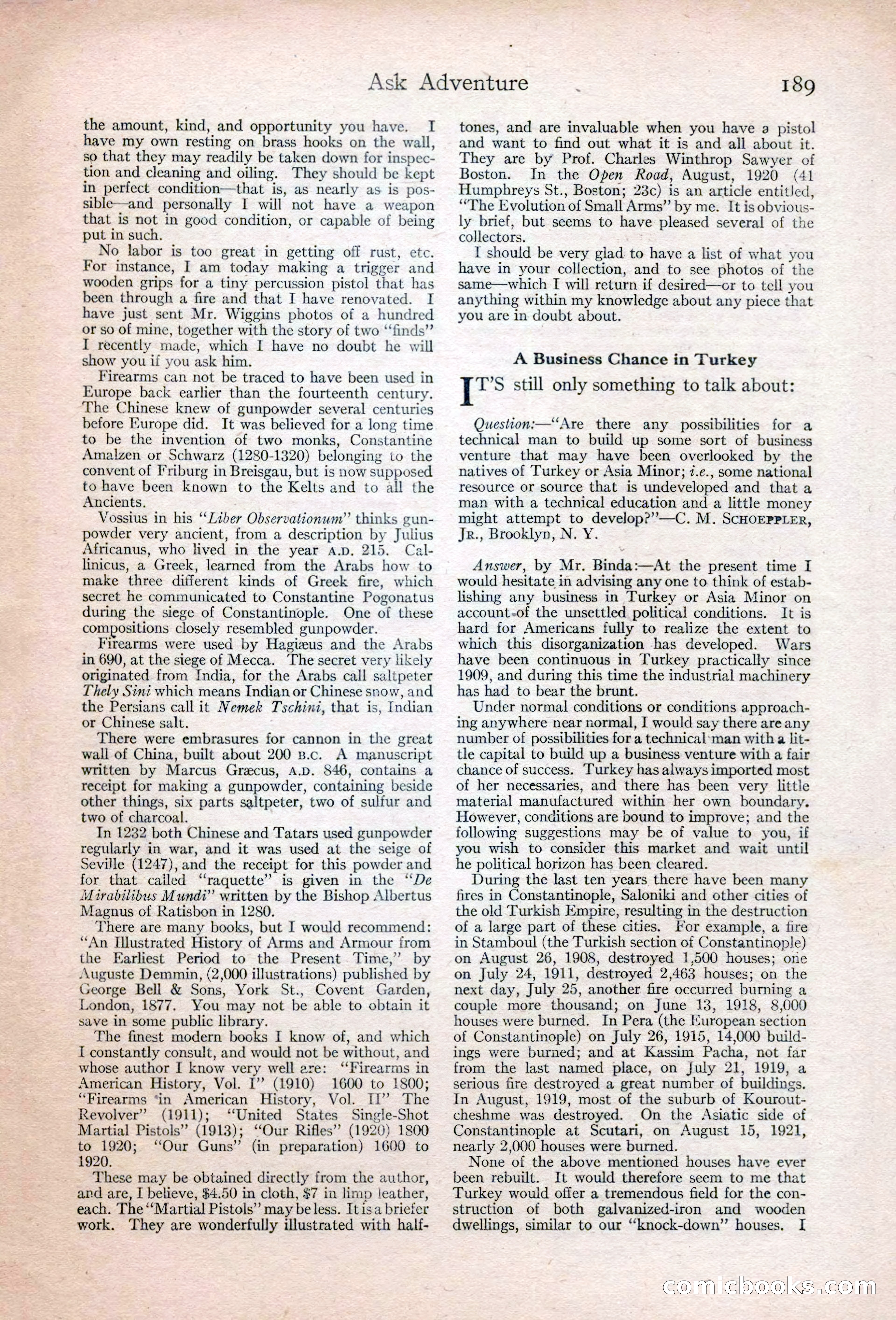
A restored page from Pulp Fiction, 1922. Page through the whole issue in the reader above.
📄 Transcribed text from this page (OCR, searchable)
Machine-transcribed from the original scan — historical spelling and the odd misread are preserved.
Ask Adventure - the amount, kind, and opportunity you have. I have my own resting on brass hooks on the wall, so that they may readily be taken down for inspec- tion and cleaning and oiling. They should be kept in perfect condition—that is, as nearly as is pos- sible—and personally I will not have a weapon that is not in good condition, or capable of being put in such. No labor is too great in getting off rust, etc. For instance, I am today making a trigger and wooden grips for a tiny percussion pistol that has been through a fire and that I have renovated. I have just sent Mr. Wiggins photos of a hundred or so of mine, together with the story of two “‘finds”’ I recently made, which I have no doubt he will show you if you ask him. Firearms can not be traced to have been used in Europe back earlier than the fourteenth century. The Chinese knew of gunpowder several centuries before Europe did. It was believed for a long time to be the invention of two monks, Constantine Amalzen or Schwarz (1280-1320) belonging to the convent of Friburg in Breisgau, but is now supposed to have been known to the Kelts and to all the Ancients. Vossius in his “Liber Observationum” thinks gun- powder very ancient, from a description by Julius Africanus, who lived in the year a.p. 215. Cal- linicus, a Greek, learned from the Arabs how to make three different kinds of Greek fire, which secret he communicated to Constantine Pogonatus during the siege of Constantinople. One of these compositions closely resembled gunpowder. Firearms were used by Hagieus and the Arabs in 690, at the siege of Mecca. The secret very likely originated from India, for the Arabs call saltpeter Thely Sini which means Indian or Chinese snow, and the Persians call it Nemek Tschini, that is, Indian or Chinese salt. There were embrasures for cannon in the great wall of China, built about 200 B.c. A manuscript written by Marcus Grecus, A.D. 846, contains a receipt for making a gunpowder, containing beside other things, six parts saltpeter, two of sulfur and two of charcoal. In 1232 both Chinese and Tatars used gunpowder regularly in war, and it was used at the seige of Seville (1247), and the receipt for this powder and for that called ‘‘raquette” is given in the “De Mirabilibus Mundi” written by the Bishop Albertus Magnus of Ratisbon in 1280. There are many books, but I would recommend: ‘An Illustrated History of Arms and Armour from the Earliest Period to the Present Time,” by Auguste Demmin, (2,000 illustrations) published by George Bell & Sons, York St., Covent Garden, London, 1877. You may not be able to obtain it save in some public library. The finest modern books I know of, and which I constantly consult, and would not be without, and whose author I know very well are: ‘Firearms in American History, Vol. I”? (1910) 1600 to 1800; “Firearms ‘in American History, Vol. II” The Revolver” (1911); “United States Single-Shot Martial Pistols” (1913); ‘‘Our Rifles” (1920) 1800 to 1920; “Our Guns” (in preparation) 1600 to 1920. These may be obtained directly from the author, and are, I believe, $4.50 in cloth, $7 in limp leather, each. The ‘Martial Pistols” may be less. It isa briefer work. They are wonderfully illustrated with half- 189 tones, and are invaluable when you have a pistol and want to find out what it is and all about it. They are by Prof. Charles Winthrop Sawyer of Boston. In the Open Road, August, 1920 (41 Humphreys St., Boston; 23c) is an article entitled, “The Evolution of Small Arms” by me. It is obvious- ly brief, but seems to have pleased several of the collectors. I should be very glad to have a list of what you have in your collection, and to see photos of the same—which I will return if desired—or to tell you anything within my knowledge about any piece that you are in doubt about. A Business Chance in Turkey Ese still only something to talk about: Question: —‘Are there any possibilities for a technical man to build up some sort of business venture that may have been overlooked by the natives of Turkey or Asia Minor; 7.e., some national resource or source that is undeveloped and that a man with a technical education and a little money might attempt to develop?’”’—C. M. ScHOEPPLER, Jr., Brooklyn, N. Y. Answer, by Mr. Binda:—At the present time I would hesitate in advising any one to think of estab- lishing any business in Turkey or Asia Minor on account-of the unsettled political conditions. It is hard for Americans fully to realize the extent to which this disorganization has developed. Wars have been continuous in Turkey practically since 1909, and during this time the industrial machinery has had to bear the brunt. Under normal conditions or conditions approach- ing anywhere near normal, I would say there are any number of possibilities for a technical-man with a lit- tle capital to build up a business venture with a fair chance of success. Turkey has always imported most of her necessaries, and there has been very little material manufactured within her own boundary. However, conditions are bound to improve; and the following suggestions may be of value to you, if you wish to consider this market and wait until he political horizon has been cleared. During the last ten years there have been many fires in Constantinople, Saloniki and other cities of the old Turkish Empire, resulting in the destruction of a large part of these cities, For example, a fire in Stamboul (the Turkish section of Constantinople) on August 26, 1908, destroyed 1,500 houses; one on July 24, 1911, destroyed 2,463 houses; on the next day, July 25, another fire occurred burning a couple more thousand; on June 138, 1918, 8,000 houses were burned. In Pera (the European section of Constantinople) on July 26, 1915, 14,000 build- ings were burned; and at Kassim Pacha, not far from the last named place, on July 21, 1919, a serious fire destroyed a great number of buildings. In August, 1919, most of the suburb of Kourout- cheshme was destroyed. On the Asiatic side of Constantinople at Scutari, on August 15, 1921, nearly 2,000 houses were burned. None of the above mentioned houses have ever been rebuilt. It would therefore seem to me that Turkey would offer a tremendous field for the con- struction of both galvanized-iron and wooden dwellings, similar to our “knock-down’”’ houses. I GomiGchbooks (C@