
Pulp Fiction, 1922 · page 196 of 200
Adventure Magazine Cover — page 196: what you’re looking at
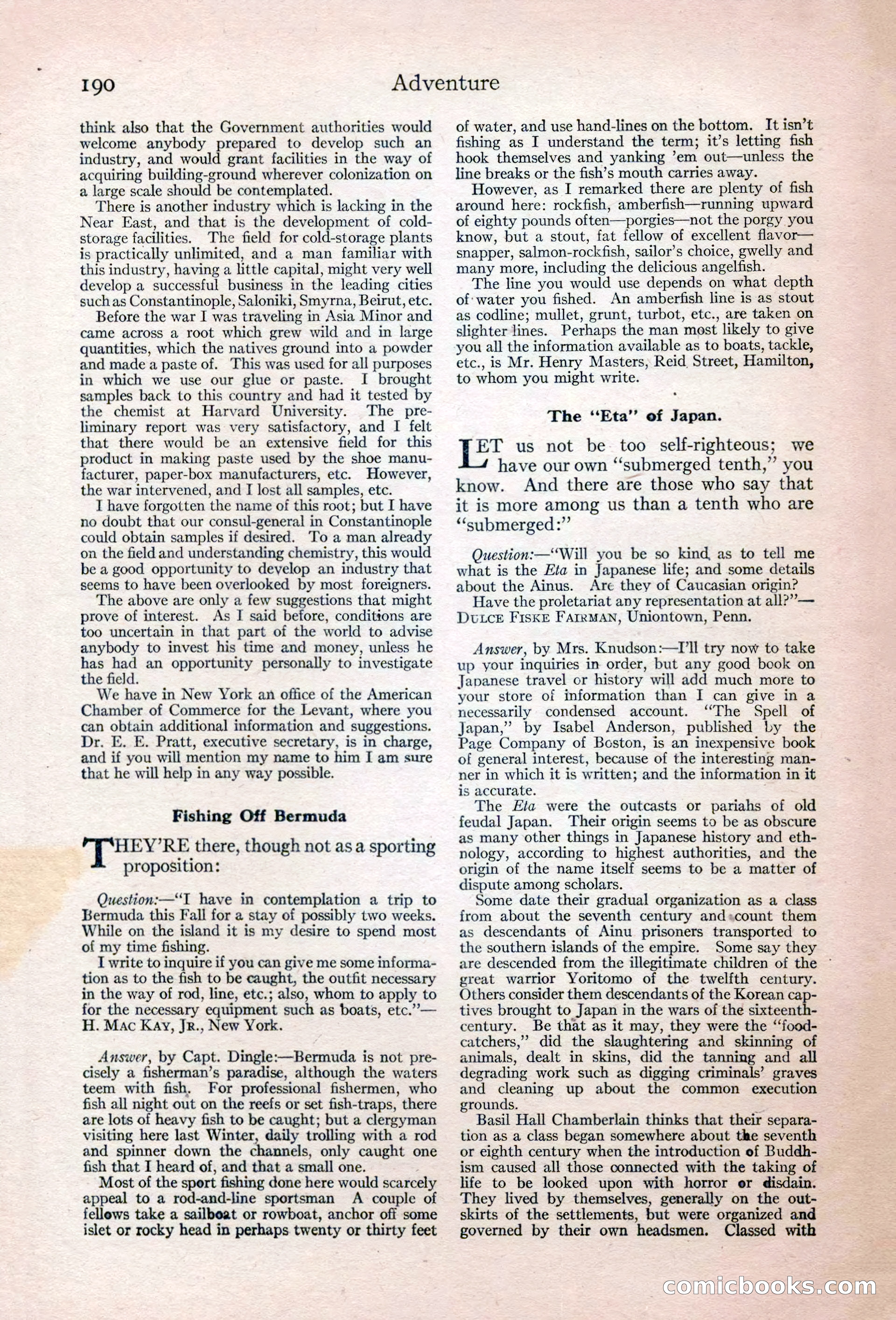
A restored page from Pulp Fiction, 1922. Page through the whole issue in the reader above.
📄 Transcribed text from this page (OCR, searchable)
Machine-transcribed from the original scan — historical spelling and the odd misread are preserved.
190 think also that the Government authorities would welcome anybody prepared to develop such an industry, and would grant facilities in the way of acquiring building-ground wherever colonization on a large scale should be contemplated. There is another industry which is lacking in the Near East, and that is the development of cold- storage facilities. The field for cold-storage plants is practically unlimited, and a man familiar with this industry, having a little capital, might very well develop a successful business in the leading cities such as Constantinople, Saloniki, Smyrna, Beirut, etc. Before the war I was traveling in Asia Minor and came across a root which grew wild and in large quantities, which the natives ground into a powder and made a paste of. This was used for all purposes in which we use our glue or paste. I brought samples back to this country and had it tested by the chemist at Harvard University. The pre- liminary report was very satisfactory, and I felt that there would be an extensive field for this product in making paste used by the shoe manu- facturer, paper-box manufacturers, etc. However, the war intervened, and I lost all samples, etc. I have forgotten the name of this root; but I have no doubt that our consul-general in Constantinople could obtain samples if desired. To a man already on the field and understanding chemistry, this would be a good opportunity to develop an industry that seems to have been overlooked by most foreigners. The above are only a few suggestions that might prove of interest. As I said before, condittons are too uncertain in that part of the world to advise anybody to invest his time and money, unless he has had an opportunity personally to investigate the field. We have in New York an office of the American Chamber of Commerce for the Levant, where you can obtain additional information and suggestions. Dr. E. E. Pratt, executive secretary, is in charge, and if you will mention my name to him I am sure that he will help in any way possible. Fishing Off Bermuda HEY’RE there, though not asa sporting proposition: Question:—“T have in contemplation a trip to Bermuda this Fall for a stay of possibly two weeks. While on the island it is my desire to spend most of my time fishing. I write to inquire if you can give me some informa- tion as to the fish to be caught, the outfit necessary in the way of rod, line, etc.; also, whom to apply to for the necessary equipment such as boats, etc.”— H. Mac Kay, Jr., New York. Answer, by Capt. Dingle:-—Bermuda is not pre- cisely a fisherman’s paradise, although the waters teem with fish. For professional fishermen, who fish all night out on the reefs or set fish-traps, there are lots of heavy fish to be caught; but a clergyman visiting here last Winter, daily trolling with a rod and spinner down the channels, only caught one fish that I heard of, and that a small one. Most of the sport fishing done here would scarcely appeal to a rod-and-line sportsman A couple of fellows take a sailboat or rowboat, anchor off some islet or rocky head in perhaps twenty or thirty feet Adventure of water, and use hand-lines on the bottom. It isn’t fishing as I understand the term; it’s letting fish hook themselves and yanking ’em out—unless the line breaks or the fish’s mouth carries away. However, as I remarked there are plenty of fish around here: rockfish, amberfish—running upward of eighty pounds often—porgies—not the porgy you know, but a stout, fat fellow of excellent flavor— snapper, salmon-rockfish, sailor’s choice, gwelly and many more, including the delicious angelfish. The line you would use depends on what depth of: water you fished. An amberfish line is as stout as codline; mullet, grunt, turbot, etc., are taken on slighter lines. Perhaps the man most likely to give you all the information available as to boats, tackle, etc., is Mr. Henry Masters, Reid Street, Hamilton, to whom you might write. The ‘‘Eta”’ of Japan. ET us not be too self-righteous; we have our own “submerged tenth,” you know. And there are those who say that it is more among us than a tenth who are “Submerged:” Question: —‘‘Will you be so kind, as to tell me what is the Eta in Japanese life; and some details about the Ainus. Are they of Caucasian origin? Have the proletariat any representation at all?” — Dttce Fiske FarrMAN, Uniontown, Penn. Answer, by Mrs. Knudson:—l’ll try now to take up your inquiries in order, but any good book on Japanese travel or history will add much more to your store of information than I can give in a necessarily condensed account. ‘The Spell of Japan,” by Isabel Anderson, published by the Page Company of Boston, is an inexpensive book of general interest, because of the interesting man- ner in which it is written; and the information in it is accurate. The Hia were the outcasts or pariahs of old feudal Japan. ‘Their origin seems to be as obscure as many other things in Japanese history and eth- nology, according to highest authorities, and the origin of the name itself seems to be a matter of dispute among scholars. Some date their gradual organization as a class from about the seventh century andscount them as descendants of Ainu prisoners transported to the southern islands of the empire. Some say they are descended from the illegitimate children of the ~ great warrior Yoritomo of the twelfth century. Others consider them descendants of the Korean cap- tives brought to Japan in the wars of the sixteenth- century. Be that as it may, they were the “‘food- catchers,’ did the slaughtering and skinning of animals, dealt in skins, did the tanning and all degrading work such as digging criminals’ graves and cleaning up about the common execution grounds. : Basil Hall Chamberlain thinks that their separa- tion as a class began somewhere about the seventh or eighth century when the introduction of Buddh- ism caused all those connected with the taking of life to be looked upon with horror or disdain. They lived by themselves, generally on the out- skirts of the settlements, but were organized and governed by their own headsmen. Classed with CORMICLOOO cS (EO)