
Pulp Fiction, 1922 · page 126 of 200
Adventure Magazine Cover — page 126: what you’re looking at
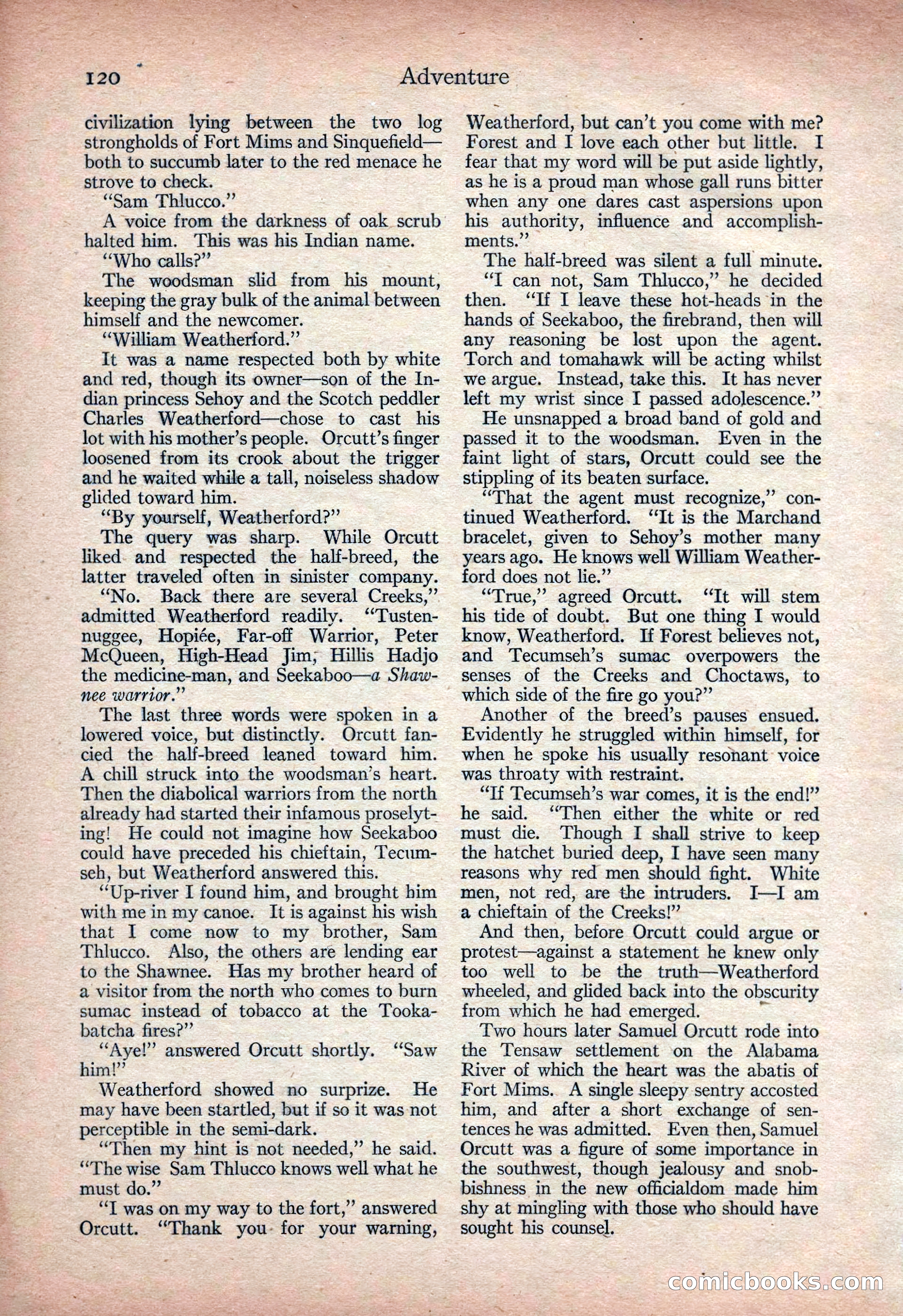
A restored page from Pulp Fiction, 1922. Page through the whole issue in the reader above.
📄 Transcribed text from this page (OCR, searchable)
Machine-transcribed from the original scan — historical spelling and the odd misread are preserved.
ng ah ie yp St aed ey A poe in er ee PIs) 7 tee ew ae iy foe ee ere” na ei A BI ng 5s - Noe Petes! Sea? ae te FS -- Ss < RN NS Ae lke 4 ore es as cg 25% Pe ar aes he . or ‘ . a = try 7 : ~~ = : ’ rs ; Sue ~~" - — ». aa 120 civilization lying between the two log strongholds of Fort Mims and Sinquefield— both to succumb later to the red menace he strove to check. “Sam Thlucco.”’ A voice from the darkness of oak scrub halted him. This was his Indian name. “Who calls?”’ The woodsman slid from his mount, keeping the gray bulk of the animal between himself and the newcomer. “William Weatherford.” It was a name respected both by white and red, though its owner—son of the In- dian princess Sehoy and the Scotch peddler Charles Weatherford—chose to cast his lot with his mother’s people. Orcutt’s finger loosened from its crook about the trigger and he waited while a tall, noiseless shadow glided toward him. “By yourself, Weatherford?” The query was sharp. While Orcutt liked. and respected the half-breed, the latter traveled often in sinister company. “No. Back there are several Creeks,” admitted Weatherford readily. ‘‘Tusten- nuggee, Hopiée, Far-off Warrior, Peter McQueen, High-Head Jim; Hillis Hadjo the medicine-man, and Seekaboo—a Shaw- mee warrior.” The last three words were spoken in a lowered voice, but distinctly. Orcutt fan- cied the half-breed leaned toward him. A chill struck into the woodsman’s heart. Then the diabolical warriors from the north already had started their infamous proselyt- ing! He could not imagine how Seekaboo could have preceded his chieftain, Tecum- seh, but Weatherford answered this. “Up-river I found him, and brought him with me in my canoe. It is against his wish that I come now to my brother, Sam Thlucco. Also, the others are lending ear to the Shawnee. Has my brother heard of a visitor from the north who comes to burn sumac instead of tobacco at the Tooka- batcha fires?” “Aye!” answered Orcutt shortly. him!” Weatherford showed no surprize. He may have been startled, but if so it was not perceptible in the semi-dark. “Then my hint is not needed,” he said. “The wise Sam Thlucco knows well what he must do.” “T was on my way to the fort,’ answered Orcutt. “Thank you- for your warning, “Saw Adventure — Weatherford, but can’t you come with me? Forest and I love each other but little. I fear that my word will be put aside lightly, as he is a proud man whose gall runs bitter when any one dares cast aspersions upon his authority, influence and accomplish- ments.” | The half-breed was silent a full minute. “T can not, Sam Thlucco,” he decided then. “If I leave these hot-heads in the hands of Seekaboo, the firebrand, then will any reasoning be lost upon the agent. Torch and tomahawk will be acting whilst we argue. Instead, take this. It has never left my wrist since I passed adolescence.” He unsnapped a broad band of gold and passed it to the woodsman. Even in the faint light of stars, Orcutt could see the stippling of its beaten surface. “That the agent must recognize,” con- tinued Weatherford. ‘It is the Marchand bracelet, given to Sehoy’s mother many years ago. He knows well William Weather- ford does not lie.” “True,” agreed Orcutt. “It will stem his tide of doubt. But one thing I would know, Weatherford. If Forest believes not, and Tecumseh’s sumac overpowers the senses of the Creeks and Choctaws, to which side of the fire go you?” Another of the breed’s pauses ensued. Evidently he struggled within himself, for when he spoke his usually resonant voice was throaty with restraint. “Tf Tecumseh’s war comes, it is the end!’’ he said. ‘‘Then either the white or red must die. Though I shall strive to keep the hatchet buried deep, I have seen many reasons why red men should fight. White men, not red, are the intruders. I—I am a chieftain of the Creeks!” And then, before Orcutt could argue or protest—against a statement he knew only too well to be the truth—Weatherford wheeled, and glided back into the obscurity from which he had emerged. Two hours later Samuel Orcutt rode into the Tensaw settlement on the Alabama River of which the heart was the abatis of Fort Mims. A single sleepy sentry accosted him, and after a short exchange of sen- tences he was admitted. Even then, Samuel Orcutt was a figure of some importance in the southwest, though jealousy and snob- bishness in the new officialdom made him shy at mingling with those who should have sought his counsel. JOOKS (E@) |