
Pulp Fiction, 1922 · page 181 of 200
Adventure Magazine Cover — page 181: what you’re looking at
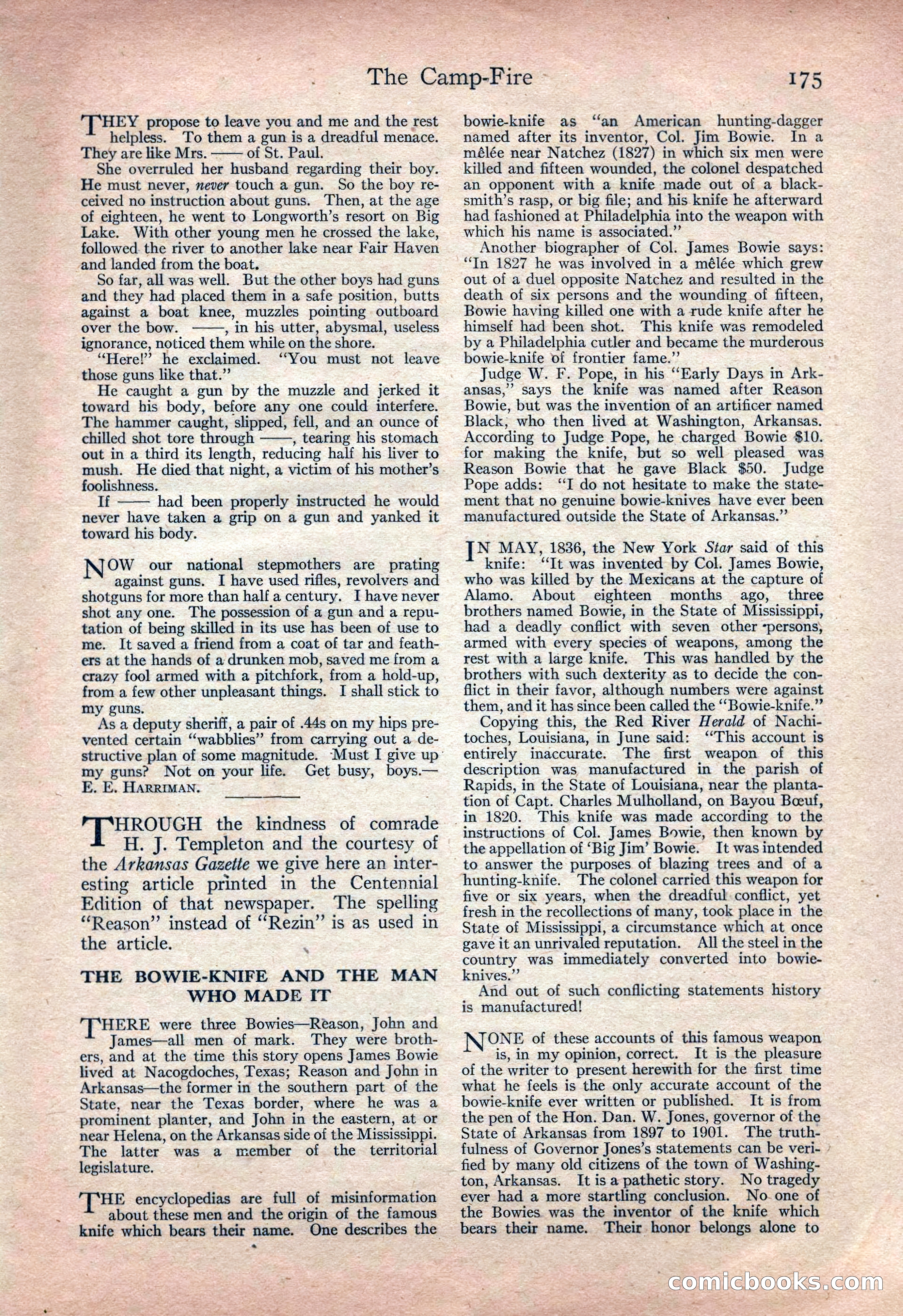
A restored page from Pulp Fiction, 1922. Page through the whole issue in the reader above.
📄 Transcribed text from this page (OCR, searchable)
Machine-transcribed from the original scan — historical spelling and the odd misread are preserved.
The Camp-Fire - "T HEY propose to leave you and me and the rest helpless. To them a gun is a dreadful menace. They are like Mrs. of St. Paul. : She overruled her husband regarding their boy. He must never, zever touch a gun. So the boy re- ceived no instruction about guns. Then, at the age of eighteen, he went to Longworth’s resort on Big Lake. With other young men he crossed the lake, followed. the river to another lake near Fair Haven and landed from the boat. So far, all was well. But the other boys had guns and they had placed them in a safe position, butts against a boat knee, muzzles pointing outboard over the bow. , in his utter, abysmal, useless ignorance, noticed them while on the shore. “Tere!” he exclaimed. ‘You must not leave those guns like that.” He caught a gun by the muzzle and jerked it toward his body, before any one could interfere. The hammer caught, slipped, fell, and an ounce of chilled shot tore through , tearing his stomach out in a third its length, reducing half his liver to mush. He died that night, a victim of his mother’s foolishness. If had been properly instructed he would never have taken a grip on a gun and yanked it toward his body. Now our national stepmothers are prating against guns. I have used rifles, revolvers and shotguns for more than half a century. I have never shot any one. The possession of a gun and a repu- tation of being skilled in its use has been of use to me. It saved a friend from a coat of tar and feath- ers at the hands of a drunken mob, saved me from a crazy fool armed with a pitchfork, from a hold-up, from a few other unpleasant things. I shall stick to my guns. As a deputy sheriff, a pair of .44s on my hips pre- vented certain ‘“‘wabblies” from carrying out a de- structive plan of some magnitude. Must I give up’ my guns? Not on your life. Get busy, boys.— FE. E. HARRIMAN. HROUGH the kindness of comrade H. J. Templeton and the courtesy of the Arkansas Gazette we give here an inter- esting article printed in the Centennial Edition of that newspaper. The spelling “Reason” instead of “‘Rezin’”’ is as used in the article. : THE BOWIE-KNIFE AND THE MAN WHO MADE IT "THERE were three Bowies—Reéason, John and James—all men of mark. They were broth- ers, and at the time this story opens James Bowie lived at Nacogdoches, Texas; Reason and John in Arkansas—the former in the southern part of the State, near the Texas border, where he was a prominent planter, and John in the eastern, at or near Helena, on the Arkansas side of the Mississippi. The latter was a member of the territorial legislature. ‘THE encyclopedias are full of misinformation about these men and the origin of the famous knife which bears their name. One describes the * 175 bowie-knife as “an American hunting-dagger named after its inventor, Col. Jim Bowie. In a mélée near Natchez (1827) in which six men were killed and fifteen wounded, the colonel despatched an opponent with a knife made out of a black- smith’s rasp, or big file; and his knife he afterward had fashioned at Philadelphia into the weapon with which his name is associated.” Another biographer of Col. James Bowie says: “In 1827 he was involved in a mélée which grew out of a duel opposite Natchez and resulted in the death of six persons and the wounding of fifteen, Bowie having killed one with a rude knife after he himself had been shot. This knife was remodeled by a Philadelphia cutler and became the murderous bowie-knife of frontier fame.”’ | Judge W. F. Pope, in his “Early Days in Ark- ansas,’ says the knife was named after Reason Bowie, but was the invention of an artificer named Black; who then lived at Washington, Arkansas. According to Judge Pope, he charged Bowie $10. for making the knife, but so well pleased was Reason Bowie that he gave Black $50. Judge Pope adds: “I do not hesitate to make the state- ment that no genuine bowie-knives have ever been manufactured outside the State of Arkansas.”’ [N MAY, 1836, the New York Séar said of this knife: ‘It was invented by Col. James Bowie, who was killed by the Mexicans at the capture of Alamo. About eighteen months ago, three brothers named Bowie, in the State of Mississippi, had a deadly conflict with seven other -persons, armed with every species of weapons, among the rest with a large knife. This was handled by the brothers with such dexterity as to decide the con- flict in their favor, although numbers were against them, and it has since been called the ““Bowie-knife.” Copying this, the Red River Herald of Nachi- toches, Louisiana, in June said: ‘This account is entirely inaccurate. The first weapon of this description was manufactured in the parish of Rapids, in the State of Louisiana, near the planta- tion of Capt. Charles Mulholland, on Bayou Boeuf, in 1820. This knife was made according to the instructions of Col. James Bowie, then known by the appellation of ‘Big Jim’ Bowie. It was intended to answer the purposes of blazing trees and of a hunting-knife. The colonel carried this weapon for five or six years, when the dreadful conflict, yet fresh in the recollections of many, took place in the State of Mississippi, a circumstance which at once gave it an unrivaled reputation. All the steel in the country was immediately converted into bowie- knives.” And out of such conflicting statements history is manufactured! ONE of these accounts of this famous weapon is, in my opinion, correct. It is the pleasure of the writer to present herewith for the first time what he feels is the only accurate account of the bowie-knife ever written or published. It is from the pen of the Hon. Dan. W. Jones, governor of the State of Arkansas from 1897 to 1901. The truth- fulness of Governor Jones’s statements can be veri- ° fied by many old citizens of the town of Washing- ton, Arkansas. It is a pathetic story. No tragedy ever had a more startling conclusion. No-one of the Bowies was the inventor of the knife which bears their name. Their honor belongs alone to nNicboo (E ‘S. 5 eo)