
Pulp Fiction, 1922 · page 182 of 200
Adventure Magazine Cover — page 182: what you’re looking at
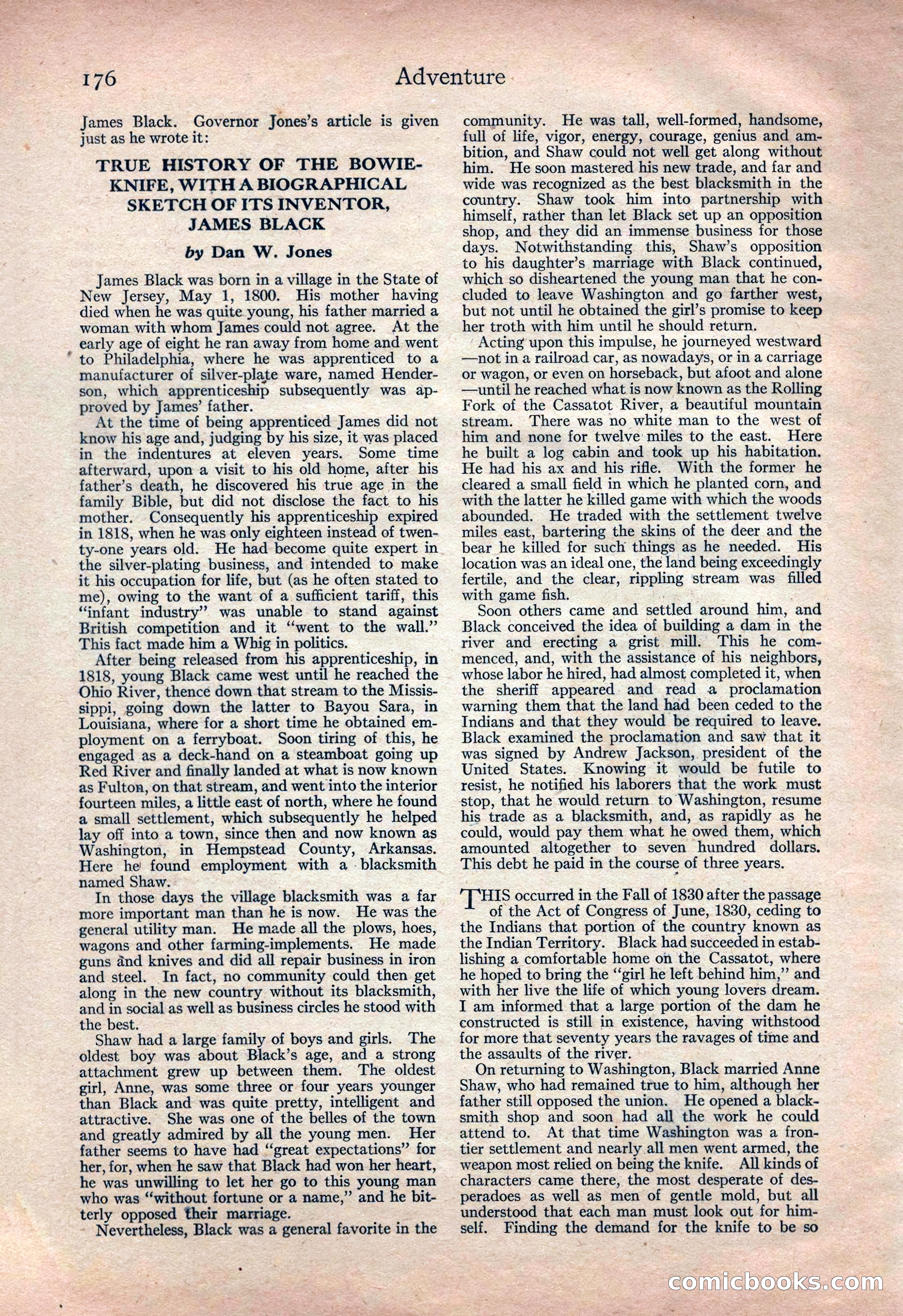
A restored page from Pulp Fiction, 1922. Page through the whole issue in the reader above.
📄 Transcribed text from this page (OCR, searchable)
Machine-transcribed from the original scan — historical spelling and the odd misread are preserved.
J 176 James Black. Governor Jones’s article is given just as he wrote it: TRUE HISTORY OF THE BOWIE- KNIFE, WITH A BIOGRAPHICAL SKETCH OF ITS INVENTOR, JAMES BLACK by Dan W. Jones James Black was born in a village in the State of New Jersey, May 1, 1800. His mother having died when he was quite young, his father married a woman with whom James could not agree. At the early age of eight he ran away from home and went to Philadelphia, where he was apprenticed to a manufacturer of silver-plate ware, named Hender- son, which apprenticeship subsequently was ap- proved by James’ father. At the time of being apprenticed James did not know his age and, judging by his size, it was placed in the indentures at eleven years. Some time afterward, upon a visit to his old home, after his father’s death, he discovered his true age in the family Bible, but did not disclose the fact to his mother. Consequently his apprenticeship expired in 1818, when he was only eighteen instead of twen- ty-one years old. He had become quite expert in the silver-plating business, and intended to make it his occupation for life, but (as he often stated to me), owing to the want of a sufficient tariff, this “infant industry’ was unable to stand against British competition and it “went to the wall.” This fact made him a Whig in politics. After being released from his apprenticeship, in 1818, young Black came west until he reached the Ohio River, thence down that stream to the Missis- sippi, going down the latter to Bayou Sara, in Louisiana, where for a short time he obtained em- ployment on a ferryboat. Soon tiring of this, he engaged as a deck-hand on a steamboat going up Red River and finally landed at what is now known as Fulton, on that stream, and went into the interior fourteen miles, a little east of north, where he found a small settlement, which subsequently he helped lay off into a town, since then and now known as Washington, in Hempstead County, Arkansas. Here he found employment with a - blacksmith named Shaw. In those days the village blacksmith was a far more important man than he is now. He was the general utility man. He made all the plows, hoes, wagons and other farming-implements. He made guns and knives and did all repair business in iron and steel. In fact, no community could then get along in the new country without its blacksmith, and in social as well as business circles he stood with the best. Shaw had a large family of boys and girls. The oldest boy was about Black’s age, and a strong attachment grew up between them. The oldest girl, Anne, was some three or four years younger than Black and was quite pretty, intelligent and attractive. She was one of the belles of the town and greatly admired by all the young men. Her father seems to have had “great expectations” for her, for, when he saw that Black had won her heart, he was unwilling to let her go to this young man who was “without fortune or a name,” and he bit- terly opposed their marriage. - Nevertheless, Black was a general favorite in the Adventure community. He was tall, well-formed, handsome, full of life, vigor, energy, courage, genius and am- bition, and Shaw could not well get along without him. He soon mastered his new trade, and far and wide was recognized as the best blacksmith in the country. Shaw took him into partnership with himself, rather than let Black set up an opposition shop, and they did an immense business for those days. Notwithstanding this, Shaw’s opposition to his daughter’s marriage with Black continued, which so disheartened the young man that he con- cluded to leave Washington and go farther west, but not until he obtained the girl’s promise to keep her troth with him until he should return. Acting’ upon this impulse, he journeyed westward —not in a railroad car, as nowadays, or in a carriage or wagon, or even on horseback, but afoot and alone —until he reached what is now known as the Rolling Fork of the Cassatot River, a beautiful mountain stream. ‘There was no white man to the west of him and none for twelve miles to the east. Here he built a log cabin and took up his habitation, He had his ax and his rifle. With the former he cleared a small field in which he planted corn, and with the latter he killed game with which the woods abounded. He traded with the settlement twelve miles east, bartering the skins of the deer and the bear he killed for such things as he needed. His location was an ideal one, the land being exceedingly fertile, and the clear, rippling stream was filled with game fish. cinegee Soon others came and settled around him, and Black conceived the idea of building a dam in the river and erecting a grist mill: This he com- menced, and, with the assistance of his neighbors, whose labor he hired, had almost completed it, when the sheriff appeared. and read a proclamation warning them that the land had been ceded to the Indians and that they would be required to leave. Black examined the proclamation and saw that it was signed by Andrew Jackson, president of the United States. Knowing it would be futile to resist, he notified his laborers that the work must stop, that he would return to Washington, resume his trade as a blacksmith, and, as rapidly as he could, would pay them what he owed them, which amounted altogether to seven hundred dollars. This debt he paid in the course of three years. ‘THis occurred in the Fall of 1830 after the passage of the Act of Congress of June, 1830, ceding to the Indians that portion of the country known as the Indian Territory. Black had succeeded in estab- lishing a comfortable home on the Cassatot, where he hoped to bring the “girl he left behind him,” and with her live the life of which young lovers dream. I am informed that a large portion of the dam he constructed is still in existence, having withstood for more that seventy years the ravages of time and the assaults of the river. On returning to Washington, Black married Anne Shaw, who had remained true to him, although her father still opposed the union. He opened a black- smith shop and soon had all the work he could attend to. At that time Washington was a fron- tier settlement and nearly all men went armed, the weapon most relied on being the knife. All kinds of characters came there, the most desperate of des- peradoes as well as men of gentle mold, but all understood that each man must look out for him- self. Finding the demand for the knife to be so Gomichoo () <S (EC) nm