
Pulp Fiction, 1922 · page 183 of 200
Adventure Magazine Cover — page 183: what you’re looking at
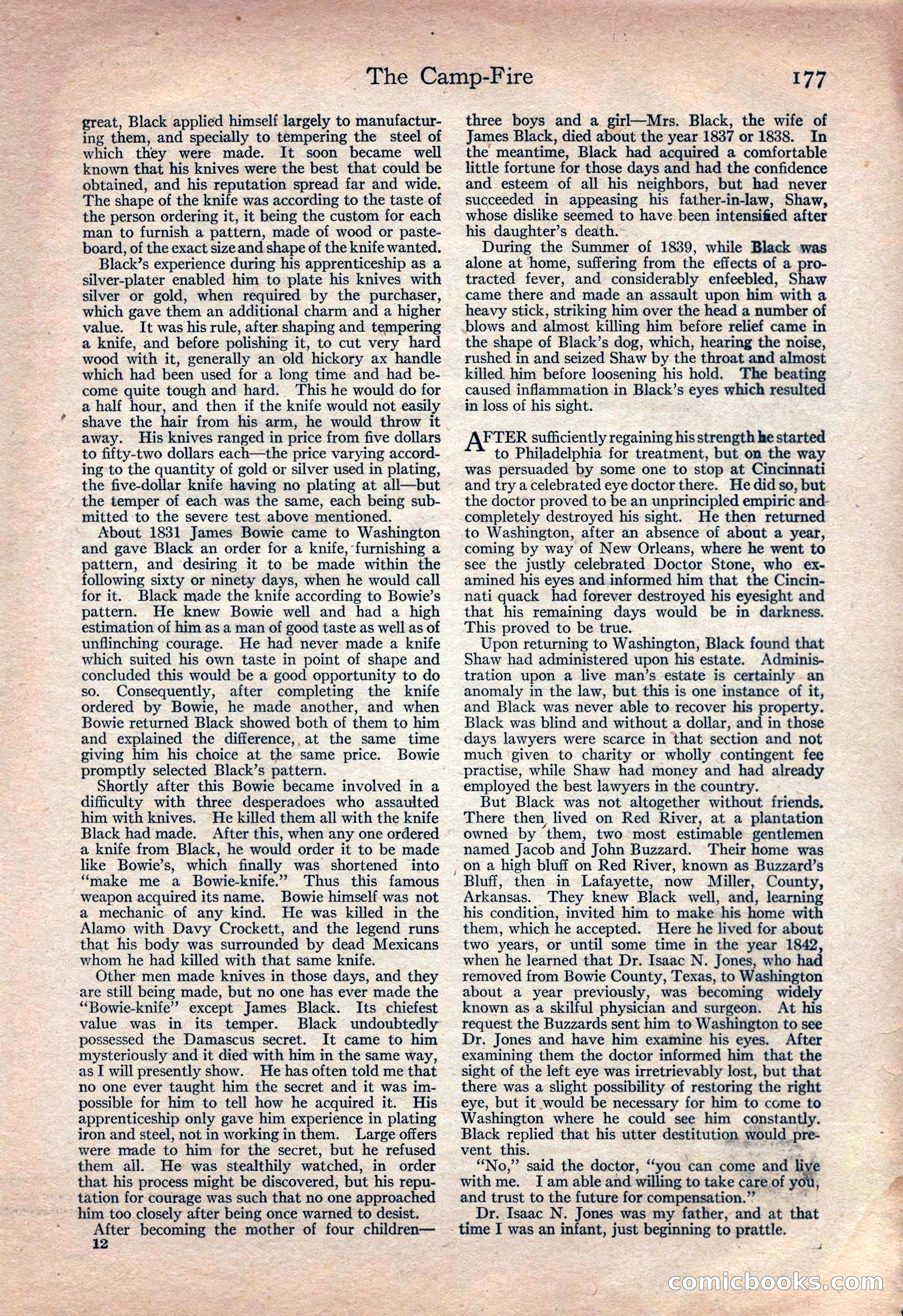
A restored page from Pulp Fiction, 1922. Page through the whole issue in the reader above.
📄 Transcribed text from this page (OCR, searchable)
Machine-transcribed from the original scan — historical spelling and the odd misread are preserved.
~The Camp-Fire great, Black applied himself largely to manufactur- ing them, and specially to tempering the steel of which they were made. It soon became well known that his knives were the best that could be obtained, and his reputation spread far and wide. The shape of the knife was according to the taste of the person ordering it, it being the custom for each man to furnish a pattern, made of wood or paste- board, of the exact size and shape of the knife wanted. Black’s experience during his apprenticeship as a silver-plater enabled him to plate his knives with silver or gold, when required by the purchaser, which gave them an additional charm and a higher value. It was his rule, after shaping and tempering a knife, and before polishing it, to cut very hard wood with it, generally an old hickory ax handle which had been used for a long time and had be- come quite tough and hard. This he would do for a half hour, and then if the knife would not easily shave the hair from his arm, he would throw it away. His knives ranged in price from five dollars to fifty-two dollars each—the price varying accord- ing to the quantity of gold or silver used in plating, the five-dollar knife having no plating at all—but the temper of each was the same, each being sub- mitted ‘to the severe test above mentioned. About 1831 James Bowie came to Washington and gave Black an order for a knife, furnishing a pattern, and desiring it to be made within the following sixty or ninety days, when he would call for it. Black made the knife according to Bowie’s pattern. He knew Bowie well and had a high estimation of him as a man of good taste as well as of unflinching courage. He had never made a knife which suited his own taste in point of shape and concluded this would be a good opportunity to do so. Consequently, after completing the knife ordered by Bowie, he made another, and when Bowie returned Black showed both of them to him and explained the difference, at the same time giving him his choice at the same price. Bowie promptly selected Black’s pattern. Shortly after this Bowie became involved in a difficulty with three desperadoes who assaulted him with knives. He killed them all with the knife Black had made. After this, when any one ordered a knife from Black, he would order it to be made like Bowie’s, which finally was shortened into “make me a Bowie-knife.” Thus this famous weapon acquired its name. Bowie himself was not a mechanic of any kind. He was killed in the Alamo with Davy Crockett, and the legend runs that his body was surrounded by dead Mexicans whom he had killed with that same knife. Other men made knives in those days, and they are still being made, but no one has ever made the ““Bowie-knife’”’ except James Black. Its chiefest value was in its temper. Black undoubtedly possessed the Damascus secret. It came to him mysteriously and it died with him in the same way, as I will presently show. He has often told me that no one ever taught him the secret and it was im- possible for him to tell how he acquired it. His apprenticeship only gave him experience in plating iron and steel, not in working in them. Large offers were made to him for the secret, but he refused them ail. He was stealthily watched, in order that his process might be discovered, but his repu- tation for courage was such that no one approached him too closely after being once warned to desist. ass becoming the mother of four children— 177 three boys and a girl—Mrs. Black, the wife of James Black, died about the year 1837 or 1838. In the meantime, Black had acquired a comfortable little fortune for those days and had the confidence and esteem of all his neighbors, but had never succeeded in appeasing his father-in-law, Shaw, whose dislike seemed to have. been intensified after his daughter’s death.~ During the Summer of 1839, while Black was alone at home, suffering from the effects of a pro- tracted fever, and considerably enfeebled, Shaw came there and made an assault upon him with a heavy stick, striking him over the head a number of blows and almost killing him before relief came in the shape of Black’s dog, which, hearing the noise, rushed in and seized Shaw by the throat and almost killed him before loosening his hold. The beating caused inflammation in Black’s eyes which resulted in loss of his sight. AFTER sufficiently regaining his strength he started to Philadelphia for treatment, but on the way was persuaded by some one to stop at Cincinnati and try a celebrated eye doctor there. He did so, but the doctor proved to be an unprincipled empiric and- completely destroyed his sight. He then returned to Washington, after an absence of about a year, coming by way of New Orleans, where he went to see the justly celebrated Doctor Stone, who ex- amined his eyes and informed him that the Cincin- nati quack had forever destroyed his eyesight and that his remaining days would be in darkness. This proved to be true. Upon returning to Washington, Black found that Shaw had administered upon his estate. Adminis- tration upon a live man’s estate is certainly an anomaly in the law, but this is one instance of it, and Black was never able to recover his property. Black was blind and without a dollar, and in those days lawyers were scarce in that section and not much given to charity or wholly contingent fee practise, while Shaw had money and had already employed the best lawyers in the country. But Black was not altogether without frienida, There then lived on Red River, at a plantation owned by them, two most estimable gentlemen named Jacob and John Buzzard. Their home was on a high bluff on Red River, known as Buzzard’s ' Bluff, then in Lafayette, now Miller, County, Arkansas. They knew Black well, and, learning his condition, invited him to make ‘his home with them, which he accepted. Here he lived for about two years, or until some time in the year 1842, when he learned that Dr. Isaac N. Jones, who had removed from Bowie County, Texas, to Washington about a year previously, was becoming widely known as a skilful physician and surgeon. At his request the Buzzards sent him to Washington to see Dr. Jones and have him examine his eyes. After examining them the doctor informed him that the sight of the left eye was irretrievably lost, but that there was a slight possibility of restoring the right eye, but it would be necessary for him to come to Washington where he could see him constantly. Black replied that his utter destitution would pre- vent this. TNO, said the doctor, “you can come and liye with me. I am able and willing to take care of you, and trust to the future for compensation.” Dr. Isaac N. Jones was my father, and at that - time I was an infant, just beginning to prattle. Gomicbooks -)