
Pulp Fiction, 1922 · page 191 of 200
Adventure Magazine Cover — page 191: what you’re looking at
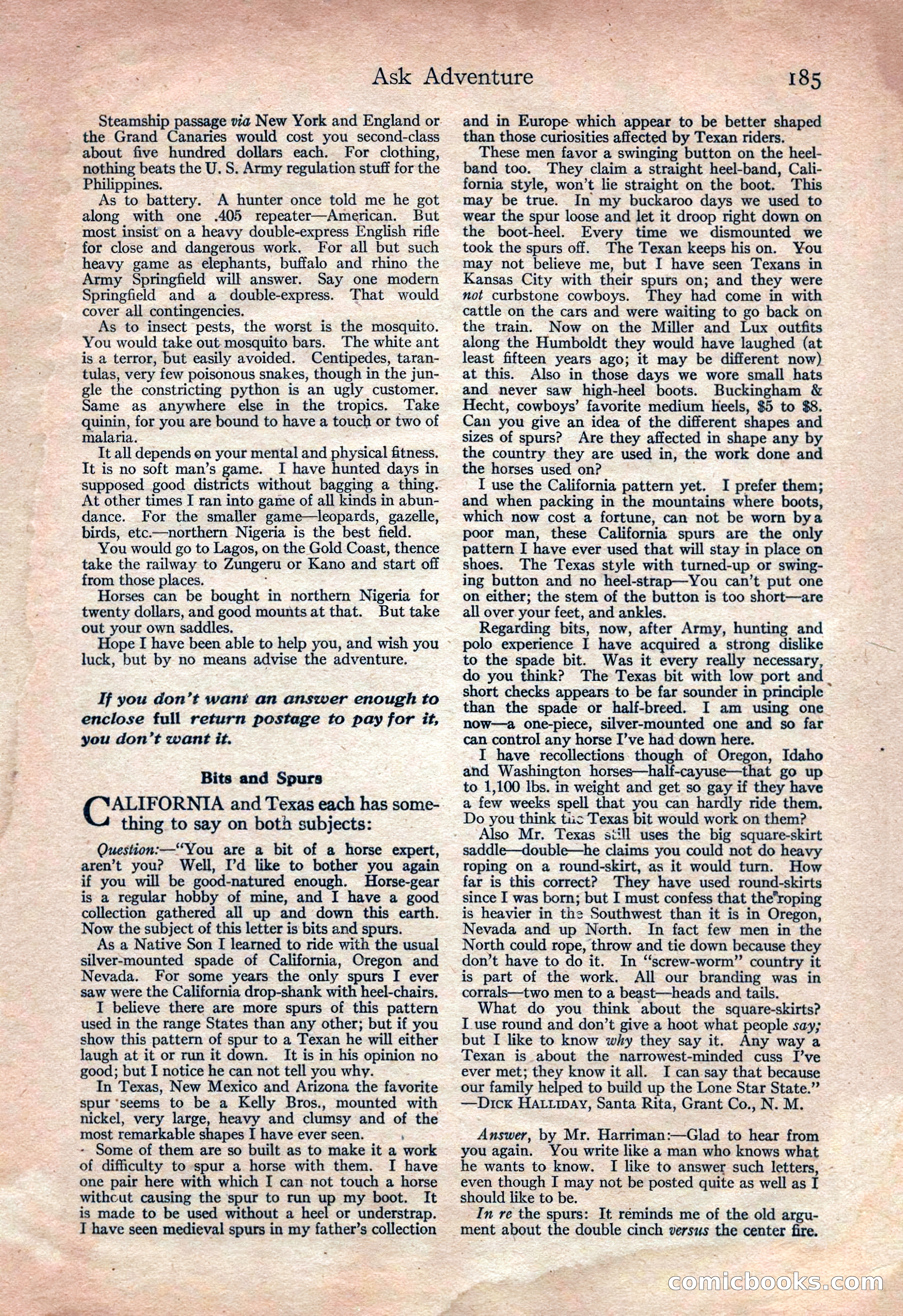
A restored page from Pulp Fiction, 1922. Page through the whole issue in the reader above.
📄 Transcribed text from this page (OCR, searchable)
Machine-transcribed from the original scan — historical spelling and the odd misread are preserved.
Ask Adventure Steamship passage via New York and England or. ~ the Grand Canaries would cost you second-class about five hundred dollars each. For clothing, nothing beats the U. S. Army regulation stuff for the Philippines. As to battery. A hunter once told me he got along with one .405 repeater—American. But most insist on a heavy double-express English rifle for close and dangerous work. For all but such heavy game as elephants, buffalo and rhino the Army Springfield wilt answer. Say one modern Springfield and a double-express. That would cover all contingencies. As to insect pests, the worst is the mosquito. You would take out: mosquito bars. The white ant is a terror, but easily avoided. Centipedes, taran- tulas, very few poisonous snakes, though in the jun- gle the constricting python is an ugly customer. Same as anywhere else in the tropics. Take quinin, for you are bound to have a touch or two of malaria. It all depends on your mental and physical fitness. It is no soft man’s game. I have hunted days in supposed good districts without bagging a thing. At other times I ran into game of all kinds in abun- dance. For the smaller game—leopards, gazelle, birds, etc.—northern Nigeria is the best field. You would go to Lagos, on the Gold Coast, thence take the railway to Zungeru or Kano and start off from those places. ; Horses can be bought in northern Nigeria for twenty dollars, and good mounts at that. But take out your own saddles. Hope I have been able to help you, and wish you > luck, but by no means advise the adventure. If you don’t want an answer enough to enclose full return postage to pay for it, you don’t want it. Bits and Spurs ALIFORNIA and Texas each has some- thing to say on both subjects: Question: —“You are a bit of a horse expert, aren’t you? Well, Id like to bother you again if you will be good-natured enough. Horse-gear is a regular hobby of mine, and I have a good collection gathered all up and down this earth. Now the subject of this letter is bits and spurs. As a Native Son I learned to ride with the usual silver-mounted spade of California, Oregon and Nevada. For some years the only spurs I ever saw were the California drop-shank with heel-chairs. I believe there are more spurs of this pattern used in the range States than any other; but if you show this pattern of spur to a Texan he will either laugh at it or run it down. It is in his opinion no good; but I notice he can not tell you why. In Texas, New Mexico and Arizona the favorite spur ‘seems to be a Kelly Bros., mounted with nickel, very large, heavy and clumsy and of the most remarkable shapes I have ever seen. , - Some of them are so built as to make it a work of difficulty to spur a horse with them. I have one pair here with which I can not touch a horse withcut causing the spur to run up my boot. It is made to be used without a heel or understrap. T have seen medieval spurs in my father’s collection ee eee a — ~ ee a > ots ae | es 2 7 "4 as ¥4 — alee < = 185 and in Europe which appear to be better shaped than those curiosities affected by Texan riders. These men favor a swinging button on the heel- band too. They claim a straight heel-band, Cali- fornia style, won’t lie straight on the boot. This may be true. In my buckaroo days we used to wear the spur loose and let it droop right down on the boot-heel. Every time we dismounted we took the spurs off. The Texan keeps hison. You may not believe me, but I have seen Texans in Kansas City with their spurs on; and they were not curbstone cowboys. They had come in with cattle on the cars and were waiting to go back on the train. Now on the Miller and Lux outfits along the Humboldt they would have laughed (at least fifteen years ago; it may be different now) at this. Also in those days we wore small hats and never saw high-heel boots. Buckingham & Hecht, cowboys’ favorite medium heels, $5 to $8. Can you give an idea of the different shapes and sizes of spurs? Are they affected in shape any by the country they are used in, the work done and the horses used on? : I use the California pattern yet. I prefer them; and when packing in the mountains where boots, which now cost a fortune, can not be worn bya poor man, these California spurs are the only pattern I have ever used that will stay in place on shoes. The Texas style with turned-up or swing- ing button and no heel-strap—You can’t put one on either; the stem of the button is too short—are all over your feet, and ankles. Regarding bits, now, after Army, hunting and polo experience I have acquired a strong dislike to the spade bit. Was it every really necessary, do you think? The Texas bit with low port and_ short checks appears to be far sounder in principle than the spade or half-breed. I am using one now—a one-piece, silver-mounted one and so far can control any horse I’ve had down here. I have recollections though of Oregon, Idaho and Washington horses—half-cayuse—that go up to 1,100 lbs. in weight and get so gay if they have a few weeks spell that you can hardly ride them, Do you think tuic Texas bit would work on them? Also Mr. Texas sitll uses the big square-skirt 3 saddle—double—he claims you could not do heavy roping on a round-skirt, as it would turn. How far is this correct? They have used round-skirts since I was born; but I must confess that the’roping is heavier in the Southwest than it is in Oregon, Nevada and up North. In fact few men in the North could rope, throw and tie down because they don’t have to do it. In “screw-worm” country it is part of the work. All our branding was in corrals—two men to a beast—heads and tails. What do you think about the square-skirts? I_use round and don’t give a hoot what people say; but I like to know why they say it. Any way a Texan is about the narrowest-minded cuss I’ve ever met; they know it all. I can say that because our family helped to build up the Lone Star State.” —Dick HAtimay, Santa Rita, Grant Co., N. M. Answer, by Mr. Harriman:—Glad to hear from you again. You write like a man who knows what he wants to know. I like to answer such letters, - even though I may not be posted quite as well as I should like to be. In re the spurs: It reminds me of the old argu- ment about the double cinch versus the center fire. MUICLOOOKS (EO) nm