
Pulp Fiction, 1922 · page 192 of 200
Adventure Magazine Cover — page 192: what you’re looking at
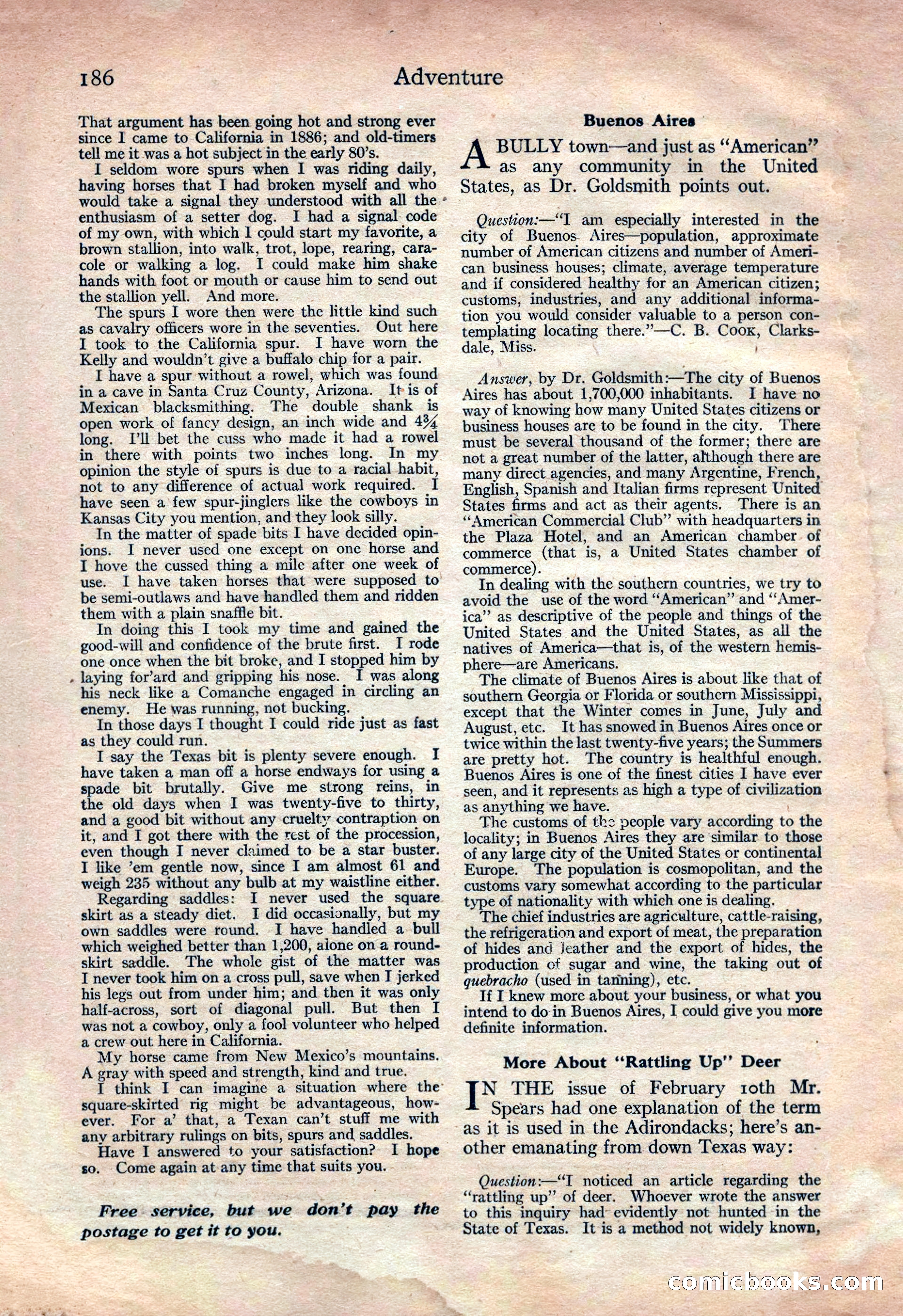
A restored page from Pulp Fiction, 1922. Page through the whole issue in the reader above.
📄 Transcribed text from this page (OCR, searchable)
Machine-transcribed from the original scan — historical spelling and the odd misread are preserved.
186 That argument has been going hot and strong ever since I came to California in 1886; and old-timers tell me it was a hot subject in the early 80’s. I seldom wore spurs when I was riding daily, having horses that I had broken myself and who would take a signal they understood with all the enthusiasm of a setter dog. I had a signal code of my own, with which I could start my favorite, a brown stallion, into walk, trot, lope, rearing, cara- cole or walking a log. I could make him shake hands with foot or mouth or cause him to send out the stallion yell. And more. The spurs I wore then were the little kind such as cavalry officers wore in the seventies. Out here I took to the California spur. I have worn the Kelly and wouldn’t give a buffalo chip for a pair. I have a spur without a rowel, which was found in a cave in Santa Cruz County, Arizona. It is of Mexican blacksmithing. The double shank is open work of fancy design, an inch wide and 434 long. I'll bet the cuss who made it had a rowel in there with points two inches long. In my opinion the style of spurs is due to a racial habit, not to any difference of actual work required. I have seen a few spur-jinglers like the cowboys in Kansas City you mention, and they look silly. In the matter of spade bits I have decided opin- jons. I never used one except on one horse and I hove the cussed thing a mile after one week of use. I have taken horses that were supposed to be semi-outlaws and have handled them and ridden them with a plain snaffle bit. In doing this I took my time and gained the good-will and confidence of the brute first. I rode one once when the bit broke, and I stopped him by , laying for’ard and gripping his nose. I was along his neck like a Comanche engaged in circling an enemy. He was running, not bucking. In those days I thought I could ride just as fast as they could run. I say the Texas bit is plenty severe enough. I have taken a man off a horse endways for using a spade bit brutally. Give me strong reins, in the old days when I was twenty-five to thirty, and a good bit without any cruelty contraption on it, and I got there with the rest of the procession, even though I never claimed to be a star buster. I like ’em gentle now, since I am almost 61 and weigh 235 without any bulb at my waistline either. Regarding saddles: I never used the square skirt as a steady diet. I did occasionally, but my own saddles were round. I have handled a bull which weighed better than 1,200, aione on a round- skirt saddle. The whole gist of the matter was I never took him on a cross pull, save when I jerked his legs out from under him; and then it was only half-across, sort of diagonal pull. But then I was not a cowboy, only a fool volunteer who helped a crew out here in California. My horse came from New Mexico’s mountains. A gray with speed and strength, kind and true. I think I can imagine a situation where the square-skirted rig might be advantageous, how- ever. For a’ that, a Texan can’t stuff me with any arbitrary rulings on bits, spurs and saddles. Have I answered to your satisfaction? I hope so. Come again at any time that suits you. . Free. service, but we don’t pay the postage to get it to you. Adventure Buenos Aires — BULLY town—and just as “American” as any community in the United States, as Dr. Goldsmith points out. Question:—“T am especially interested in the city of Buenos. Aires—population, approximate number of American citizens and number of Ameri- can business houses; climate, average temperature and if considered healthy for an American citizen; customs, industries, and any additional informa- tion you would consider valuable to a person con- templating locating there.”—C. B. Coox, Clarks- dale, Miss. } Answer, by Dr. Goldsmith:—The city of Buenos Aires has about 1,700,000 inhabitants. I have no way of knowing how many United States citizens or business houses are to be found in the city. There must be several thousand of the former; there are not a great number of the latter, although there are many direct agencies, and many Argentine, French, English, Spanish and Italian firms represent United States firms and act as their agents. There is an “American Commercial Club” with headquarters in the Plaza Hotel, and an American chamber. of commerce (that is, a United States chamber of commerce). ; In dealing with the southern countries, we try to avoid the use of the word ‘‘American” and ‘‘Amer- ica’? as descriptive of the people and things of the United States and the United States, as all the natives of America—that is, of the western hemis- phere—are Americans. The climate of Buenos Aires is about like that of southern Georgia or Florida or southern Mississippi, except that the Winter comes in June, July and August, etc. It has snowed in Buenos Aires once or twice within the last twenty-five years; the Summers are pretty hot. The country is healthful enough. Buenos Aires is one of the finest cities I have ever seen, and it represents as high a type of civilization as anything we have. The customs of the people vary according to the locality; in Buenos Aires they are similar to those of any large city of the United States or continental Europe. The population is cosmopolitan, and the customs vary somewhat according to the particular type of nationality with which one is dealing. The chief industries are agriculture, cattle-raising, the refrigeration and export of meat, the preparation of hides and jeather and the export of hides, the production of sugar and wine, the taking out of quebracho (used in tarining), etc. If I knew more about your business, or what you intend to doin Buenos Aires, I could give you more definite information. More About ‘“‘Rattling Up’’ Deer eS THE issue of February 1oth Mr. Spears had one explanation of the term -as it is used in the Adirondacks; here’s an- other emanating from down Texas way: Question:—“I noticed an article regarding the “rattling up’’ of deer. Whoever wrote the answer to this inquiry had evidently not hunted in the State of Texas. It is a method not widely known, Gomichoo <S