
Pulp Fiction, 1922 · page 194 of 200
Adventure Magazine Cover — page 194: what you’re looking at
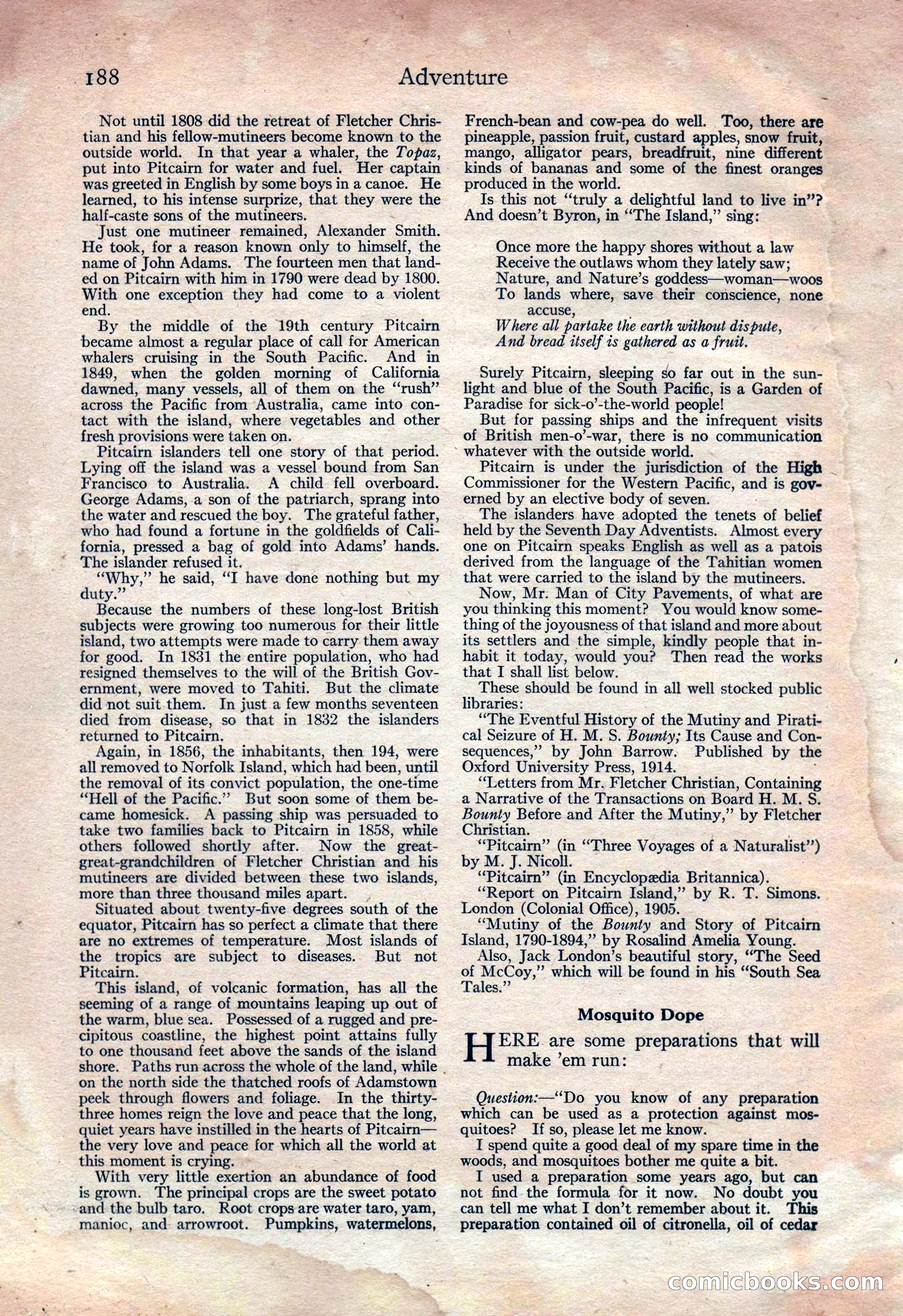
A restored page from Pulp Fiction, 1922. Page through the whole issue in the reader above.
📄 Transcribed text from this page (OCR, searchable)
Machine-transcribed from the original scan — historical spelling and the odd misread are preserved.
188 Not until 1808 did the retreat of Fletcher Chris- tian and his fellow-mutineers become known to the outside world. In that year a whaler, the Topaz, put into Pitcairn for water and fuel. Her captain was greeted in English by some boys in a canoe. He learned, to his intense surprize, that they were the half-caste sons of the mutineers. Just one mutineer remained, Alexander Smith. He took, for a reason known only to himself, the name of John Adams. The fourteen men that land- ed on Pitcairn with him in 1790 were dead by 1800. With one exception they had come to a violent end. By the middle of the 19th century Pitcairn became almost a regular place of call for American whalers cruising in the South Pacific. And in 1849, when the golden morning of California dawned, many vessels, all of them on the “rush” across the Pacific from Australia, came into con- tact with the island, where vegetables and other fresh provisions were taken on. Pitcairn islanders tell one story of that period. Lying off the island was a vessel bound from San Francisco to Australia. A child fell overboard. George Adams, a son of the patriarch, sprang into the water and rescued the boy. The grateful father, who had found a fortune in the goldfields of Cali- fornia, pressed a bag of gold into Adams’ hands. The islander refused it. 5 “Why,” he said, “I have done nothing but my uty.” Because the numbers of these long-lost British subjects were growing too numerous for their little island, two attempts were made to carry them away for good. In 1831 the entire population, who had resigned themselves to the will of the British Gov- ernment, were moved to Tahiti. But the climate did not suit them. In just a few months seventeen died from disease, so that in 1832 the islanders returned to Pitcairn. Again, in 1856, the inhabitants, then 194, were all removed to Norfolk Island, which had been, until the removal of its convict population, the one-time “Hell of the Pacific.” But soon some of them be- came homesick. A passing ship was persuaded to take two families back to Pitcairn in 1858, while others followed shortly after. Now the great- great-grandchildren of Fletcher Christian and his mutineers are divided between these two islands, more than three thousand miles apart. | Situated about twenty-five degrees south of the equator, Pitcairn has so perfect a climate that there are no extremes of temperature. Most islands of the tropics are subject to diseases. But not Pitcairn. This island, of volcanic formation, has all the seeming of a range of mountains leaping up out of the warm, blue sea. Possessed of a rugged and pre- cipitous coastline, the highest point attains fully to one thousand feet above the sands of the island shore. Paths run across the whole of the land, while . on the north side the thatched roofs of Adamstown peek through flowers and foliage. In the thirty- three homes reign the love and peace that the long, quiet years have instilled in the hearts of Pitcairn— the very love and peace for which all the world at this moment is crying. ~ : With very little exertion an abundance of food is grown. The principal crops are the sweet potato -and the bulb taro. Root crops are water taro, yam, manioc, and arrowroot. Pumpkins, watermelons, Adventure ~ French-bean and cow-pea do well. Too, there are pineapple, passion fruit, custard apples, snow fruit, mango, alligator pears, breadfruit, nine different kinds of bananas and some of the finest oranges produced in the world. . Is this not “truly a delightful land to live in”? And doesn’t Byron, in ‘The Island,” sing: Once more the happy shores without a law Receive the outlaws whom they lately saw; Nature, and Nature’s goddess—woman—woos To lands where, save their conscience, none accuse, : Where all partake the earth without dispute, And bread itself is gathered as a fruit. Surely Pitcairn, sleeping go far out in the sun- light and blue of the South Pacific, is a Garden of Paradise for sick-o’-the-world people! But for passing ships and the infrequent visits of British men-o’-war, there is no communication ’ whatever with the outside world. Pitcairn is under the jurisdiction of the High _ Commissioner for the Western Pacific, and is gov- erned by an elective body of seven. : The islanders have adopted the tenets of belief held by the Seventh Day Adventists. Almost every one on Pitcairn speaks English as well as a patois derived from the language of the Tahitian women that were carried to the island by the mutineers. Now, Mr. Man of City Pavements, of what are you thinking this moment? You would know some- thing of the joyousness of that island and more about its settlers and the simple, kindly people that in- habit it today, would you? Then read the works that I shall list below. These should be found in all well stocked public libraries: ‘‘The Eventful History of the Mutiny and Pirati- cal Seizure of H. M.S. Bounty; Its Cause and Con- sequences,” by John Barrow. Published by the Oxford University Press, 1914. “Letters from Mr. Fletcher Christian, Containing a Narrative of the Transactions on Board H. M. S. Bounty Before and After the Mutiny,” by Fletcher Christian. “Pitcairn” (in “Three Voyages of a Naturalist’’) by M. J. Nicoll. : “Pitcairn” (in Encyclopedia Britannica). “Report on Pitcairn Island,’ by R. T. Simons. London (Colonial Office), 1905. “Mutiny of the Bounty and Story of Pitcairn Island, 1790-1894,” by Rosalind Amelia Young. Also, Jack London’s beautiful story, ‘““The Seed . eae which will be found in his “South Sea ales.” Mosquito Dope HERE are some preparations that will make ’em run: Question:—‘‘Do you know of any preparation which can be used as a protection against mos- quitoes? If so, please let me know. I spend quite a good deal of my spare time in the woods, and mosquitoes bother me quite a bit. I used a preparation some years ago, but can not find the formula for it now. No doubt you can tell me what I don’t remember about it. This preparation contained oil of citronella, oil of cedar GComichbooks