
Pulp Fiction, 1922 · page 193 of 200
Adventure Magazine Cover — page 193: what you’re looking at
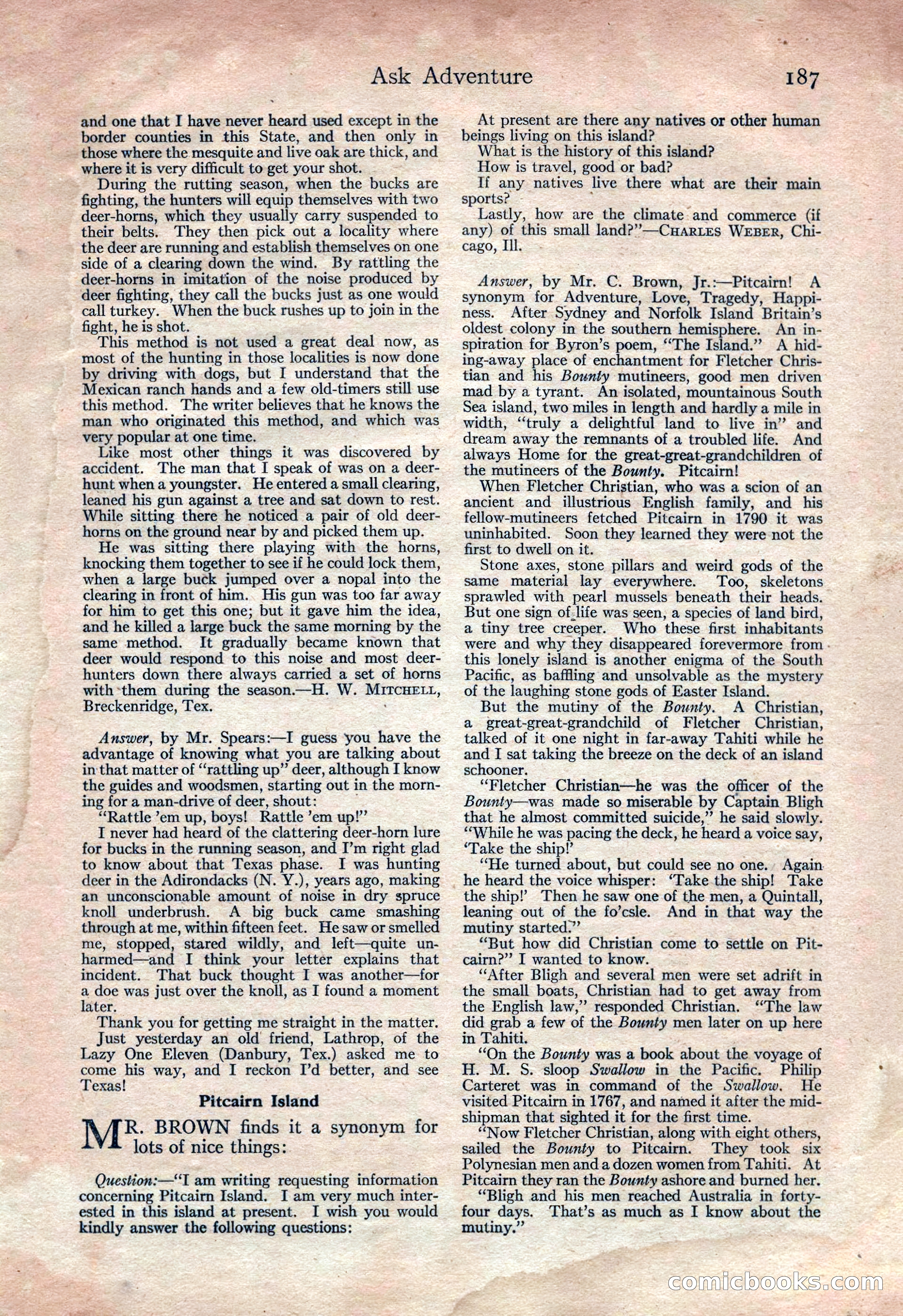
A restored page from Pulp Fiction, 1922. Page through the whole issue in the reader above.
📄 Transcribed text from this page (OCR, searchable)
Machine-transcribed from the original scan — historical spelling and the odd misread are preserved.
Ask Adventure and one that I have never heard used except in the border counties in this State, and then only in those where the mesquite and live oak are thick, and where it is very difficult to get your shot. During the rutting season, when the bucks are fighting, the hunters will equip themselves with two deer-horns, which they usually carry suspended to their belts. They then pick out a locality where the deer are running and establish themselves on one side of a clearing down the wind. By rattling the deer-horns in imitation of the noise produced by deer fighting, they call the bucks just as one would call turkey. When the buck rushes up to join in the fight, he is shot. This method is not used a great deal now, as most of the hunting in those localities is now done by driving with dogs, but I understand that the Mexican ranch hands and a few old-timers still use this method. The writer believes that he knows the man who originated this method, and which was very popular at one time. Like most other things it was discovered by accident. The man that I speak of was on a deer- hunt when a youngster. He entered a small clearing, leaned his gun against a tree and sat down to rest. While sitting there he noticed a pair of old deer- horns on the ground near by and picked them up. He was sitting there playing with the horns, knocking them together to see if he could lock them, when a large buck jumped over a nopal into the clearing in front of him. His gun was too far away for him to get this one; but it gave him the idea, and he killed a large buck the same morning by the same method. It gradually became known that deer would respond to this noise and most deer- hunters down there always carried a set of horns with ‘them during the season.—H. W. MITcHELL, Breckenridge, Tex. : Answer, by Mr. Spears:—I guess you have the advantage of knowing what you are talking about in that matter of ‘rattling up” deer, although I know the guides and woodsmen, starting out in the morn- ing for a man-drive of deer, shout: “Rattle ’em up, boys! Rattle ’em up!’ T never had heard of the clattering deer-horn lure for bucks in the running season, and I’m right glad to know about that Texas phase. I was hunting deer in the Adirondacks (N. Y.), years ago, making an unconscionable amount of noise in dry spruce knoll underbrush. A big buck came smashing through at me, within fifteen feet. He saw or smelled me, stopped, stared wildly, and left—quite un- harmed—and I think your letter explains that incident. That buck thought I was another—for a doe was just over the knoll, as I found a moment later. Thank you for getting me straight in the matter. Just yesterday an old friend, Lathrop, of the Lazy One Eleven (Danbury, Tex.) asked me to come his way, and I reckon I’d better, and see Texas! Pitcairn Island Me: BROWN finds it a synonym for lots of nice things: Question: —“T am writing requesting information concerning Pitcairn Island. I am very much inter- ested in this island at present. I wish you would kindly answer the following questions: 187 At present are there any natives or other human beings living on this island? What is the history of this island? How is travel, good or bad? If any natives live there what are their main sports? - : Lastly, how are the climate and commerce (if any) of this small land?”—Cuaritres WEBER, Chi- cago, Ill. Answer, by Mr. C. Brown, Jr.:—Pitcairn! A synonym for Adventure, Love, Tragedy, Happi- ness. After Sydney and Norfolk Island Britain’s oldest colony in the southern hemisphere. An in- spiration for Byron’s poem, ‘‘The Island.” <A hid- ing-away place of enchantment for Fletcher Chris- tian and his Bounty mutineers, good men driven mad by a tyrant. An isolated, mountainous South Sea island, two miles in length and hardly a mile in width, “truly a delightful land to live in” and dream away the remnants of a troubled life. And always Home for the great-great-grandchildren of the mutineers of the Bounty. Pitcairn! When Fletcher Christian, who was a scion of an ancient and illustrious English family, and his fellow-mutineers fetched Pitcairn in 1790 it was uninhabited. Soon they learned they were not the first to dwell on it. Stone axes, stone pillars and weird gods of the same material lay everywhere. Too, skeletons sprawled with pearl mussels beneath their heads. But one sign of.life was seen, a species of land bird, a tiny tree creeper. Who these first inhabitants were and why they disappeared forevermore from - this lonely island is another enigma of the South Pacific, as baffling and unsolvable as the mystery of the laughing stone gods of Easter Island. But the mutiny of the Bounty. A Christian, a great-great-grandchild of Fletcher Christian, talked of it one night in far-away Tahiti while he and I sat taking the breeze on the deck of an island schooner. “Fletcher Christian—he was the officer of the Bounty—was made so miserable by Captain Bligh that he almost committed suicide,”’ he said slowly. “While he was pacing the deck, he heard a voice say, “Take the ship!’ “He turned about, but could see no one. Again. he heard the voice whisper: “Take the ship! Take the ship!’ Then he saw one of the men, a Quintall, leaning out of the fo’csle. And in that way the mutiny started.” “But how did Christian come to settle on Pit- cairn?’ I wanted to know. “After Bligh and several men were set adrift in the small boats, Christian had to get away from the English law,” responded Christian. ‘“The law did grab a few of the Bounty men later on up here in Tahiti. ; “On the Bounty was a book about the voyage of H. M. S. sloop Swallow in the Pacific. Philip Carteret was in command of the Swallow. He visited Pitcairn in 1767, and named it after the mid- shipman that sighted it for the first time. “Now Fletcher Christian, along with eight others, sailed the Bounty to Pitcairn. They took six Polynesian men and a dozen women from Tahiti. At Pitcairn they ran the Bounty ashore and burned her. “Bligh and his men reached Australia in forty- four days. That’s as much as I know about the mutiny.” (EC) 1OOOL< (C@)