
Pulp Fiction, 1922 · page 54 of 200
Adventure Magazine Cover — page 54: what you’re looking at
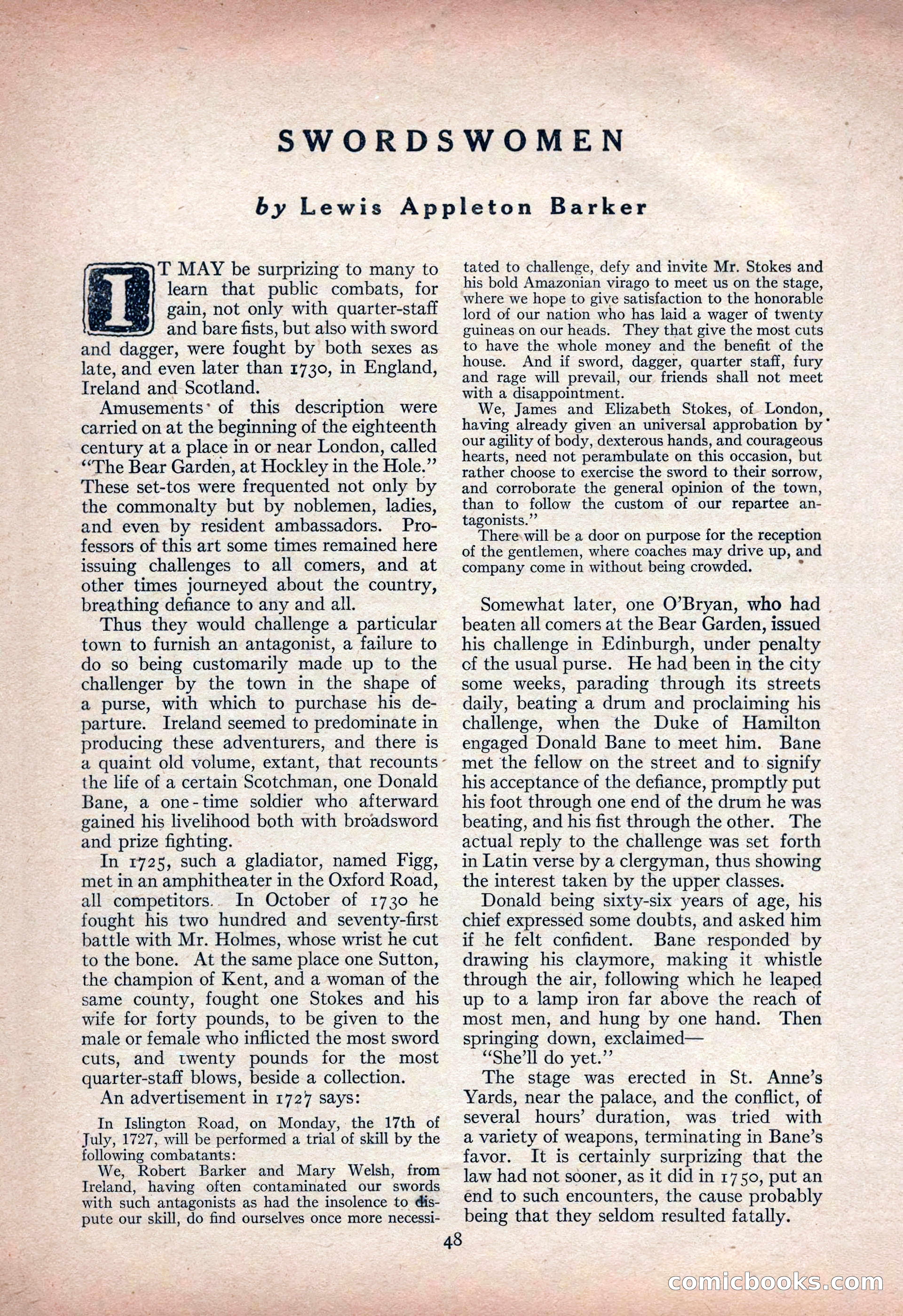
A restored page from Pulp Fiction, 1922. Page through the whole issue in the reader above.
📄 Transcribed text from this page (OCR, searchable)
Machine-transcribed from the original scan — historical spelling and the odd misread are preserved.
SWORDSWOMEN by Lewis Appleton Barker ») MAY be surprizing to many to ma) learn that public combats, for gain, not only with quarter-staff teecee) and bare fists, but also with sword nial dagger, were fought by both sexes as late, and even later than 1730, in England, Treland and Scotland. Amusements* of this description were carried on at the beginning of the eighteenth century at a place in or near London, called ‘The Bear Garden, at Hockley in the Hole.” These set-tos were frequented not only by the commonalty but by noblemen, ladies, and even by resident ambassadors. Pro- fessors of this art some times remained here issuing challenges to all comers, and at other times journeyed about the country, breathing defiance to any and all. Thus they would challenge a particular town to furnish an antagonist, a failure to do so being customarily made up to the challenger by the town in the shape of a purse, with which to purchase his de- parture. Ireland seemed to predominate in producing these adventurers, and there is a quaint old volume, extant, that recounts - the life of a certain Scotchman, one Donald Bane, a one-time soldier who afterward gained his livelihood both with broadsword and prize fighting. In 1725, such a gladiator, named Figg, met in an amphitheater in the Oxford Road, all competitors.. In October of 1730 he fought his two hundred and seventy-first battle with Mr. Holmes, whose wrist he cut to the bone. At the same place one Sutton, the champion of Kent, and a woman of the same county, fought one Stokes and his wife for forty pounds, to be given to the male or female who inflicted the most sword cuts, and twenty pounds for the most quarter-staff blows, beside a collection. An advertisement in 1727 says: In Islington Road, on Monday, the 17th of July, 1727, will be performed a trial of skill by the following combatants: We, Robert Barker and Mary Welsh, from Ireland, having often contaminated our ‘swords with such antagonists as had the insolence to dis- pute our skill, do find ourselves once more necessi- 48 tated to challenge, defy and invite Mr. Stokes and his bold Amazonian virago to meet us on the stage, where we hope to give satisfaction to the honorable lord of our nation who has laid a wager of twenty guineas on our heads. They that give the most cuts to have the whole money and the benefit of the house. And if sword, dagger, quarter staff, fury and rage will prevail, our friends shall not meet with a disappointment. We, James and Elizabeth Stokes, of London, having already given an universal approbation by‘ our agility of body, dexterous hands, and courageous hearts, need not perambulate on this occasion, but rather choose to exercise the sword to their sorrow, and corroborate the general opinion of the town, than to follow the custom of our repartee an- tagonists.”’ There. will be a door on purpose for the reception of the gentlemen, where coaches may drive up, and company come in without being crowded. Somewhat later, one O’Bryan, who had beaten all comers at the Bear Garden, issued his challenge in Edinburgh, under penalty cf the usual purse. He had been in the city some weeks, parading through its streets daily, beating a drum and proclaiming his challenge, when the Duke of Hamilton engaged Donald Bane to meet him. Bane met the fellow on the street and to signify his acceptance of the defiance, promptly put his foot through one end of the drum he was beating, and his fist through the other. The actual reply to the challenge was set forth in Latin verse by a clergyman, thus showing the interest taken by the upper classes. Donald being sixty-six years of age, his chief expressed some doubts, and asked him if he felt confident. Bane responded by drawing his claymore, making it whistle through the air, following which he leaped up to a lamp iron far above the reach of most men, and hung by one hand. Then springing down, exclaimed— “She'll do yet.” The stage was erected in St. Anne’s Yards, near the palace, and the conflict, of several hours’ duration, was tried with a variety of weapons, terminating in Bane’s favor. It is certainly surprizing that the law had not sooner, as it did in 1750, put an end to such encounters, the cause probably being that they seldom resulted fatally. mMicbook (EO)