
Pulp Fiction, 1922 · page 183 of 196
Adventure, February 20, 1922 — page 183: what you’re looking at
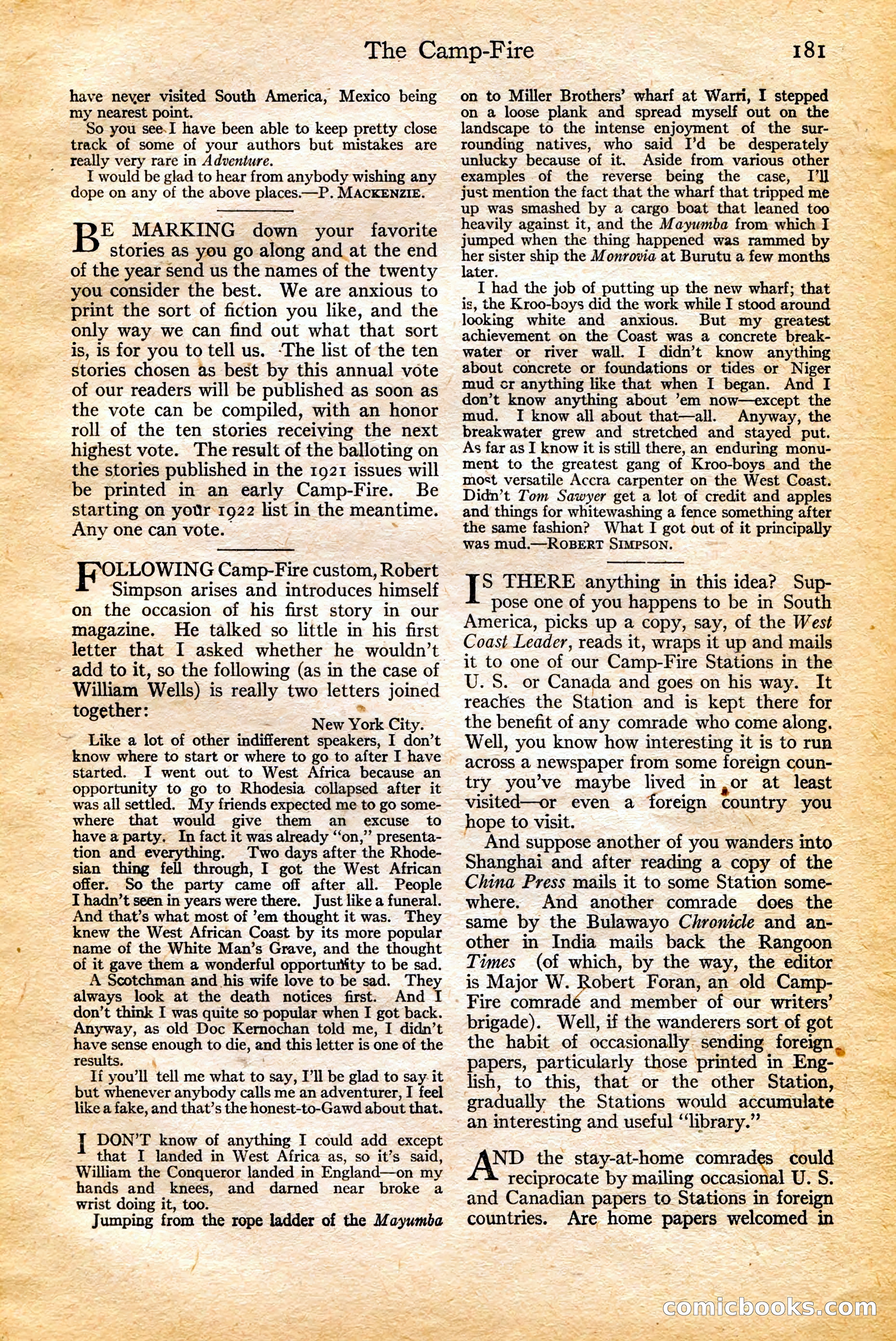
A restored page from Pulp Fiction, 1922. Page through the whole issue in the reader above.
📄 Transcribed text from this page (OCR, searchable)
Machine-transcribed from the original scan — historical spelling and the odd misread are preserved.
~ a! > is, is for you to tell us. The Camp-Fire have neyer visited South America, Mexico being my nearest point. So you see.I have been able to keep pretty close track of some of your authors but mistakes are _ Yeally very rare in Adventure. I would be glad to hear from anybody wishing any dope on any of the above places.—P. MACKENZIE. E MARKING down your favorite stories as you go along and at the end of the year send us the names of the twenty you consider the best. We are anxious to print the sort of fiction you like, and the only way we can find out what that sort ‘The list of the ten stories chosen as best by this annual vote of our readers will be published as soon as the vote can be compiled, with an honor roll of the ten stories receiving the next highest vote. The result of the balloting on the stories published in the 1921 issues will be printed in an early Camp-Fire. Be starting on your 1922 list in the meantime. _ Any one can vote. Pe WING Camp-Fire custom, Robert Simpson arises and introduces himself on the occasion of his first story in our magazine. He talked so little in his first letter that I asked whether he wouldn’t - add to it, so the following (as in the case of William Wells) is really two letters joined to er: geth New York City. Like a lot of other indifferent speakers, I don’t know where to start or where to go to after I have started. I went out to West Africa because an opportunity to go to Rhodesia collapsed after it was all settled. My friends expected me to go some- where that would give them an excuse to have a party. In fact it was already ‘‘on,” presenta- tion and everything. Two days after the Rhode- sian thing fell through, I got the West African offer. So the party came off after all. People I hadn’t seen in years were there. Just like a funeral. And that’s what most of ’em thought it was. They knew the West African Coast by its more popular name of the White Man’s Grave, and the thought of # gave them a wonderful opporturiity to be sad. A Scotchman and his wife love to be sad. They always look at the death notices first. And I don’t think I was quite so popular when I got back. Anyway, as old Doc Kernochan told me, I didn’t have sense enough to die, and this letter is one of the results. li you'll ‘tell me what to say, I'll be glad to say. it but whenever anybody calls me an adventurer, I feel like a fake, and that’s the honest-to-Gawd about that. I DON’T know of anything I could add except that I landed in West Africa as, so it’s said, ‘William the Conqueror landed in England—on my hands and knees, and darned near broke a wrist doing it, too. Jumping from the rope ladder of the Mayumba ~ 181 on to Miller Brothers’ wharf at Wart I ‘sepued on a loose plank and spread myself out on the landscape to the intense enjoyment of the sur- rounding natives, who said I’d be desperately unlucky because of it. Aside from various other examples of the reverse being the case, I'll just mention the fact that the wharf that tripped me up was smashed by a cargo boat that leaned too heavily against it, and the Mayumba from which I jumped when the thing happened was rammed by ea — ship the Monrovia at Burutu a few months I had the job of putting up the new wharf; that is, the Kroo-boys did the work while I stood around looking white and anxious. But my greatest achievement on the Coast was a concrete break- water or river wall. I didn’t know anything about concrete or foundations or tides or Niger mud cr anything like that when I began. And I don’t know anything about ’em now—except the mud. I know all about that—all. Anyway, the breakwater grew and stretched and stayed put. As far as I know it is still there, an enduring monu- ment to the greatest gang of Kroo-boys and the most versatile Accra carpenter on the West Coast: Didn’t Tom Sawyer get a lot of credit and apples and things for whitewashing a fence something after the same fashion? What I got out of it principally was mud.—RoOBERT SIMPSON. j THERE anything in this idea? Sup- pose one of you happens to be in South America, picks up a copy, say, of the West Coast Leader, reads it, wraps it up and mails it to one of our Camp-Fire Stations in the U.S. or Canada and goes on his way. It reaches the Station and is kept there for the benefit of any comrade who come along, Well, you know how interesting it is to run across a newspaper from some foreign coun- try you’ve maybe lived in,or at least visited—or even a foreign country you hope to visit. And suppose another of you nee mto Shanghai and after reading a copy of the China Press mails it to some Station some- where. And another comrade does the same by the Bulawayo Chronicle and an- other in India mails back the Rangoon Times (of which, by the way, the editor is Major W. obert Foran, an old Camp- Fire comradé and member of our writers’ brigade). Well, if the wanderers sort of got the habit of occasionally sending foreign papers, particularly those printed in Eng-~ lish, to this, that or the other Station, — = gradually the Stations would accumulate -an interesting and useful “library.” = “ANP the stay-at-home comrad reciprocate by mailing occasional U. S. and Canadian papers to Stations in foreign countries. Are home papers welcomed in — could © = com> OMe ool xs