
Pulp Fiction, 1922 · page 73 of 196
Adventure, February 20, 1922 — page 73: what you’re looking at
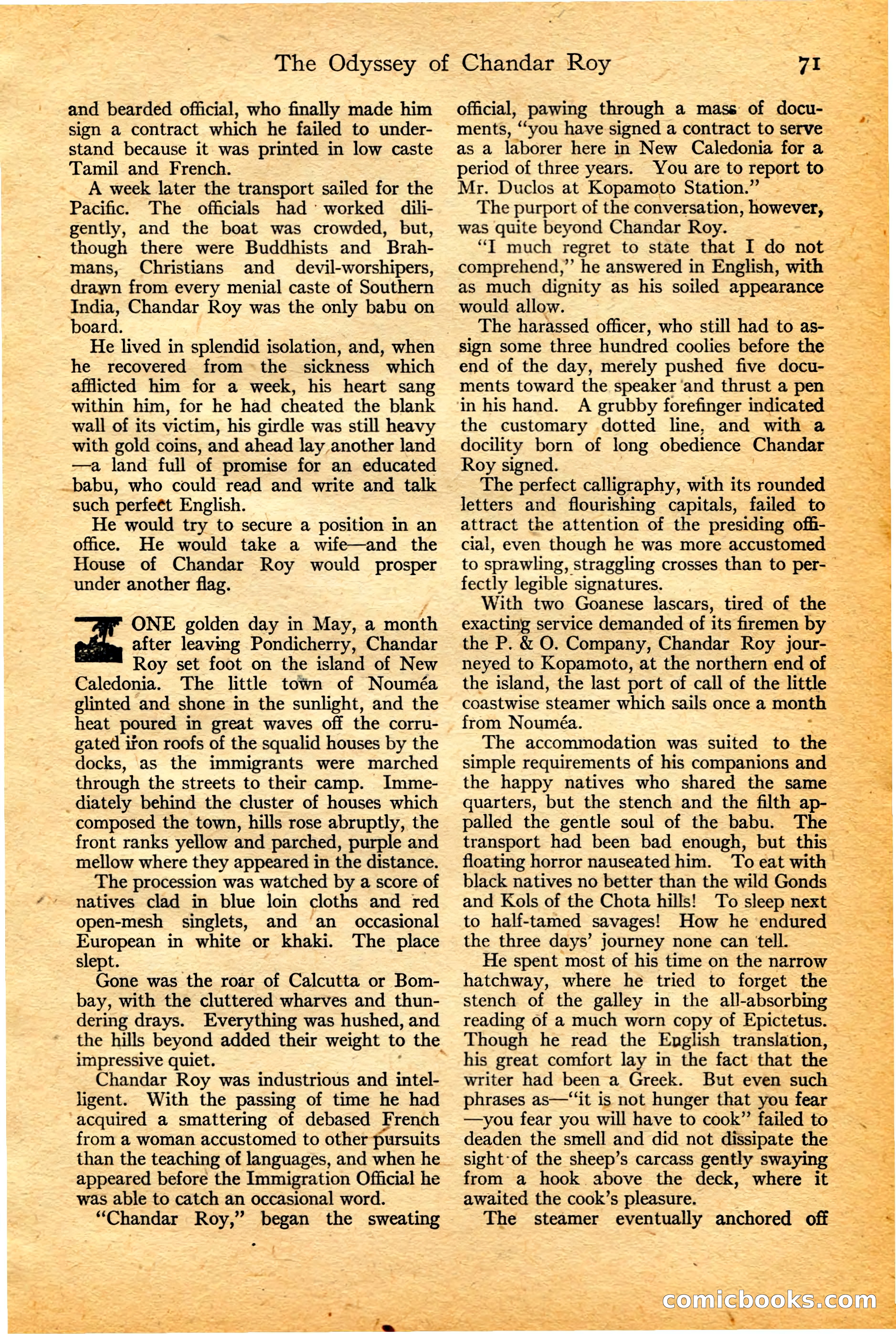
A restored page from Pulp Fiction, 1922. Page through the whole issue in the reader above.
📄 Transcribed text from this page (OCR, searchable)
Machine-transcribed from the original scan — historical spelling and the odd misread are preserved.
The Odyssey of Chandar Roy and bearded official, who finally made him sign a contract which he failed to under- stand because it was printed in low caste Tamil and French. A week later the transport sailed for the Pacific. The officials had’ worked dili- gently, and the boat was crowded, but, though there were Buddhists and Brah- mans, Christians and _ devil-worshipers, drawn from every menial caste of Southern India, Chandar Roy was the only babu on board. He lived in splendid isolation, and, when he recovered fromthe sickness which afflicted him for a week, his heart sang within him, for he had cheated the blank wall of its victim, his girdle was still heavy with gold coins, and ahead lay another land ——a land full of promise for an educated babu, who could read and write and talk such perfe¢t English. He would try to secure a position in an office. He would take a wife—and the House of Chandar Roy would prosper under another flag. oe after leaving Pondicherry, Chandar Roy set foot on the island of New Caledonia. The little town of Nouméa glinted and shone im the sunlight, and the heat poured in great waves off the corru- gated iron roofs of the squalid houses by the docks, as the immigrants were marched through the streets to their camp. Imme- ONE golden day in May, a month diately behind the cluster of houses which “acquired a smattering of debased composed the town, hills rose abruptly, the front ranks yellow and parched, purple and mellow where they appeared in the distance. The procession was watched by a score of natives clad in blue loin cloths and red open-mesh singlets, and an _ occasional European in white or khaki. The place slept. Gone was the roar of Calcutta or Bom- bay, with the cluttered wharves and thun- dering drays. Everything was hushed, and the hills beyond added their weight to the impressive quiet. Chandar Roy was industrious and intel- ligent. With the passing of time he had rench from a woman accustomed to other pursuits than the teaching of languages, and when he appeared before the Immigration Official he was able to catch an occasional word. “Chandar Roy,” began the sweating 71 official, pawing through a mass of docu- ments, “ as a laborer here in New Caledonia for a period of three years. Mr. Duclos at Kopamoto Station.” - The purport of the conversation, however, was quite beyond Chandar Roy. “T much regret to state that I do not — comprehend,”’ he answered in English, with as much dignity as his soiled appearance © would allow. The harassed officer, who still had to as- sign some three hundred coolies before the end of the day, merely pushed five docu- ments toward the speaker ‘and thrust a pen ~ in his hand. A grubby forefinger indicated the customary dotted line, and with a — docility born of long obedience Chandar Roy signed. The perfect calligraphy, with its rounded letters and flourishing capitals, failed to attract the attention of the presiding off- — cial, even though he was more accustomed to sprawling, straggling crosses than to per- — fectly legible signatures. With two Goanese lascars, tired of the exacting service demanded of its firemen by _ the P. & O. Company, Chandar Roy jour- — neyed to Kopamoto, at the northern end of the island, the last port of call of the little coastwise steamer which sails once a month from Nouméa. : The accommodation was suited to the simple requirements of his companions and the happy natives who shared the same quarters, but the stench and the filth ap- palled the gentle soul of the babu. you have signed a contract to serve You are to report to The transport had been bad enough, but this floating horror nauseated him. To eat with black natives no better than the wild Gonds and Kols of the Chota hills! to half-tamed savages! the three days’ journey none can tell. He spent most of his time on the narrow hatchway, where he tried to forget the stench of the galley in the all-absorbing reading of a much worn copy of Epictetus. | Though he read the English translation, — his great comfort lay in the fact that the writer had been a Greek. But even such phrases as—“‘it is not hunger that you fear —you fear you will have to cook”’ failed to deaden the smell and did not dissipate the sight-of the sheep’s carcass gently swaying from a hook above the deck, where it awaited the cook’s pleasure. The steamer eventually anchored off - To sleep next — How he endured re Ve Ph ‘) 7 be : y : % - 1 « EW Zeek aye Pe aS IVE WOE ar f' Ae eM off aitLAS aé , She. Tare Sid. yeah fi au bes ee 1a ‘ A 7 - AG ; * erAsie fe 4) HAP Aves : ty aes we { N i fi ¢: ah Kew wait . ; | MGI EAS 1 hy . aA > - q ; » + » ae | daa £9 ‘ a 5 J a ae. eps) . Nese Del LY, wh a - ’ : nif, Vee Waker < aki ¥ N : 4 ni Oe hee : : Da le } Yai ‘¥ d . beh Pld Set bad JESS hs ~ AM He co X : o) on