
Pulp Fiction, 1911 · page 37 of 196
Adventure Magazine Cover — page 37: what you’re looking at
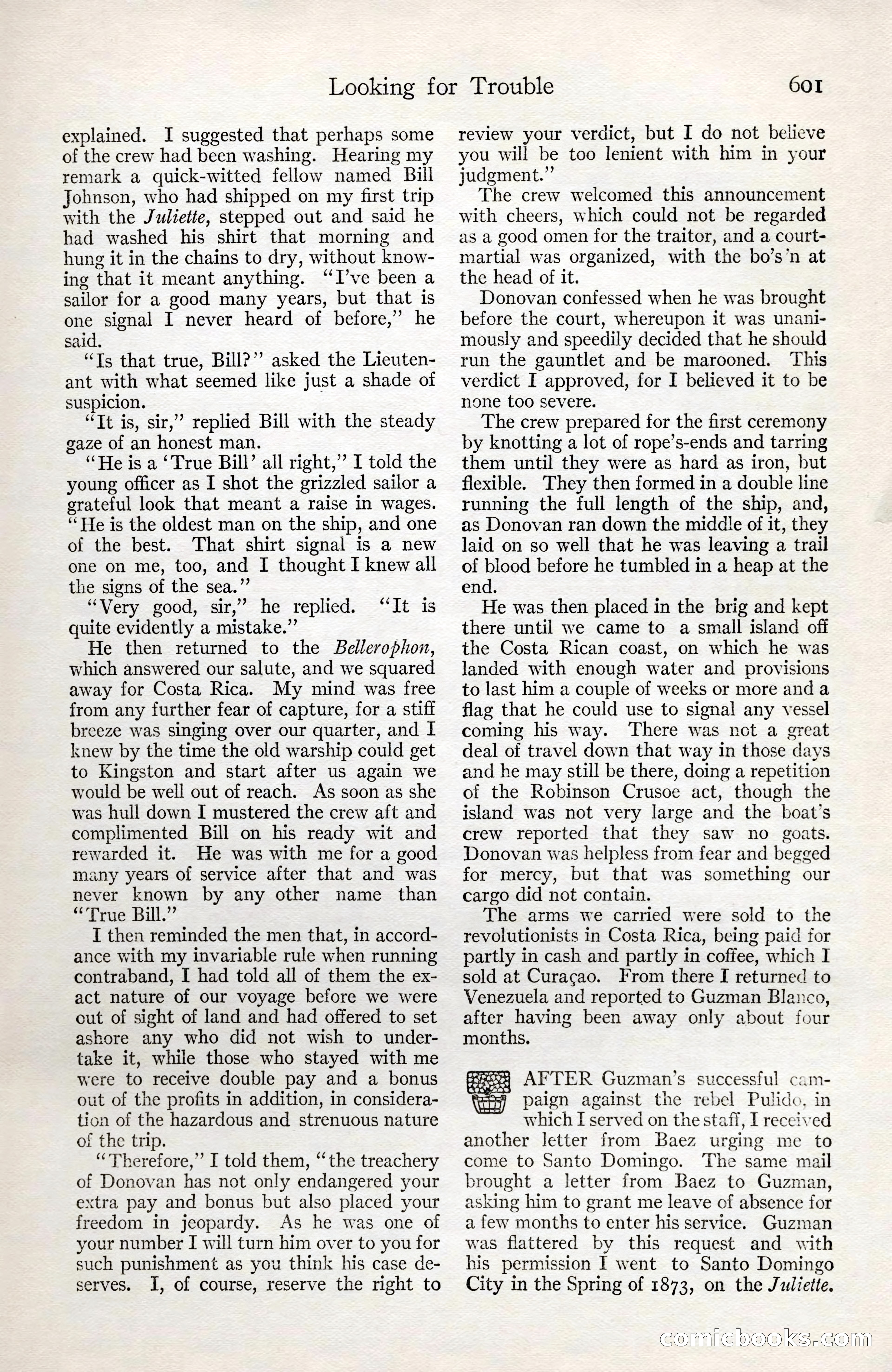
A restored page from Pulp Fiction, 1911. Page through the whole issue in the reader above.
📄 Transcribed text from this page (OCR, searchable)
Machine-transcribed from the original scan — historical spelling and the odd misread are preserved.
Looking for Trouble explained. I suggested that perhaps some of the crew had been washing. Hearing my remark a quick-witted fellow named Bill Johnson, who had shipped on my first trip with the Juliette, stepped out and said he had washed his shirt that morning and hung it in the chains to dry, without know- ing that it meant anything. “I’ve been a sailor for a good many years, but that is one signal I never heard of before,” he said. “Ts that true, Bill?’’ asked the Lieuten- ant with what seemed like just a shade of suspicion. “Tt is, sir,” replied Bill with the steady gaze of an honest man. “He is a ‘True Bill’ all right,” I told the young officer as I shot the grizzled sailor a grateful look that meant a raise in wages. “He is the oldest man on the ship, and one of the best. That shirt signal is a new one on me, too, and I thought I knew all the signs of the sea.” “Very good, sir,” he replied. quite evidently a mistake.” He then returned to the Bellerophon, which answered our salute, and we squared away for Costa Rica. My mind was free from any further fear of capture, for a stiff breeze was singing over our quarter, and I knew by the time the old warship could get to Kingston and start after us again we would be well out of reach. As soon as she was hull down I mustered the crew aft and complimented Bill on his ready wit and rewarded it. He was with me for a good many years of service after that and was never known by any other name than “True Bill.” I then reminded the men that, in accord- ance with my invariable rule when running contraband, I had told all of them the ex- act nature of our voyage before we were cut of sight of land and had offered to set ashore any who did not wish to under- take it, while those who stayed with me were to receive double pay and a bonus out of the profits in addition, in considera- tion of the hazardous and strenuous nature of the trip. “Therefore,” I told them, “the treachery of Donovan has not only endangered your extra pay and bonus but also placed your freedom in jeopardy. As he was one of your number I will turn him over to you for such punishment as you think his case de- serves. I, of course, reserve the right to “Tt is 601 review your verdict, but I do not believe you will be too lenient with him in your judgment.” The crew welcomed this announcement with cheers, which could not be regarded as a good omen for the traitor, and a court- martial was organized, with the bo’s’n at the head of it. Donovan confessed when he was brought before the court, whereupon it was unani- mously and speedily decided that he should run the gauntlet and be marooned. This verdict I approved, for I believed it to be none too severe. The crew prepared for the first ceremony by knotting a lot of rope’s-ends and tarring them until they were as hard as iron, but flexible. They then formed in a double line running the full length of the ship, and, as Donovan ran down the middle of it, they laid on so well that he was leaving a trail of blood before he tumbled in a heap at the end. He was then placed in the brig and kept there until we came to a small island off the Costa Rican coast, on which he was landed with enough water and provisions to last him a couple of weeks or more and a flag that he could use to signal any vessel coming his way. ‘There was not a great deal of travel down that way in those days and he may still be there, doing a repetition of the Robinson Crusoe act, though the island was not very large and the boat’s crew reported that they saw no goats. Donovan was helpless from fear and begged for mercy, but that was something our cargo did not contain. The arms we carried were sold to the revolutionists in Costa Rica, being paid for partly in cash and partly in coffee, which I sold at Curacao. From there I returned to Venezuela and reported to Guzman Blanco, after having been away only about four months. § AFTER Guzman’s successful cam- paign against the rebel Pulido, in which I served on the staff, I received another letter from Baez urging me to come to Santo Domingo. The same mail brought a letter from Baez to Guzman, asking him to grant me leave of absence for a few months to enter his service. Guzman was flattered by this request and with his permission I went to Santo Domingo City in the Spring of 1873, on the Juliette. CoOnnicoooks (©