
Pulp Fiction, 1911 · page 38 of 196
Adventure Magazine Cover — page 38: what you’re looking at
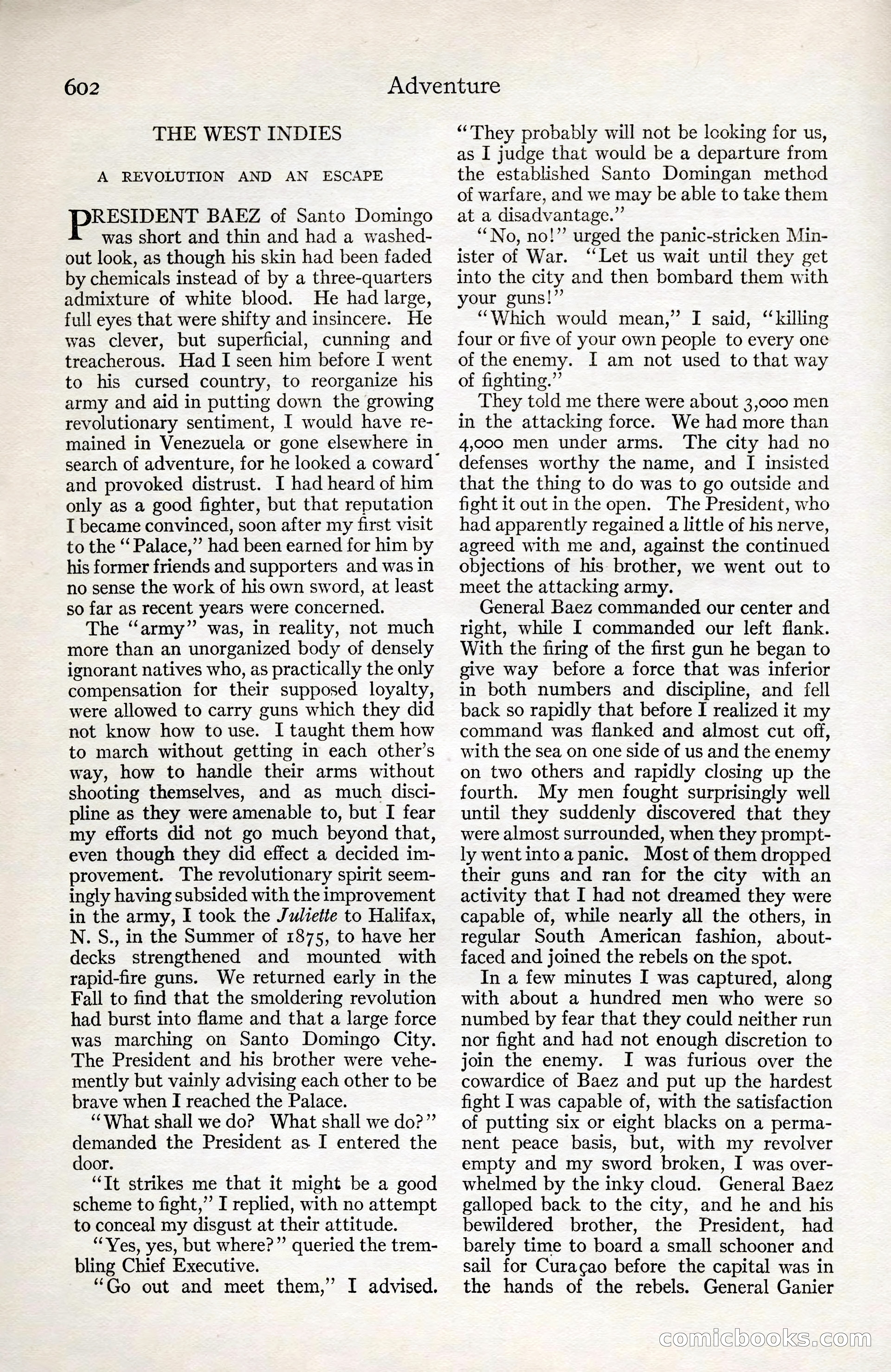
A restored page from Pulp Fiction, 1911. Page through the whole issue in the reader above.
📄 Transcribed text from this page (OCR, searchable)
Machine-transcribed from the original scan — historical spelling and the odd misread are preserved.
602 THE WEST INDIES A REVOLUTION AND AN ESCAPE RESIDENT BAEZ of Santo Domingo was short and thin and had a washed- out look, as though his skin had been faded by chemicals instead of by a three-quarters admixture of white blood. He had large, full eyes that were shifty and insincere. He was clever, but superficial, cunning and treacherous. Had I seen him before I went to his cursed country, to reorganize his army and aid in putting down the growing revolutionary sentiment, I would have re- mained in Venezuela or gone elsewhere in search of adventure, for he looked a coward and provoked distrust. I had heard of him only as a good fighter, but that reputation I became convinced, soon after my first visit to the “‘ Palace,” had been earned for him by his former friends and supporters and was in no sense the work of his own sword, at least so far as recent years were concerned. The “army” was, in reality, not much more than an unorganized body of densely ignorant natives who, as practically the only compensation for their supposed loyalty, were allowed to carry guns which they did not know how to use. I taught them how to march without getting in each other’s way, how to handle their arms without shooting themselves, and as much disci- pline as they were amenable to, but I fear my efforts did not go much beyond that, even though they did effect a decided im- provement. The revolutionary spirit seem- ingly having subsided with the improvement in the army, I took the Juliette to Halifax, N. S., in the Summer of 1875, to have her decks strengthened and mounted with rapid-fire guns. We returned early in the Fall to find that the smoldering revolution had burst into flame and that a large force was marching on Santo Domingo City. The President and his brother were vehe- mently but vainly advising each other to be brave when I reached the Palace. ‘What shall we do? What shall we do?” demanded the President as I entered the door. “Tt strikes me that it might be a good scheme to fight,” I replied, with no attempt to conceal my disgust at their attitude. “Yes, yes, but where?” queried the trem- bling Chief Executive. “Go out and meet them,” I advised. Adventure “They probably will not be looking for us, as I judge that would be a departure from the established Santo Domingan method of warfare, and we may be able to take them at a disadvantage.” “No, no!” urged the panic-stricken Min- ister of War. ‘Let us wait until they get into the city and then bombard them with your guns!”’ “Which would mean,” I said, “killing four or five of your own people to every one of the enemy. I am not used to that way of fighting.”’ They told me there were about 3,000 men in the attacking force. We had more than 4,000 men under arms. The city had no defenses worthy the name, and I insisted that the thing to do was to go outside and fight it out in the open. The President, who had apparently regained a little of his nerve, agreed with me and, against the continued objections of his brother, we went out to meet the attacking army. General Baez commanded our center and right, while [I commanded our left flank. With the firing of the first gun he began to give way before a force that was inferior in both numbers and discipline, and fell back so rapidly that before I realized it my command was flanked and almost cut off, with the sea on one side of us and the enemy on two others and rapidly closing up the fourth. My men fought surprisingly well until they suddenly discovered that they were almost surrounded, when they prompt- ly went intoa panic. Most of them dropped their guns and ran for the city with an activity that I had not dreamed they were capable of, while nearly all the others, in regular South American fashion, about- faced and joined the rebels on the spot. In a few minutes I was captured, along with about a hundred men who were so numbed by fear that they could neither run nor fight and had not enough discretion to join the enemy. I was furious over the cowardice of Baez and put up the hardest fight I was capable of, with the satisfaction of putting six or eight blacks on a perma- nent peace basis, but, with my revolver empty and my sword broken, I was over- whelmed by the inky cloud. General Baez galloped back to the city, and he and his bewildered brother, the President, had barely time to board a small schooner and sail for Curacao before the capital was in the hands of the rebels. General Ganier cComicboooks. Conn