
Pulp Fiction, 1911 · page 79 of 196
Adventure Magazine Cover — page 79: what you’re looking at
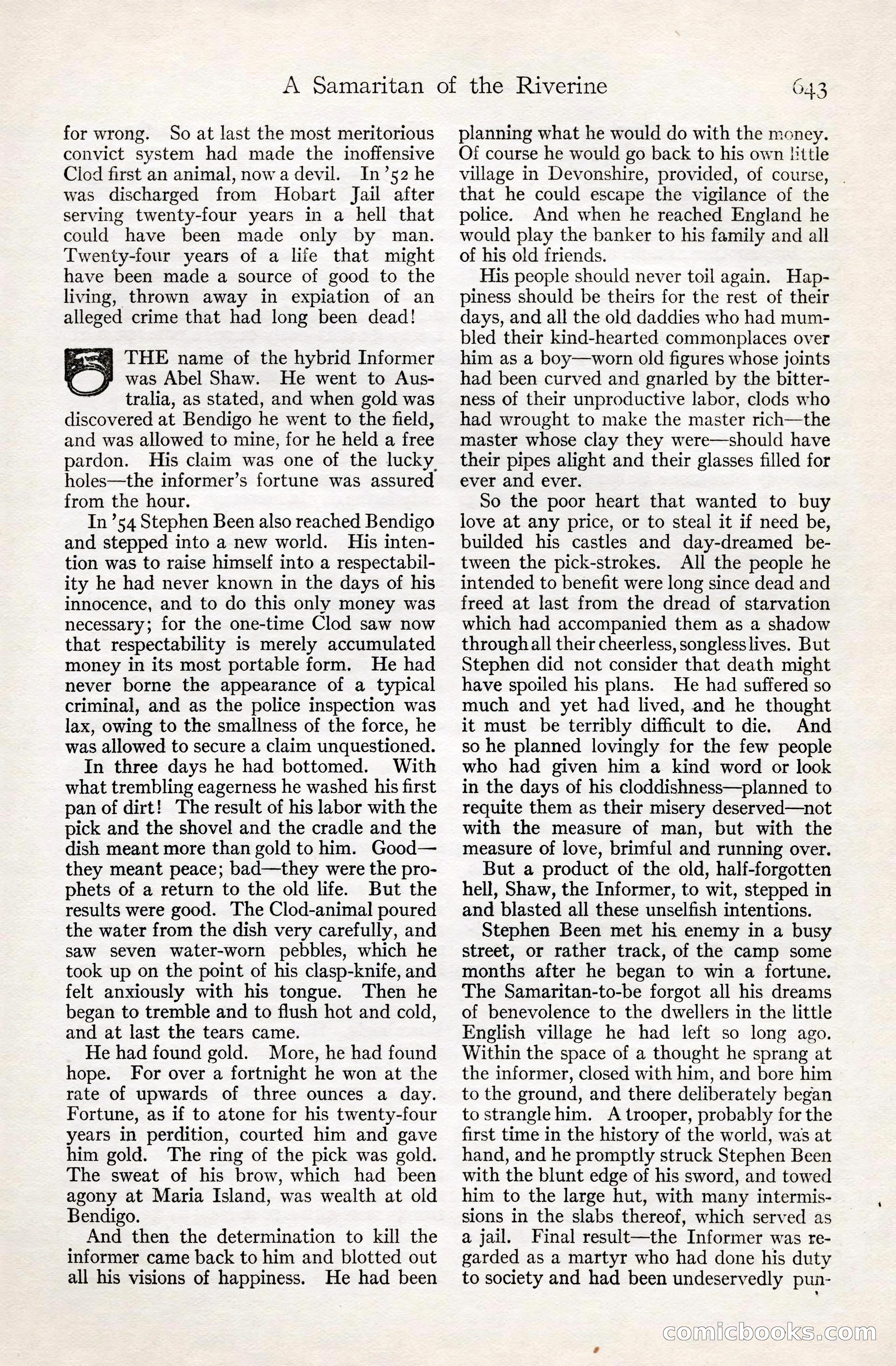
A restored page from Pulp Fiction, 1911. Page through the whole issue in the reader above.
📄 Transcribed text from this page (OCR, searchable)
Machine-transcribed from the original scan — historical spelling and the odd misread are preserved.
A Samaritan of the Riverine for wrong. So at last the most meritorious convict system had made the inoffensive Clod first an animal, nowa devil. In’52 he was discharged from Hobart Jail after serving twenty-four years in a hell that could have been made only by man. Twenty-four years of a life that might have been made a source of good to the living, thrown away in expiation of an alleged crime that had long been dead! oe, was Abel Shaw. He went to Aus- tralia, as stated, and when gold was discovered at Bendigo he went to the field, and was allowed to mine, for he held a free pardon. holes—the informer’s fortune was assured from the hour. In ’54 Stephen Been also reached Bendigo and stepped into a new world. His inten- tion was to raise himself into a respectabil- ity he had never known in the days of his innocence, and to do this only money was necessary; for the one-time Clod saw now that respectability is merely accumulated money in its most portable form. He had never borne the appearance of a typical criminal, and as the police inspection was lax, owing to the smallness of the force, he was allowed to secure a claim unquestioned. In three days he had bottomed. With what trembling eagerness he washed his first pan of dirt! The result of his labor with the pick and the shovel and the cradle and the dish meant more than gold to him. Good— they meant peace; bad—they were the pro- phets of a return to the old life. But the results were good. The Clod-animal poured the water from the dish very carefully, and saw seven water-worn pebbles, which he took up on the point of his clasp-knife, and felt anxiously with his tongue. Then he began to tremble and to flush hot and cold, and at last the tears came. He had found gold. More, he had found hope. For over a fortnight he won at the rate of upwards of three ounces a day. Fortune, as if to atone for his twenty-four years in perdition, courted him and gave him gold. The ring of the pick was gold. The sweat of his brow, which had been agony at Maria Island, was wealth at old Bendigo. And then the determination to kill the informer came back to him and blotted out all his visions of happiness. He had been THE name of the hybrid Informer His claim was one of the lucky 643 planning what he would do with the money. Of course he would go back to his own Httle village in Devonshire, provided, of course, . that he could escape the vigilance of the police. And when he reached England he would play the banker to his family and all of his old friends. His people should never toil again. Hap- piness should be theirs for the rest of their days, and all the old daddies who had mum- bled their kind-hearted commonplaces over him as a boy—worn old figures whose joints had been curved and gnarled by the bitter- ness of their unproductive labor, clods who had wrought to make the master rich—the master whose clay they were—should have their pipes alight and their glasses filled for ever and ever. So the poor heart that wanted to buy love at any price, or to steal it if need be, builded his castles and day-dreamed_be- tween the pick-strokes. All the people he intended to benefit were long since dead and freed at last from the dread of starvation which had accompanied them as a shadow through all their cheerless, songless lives. But Stephen did not consider that death might have spoiled his plans. He had suffered so much and yet had lived, and he thought it must be terribly difficult to die. And so he planned lovingly for the few people who had given him a kind word or look in the days of his cloddishness—planned to requite them as their misery deserved—not with the measure of man, but with the measure of love, brimful and running over. But a product of the old, half-forgotten hell, Shaw, the Informer, to wit, stepped in and blasted all these unselfish intentions. Stephen Been met his enemy in a busy street, or rather track, of the camp some months after he began to win a fortune. The Samaritan-to-be forgot all his dreams of benevolence to the dwellers in the little English village he had left so long ago. Within the space of a thought he sprang at the informer, closed with him, and bore him to the ground, and there deliberately began to strangle him. A trooper, probably for the first time in the history of the world, was at hand, and he promptly struck Stephen Been with the blunt edge of his sword, and towed him to the large hut, with many intermis- sions in the slabs thereof, which served as a jail. Final result—the Informer was re- garded as a martyr who had done his duty to society and had been undeservedly pun- COMMICLOOOkKS.EGO©