
Pulp Fiction, 1911 · page 80 of 196
Adventure Magazine Cover — page 80: what you’re looking at
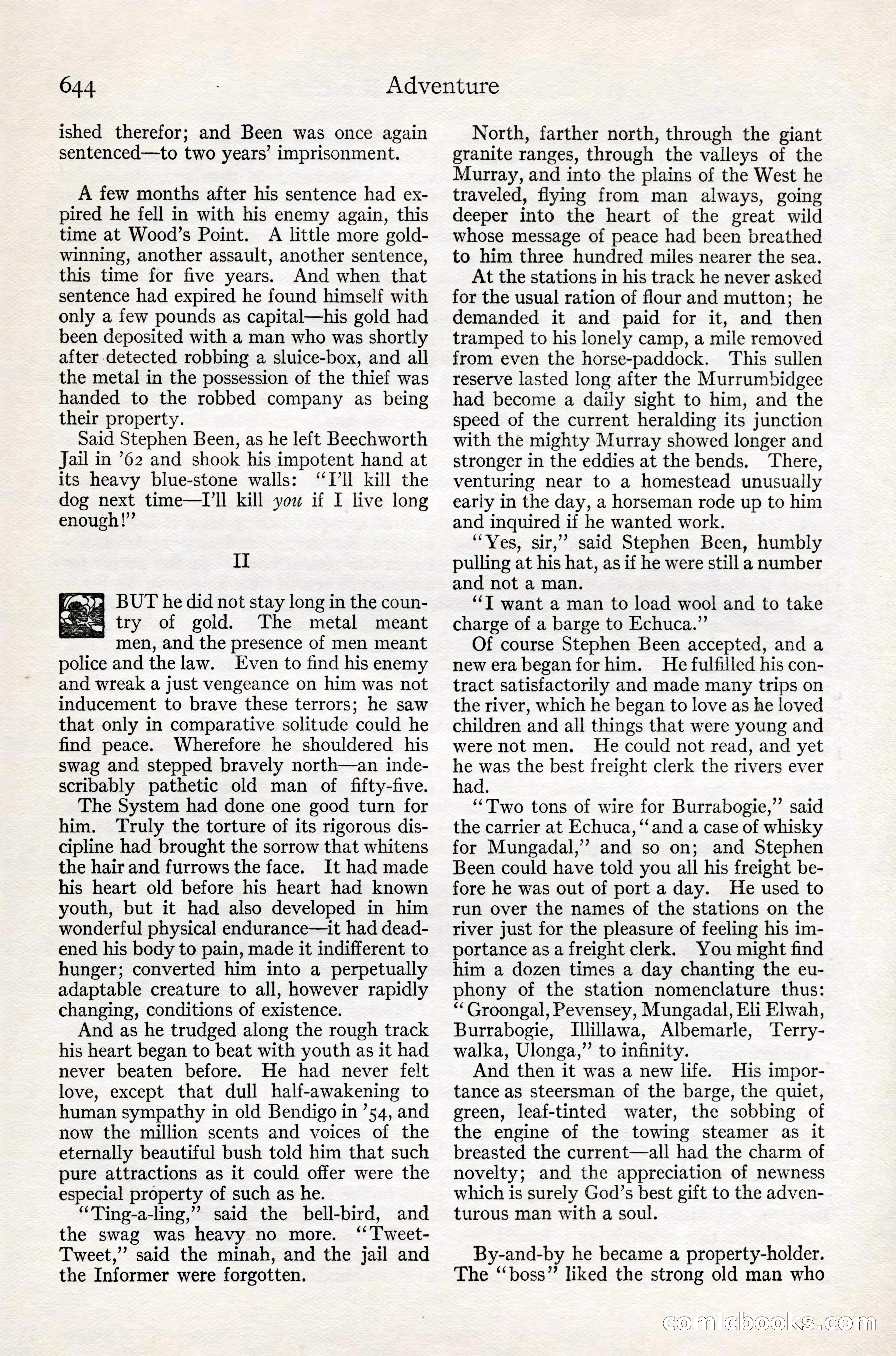
A restored page from Pulp Fiction, 1911. Page through the whole issue in the reader above.
📄 Transcribed text from this page (OCR, searchable)
Machine-transcribed from the original scan — historical spelling and the odd misread are preserved.
644 ished therefor; and Been was once again sentenced—to two years’ imprisonment. A few months after his sentence had ex- pired he fell in with his enemy again, this time at Wood’s Point. A little more gold- winning, another assault, another sentence, this time for five years. And when that sentence had expired he found himself with only a few pounds as capital—his gold had been deposited with a man who was shortly after detected robbing a sluice-box, and all the metal in the possession of the thief was handed to the robbed company as being their property. Said Stephen Been, as he left Beechworth Jail in ’62 and shook his impotent hand at its heavy blue-stone walls: “Tl kill the dog next time—TI’ll kill you if I live long enough!” II BUT he did not stay long in the coun- eas try of gold. The metal meant ~ men, and the presence of men meant police and the law. Even to find his enemy and wreak a just vengeance on him was not inducement to brave these terrors; he saw that only in comparative solitude could he find peace. Wherefore he shouldered his swag and stepped bravely north—an inde- scribably pathetic old man of fifty-five. The System had done one good turn for him. ‘Truly the torture of its rigorous dis- cipline had brought the sorrow that whitens the hair and furrows the face. It had made his heart old before his heart had known youth, but it had also developed in him wonderful physical endurance—it had dead- ened his body to pain, made it indifferent to hunger; converted him into a perpetually adaptable creature to all, however rapidly changing, conditions of existence. And as he trudged along the rough track his heart began to beat with youth as it had never beaten before. He had never felt love, except that dull half-awakening to human sympathy in old Bendigo in ’54, and now the million scents and voices of the eternally beautiful bush told him that such pure attractions as it could offer were the especial property of such as he. “Ting-a-ling,” said the bell-bird, and the swag was heavy no more. “Tweet- Tweet,’ said the minah, and the jail and the Informer were forgotten. Adventure North, farther north, through the giant granite ranges, through the valleys of the Murray, and into the plains of the West he traveled, flying from man always, going deeper into the heart of the great wild whose message of peace had been breathed to him three hundred miles nearer the sea. At the stations in his track he never asked for the usual ration of flour and mutton; he demanded it and paid for it, and then tramped to his lonely camp, a mile removed from even the horse-paddock. This sullen reserve lasted long after the Murrumbidgee had become a daily sight to him, and the speed of the current heralding its junction with the mighty Murray showed longer and stronger in the eddies at the bends. There, venturing near to a homestead unusually early in the day, a horseman rode up to him and inquired if he wanted work. ‘Yes, sir,’ said Stephen Been, humbly pulling at his hat, as if he were still a number and not a man. ‘“‘T want a man to load wool and to take charge of a barge to Echuca.” Of course Stephen Been accepted, and a new era beganforhim. He fulfilled his con- tract satisfactorily and made many trips on the river, which he began to love as he loved children and all things that were young and were not men. He could not read, and yet he was the best freight clerk the rivers ever had. “Two tons of wire for Burrabogie,”’ said the carrier at Echuca, “‘and a case of whisky for Mungadal,”’ and so on; and Stephen Been could have told you all his freight be- fore he was out of port a day. He used to run over the names of the stations on the river just for the pleasure of feeling his im- portance as a freight clerk. You might find him a dozen times a day chanting the eu- phony of the station nomenclature thus: ‘‘Groongal, Pevensey, Mungadal, Eli Elwah, Burrabogie, Illillawa, Albemarle, Terry- walka, Ulonga,” to infinity. And then it was a new life. His impor- tance as steersman of the barge, the quiet, green, leaf-tinted water, the sobbing of the engine of the towing steamer as it breasted the current—all had the charm of novelty; and the appreciation of newness which is surely God’s best gift to the adven- turous man with a soul. By-and-by he became a property-holder. The “‘boss” liked the strong old man who GCoOmiGcdooksEeo 5}