
Pulp Fiction, 1911 · page 81 of 196
Adventure Magazine Cover — page 81: what you’re looking at
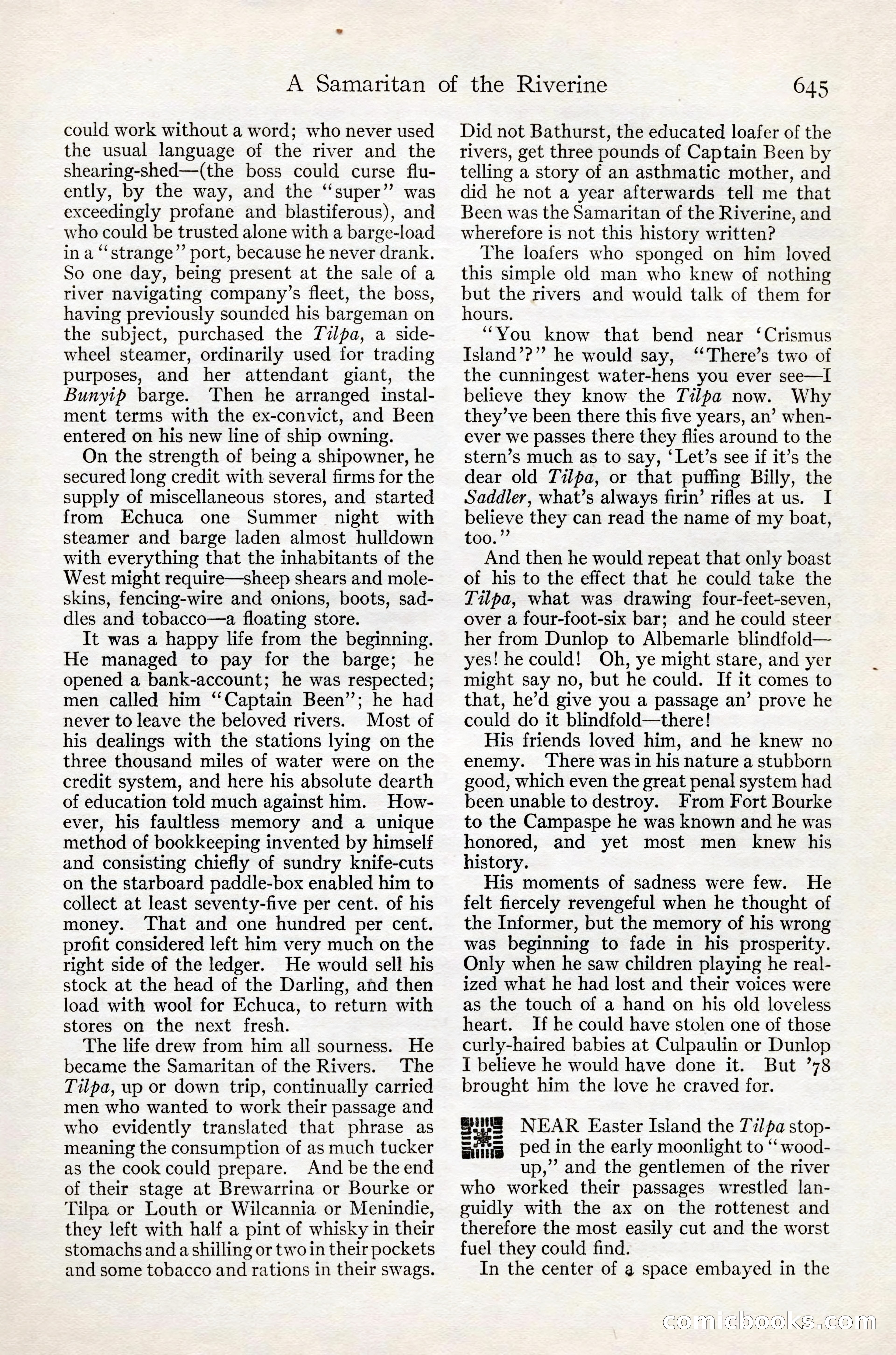
A restored page from Pulp Fiction, 1911. Page through the whole issue in the reader above.
📄 Transcribed text from this page (OCR, searchable)
Machine-transcribed from the original scan — historical spelling and the odd misread are preserved.
A Samaritan of the Riverine could work without a word; who never used the usual language of the river and the shearing-shed—(the boss could curse flu- ently, by the way, and the ‘“‘super” was exceedingly profane and blastiferous), and who could be trusted alone with a barge-load in a “strange” port, because he never drank. So one day, being present at the sale of a river navigating company’s fleet, the boss, having previously sounded his bargeman on the subject, purchased the Tilpa, a side- wheel steamer, ordinarily used for trading purposes, and her attendant giant, the Bunytp barge. Then he arranged instal- ment terms with the ex-convict, and Been entered on his new line of ship owning. On the strength of being a shipowner, he secured long credit with several firms for the supply of miscellaneous stores, and started from Echuca one Summer night with steamer and barge laden almost hulldown with everything that the inhabitants of the West might require—sheep shears and mole- skins, fencing-wire and onions, boots, sad- dles and tobacco—a floating store. It was a happy life from the beginning. He managed to pay for the barge; he opened a bank-account; he was respected; men called him “Captain Been’; he had never to leave the beloved rivers. Most of his dealings with the stations lying on the three thousand miles of water were on the credit system, and here his absolute dearth of education told much against him. How- ever, his faultless memory and a unique method of bookkeeping invented by himself and consisting chiefly of sundry knife-cuts on the starboard paddle-box enabled him to collect at least seventy-five per cent. of his money. That and one hundred per cent. profit considered left him very much on the right side of the ledger. He would sell his stock at the head of the Darling, and then load with wool for Echuca, to return with stores on the next fresh. The life drew from him all sourness. He became the Samaritan of the Rivers. The Tilpa, wp or down trip, continually carried men who wanted to work their passage and who evidently translated that phrase as meaning the consumption of as much tucker as the cook could prepare. And be the end of their stage at Brewarrina or Bourke or Tilpa or Louth or Wilcannia or Menindie, they left with half a pint of whisky in their stomachs and ashilling or two in their pockets and some tobacco and rations in their swags. 045 Did not Bathurst, the educated loafer of the rivers, get three pounds of Captain Been by telling a story of an asthmatic mother, and did he not a year afterwards tell me that Been was the Samaritan of the Riverine, and wherefore is not this history written? The loafers who sponged on him loved this simple old man who knew of nothing but the rivers and would talk of them for hours. “You know that bend near ‘Crismus Island’?”’ he would say, ‘‘There’s two of the cunningest water-hens you ever see—I believe they know the Tilpa now. Why they’ve been there this five years, an’ when- ever we passes there they flies around to the stern’s much as to say, ‘Let’s see if it’s the dear old Tilpa, or that puffing Billy, the Saddler, what’s always firin’ rifles at us. I believe they can read the name of my boat, too.”’ And then he would repeat that only boast of his to the effect that he could take the Tilpa, what was drawing four-feet-seven, over a four-foot-six bar; and he could steer her from Dunlop to Albemarle blindfold— yes! he could! Oh, ye might stare, and yer might say no, but he could. If it comes to that, he’d give you a passage an’ prove he could do it blindfold—there! His friends loved him, and he knew no enemy. There was in his nature a stubborn good, which even the great penal system had been unable to destroy. From Fort Bourke to the Campaspe he was known and he was honored, and yet most men knew his history. His moments of sadness were few. He felt fiercely revengeful when he thought of the Informer, but the memory of his wrong was beginning to fade in his prosperity. Only when he saw children playing he real- ized what he had lost and their voices were as the touch of a hand on his old loveless heart. If he could have stolen one of those curly-haired babies at Culpaulin or Dunlop I believe he would have done it. But 778 brought him the love he craved for. gis =NEAR Easter Island the Tilpa stop- =“g ped in the early moonlight to “ wood- up,” and the gentlemen of the river who worked their passages wrestled lan- guidly with the ax on the rottenest and therefore the most easily cut and the worst fuel they could find. In the center of a space embayed in the COMMICLOOCkKS. CO S|